AP English Literature Poetry Analysis Essay Practice
49 poetry analysis prompts written in the AP format. Pick one, read the full poem, and write your analysis. Fiveable scores each Poetry Analysis Essay response part by part on the AP rubric.
Your first scored response is included. A plan unlocks unlimited scoring.
49 questions
sorted by unit
Speaker's emotional isolation and literary expression
Unit 2: Intro to Poetry
In Lewis Alexander's poem sequence "Tanka I-VIII," published in 1927, the speaker engages in deep introspection while observing the natural world. Read the poem carefully. Then, in a well-written essay, analyze how Alexander uses literary elements and techniques to convey the speaker's complex experience of emotional isolation.
Respond to the prompt with a thesis that presents a defensible interpretation.
Select and use evidence to support your line of reasoning.
Explain how the evidence supports your line of reasoning.
Use appropriate grammar and punctuation in communicating your argument.
Tanka I-VIII
TANKA1 I-VIII
I
Could I but retrace
The winding stairs fate built me.
They fell from my feet.
Now I stand on the high round.
Down beneath height above depth--
II
Through the eyes of life
I looked in at my own heart:
A long furrowed field
Grown cement waiting for seed
Baking in desolation.
III
Drink in moods of joy!
Why should the sky be lonely?
Neither sun nor moon--
How my heart is shy of night
Like Autumn’s leaf brown pendants.
IV
Cold against the sky
The blue jays cried at dawning.
The larks where are they?
Heavily upon the air
My ears tuned in to listen.
V
So this is the reed?
The very pipes for singing--
Life plays me new songs.
Wistfully from out the dawn
The crows broke across the sky!
VI
And now Spring has come
Blossoming up my garden.
I alone unchanged.
Moving in my house of Autumn.
One leaf alone saves a tree.
VII
By the pool of life
Willows are drooping tonight
I can see no stars.
What dances in the water?
O my clouds dripping with tears.
VIII
Could I hear your voice
O but this silence is sweet
Words mar all beauty.
Turn then into your own heart
And pluck the roots from the soil--
Source: Lewis Alexander, Caroling Dusk, 1927
1 Tanka: A traditional Japanese poetic form consisting of five lines.
What the Poetry Analysis Essay asks
The poetry analysis essay is FRQ 1 on the AP English Literature exam. You read a poem and write an essay analyzing how the poet uses literary elements and techniques to develop a complex idea.
- 40 min
- suggested time
- 6 points
- across rows A to C
- 55%
- of your score, across all three essays
Part A: Thesis
A defensible interpretation of the poem that answers the prompt
1 pt
Part B: Evidence and commentary
Lines from the poem, with commentary on how several elements create meaning
4 pts
Part C: Sophistication
A complex reading, such as a tension the poem holds
1 pt
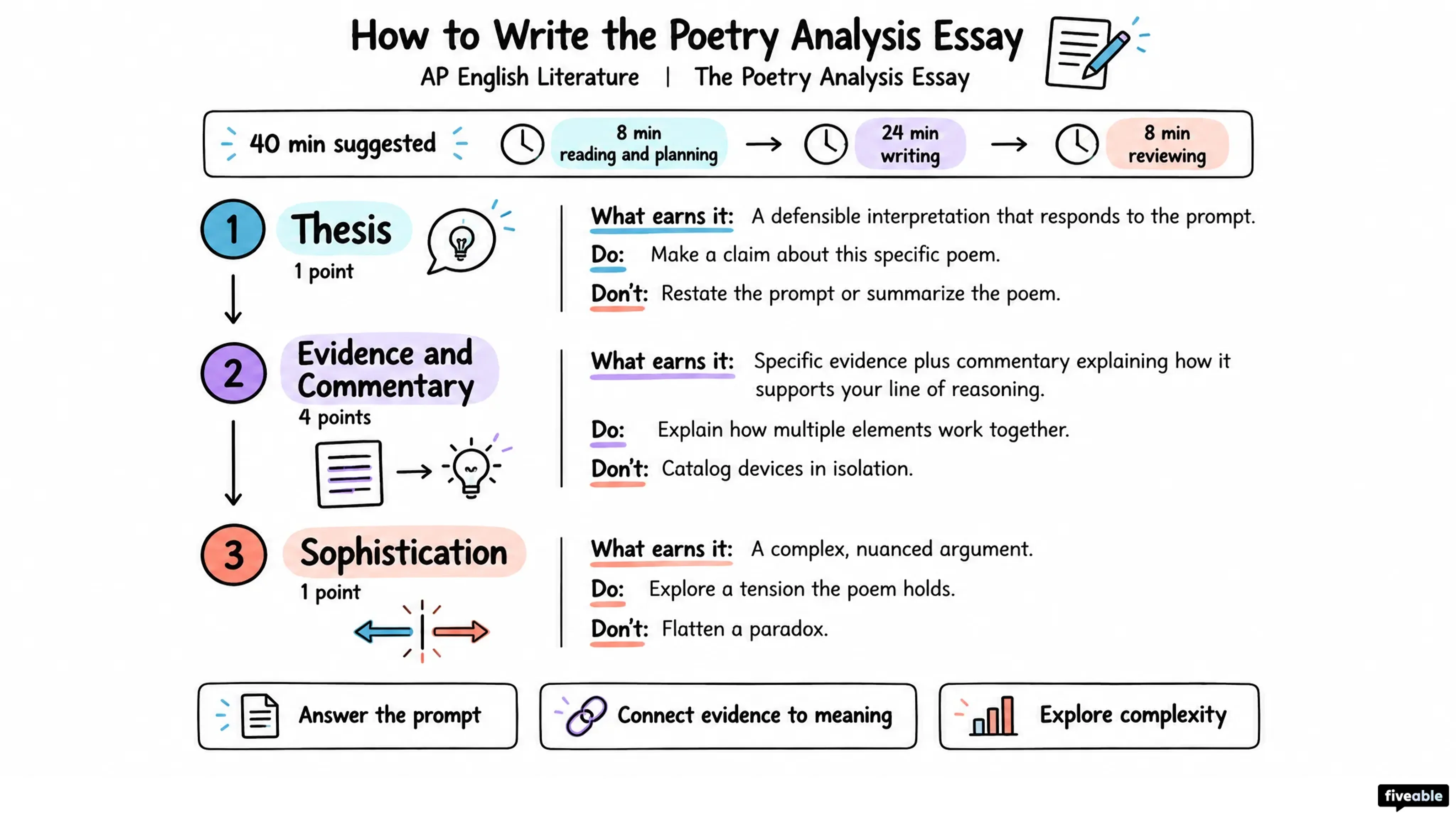
Poetry Analysis Essay skill sheet
Every rubric point on one page: what earns it, what to do and what to avoid. Tap the sheet to see it full size.
How Poetry Analysis Essay practice works
Each question follows the exam’s format, from the full prompt to a score on every part.
Read the poem and prompt
The prompt and the full poem, laid out the way the exam shows them.
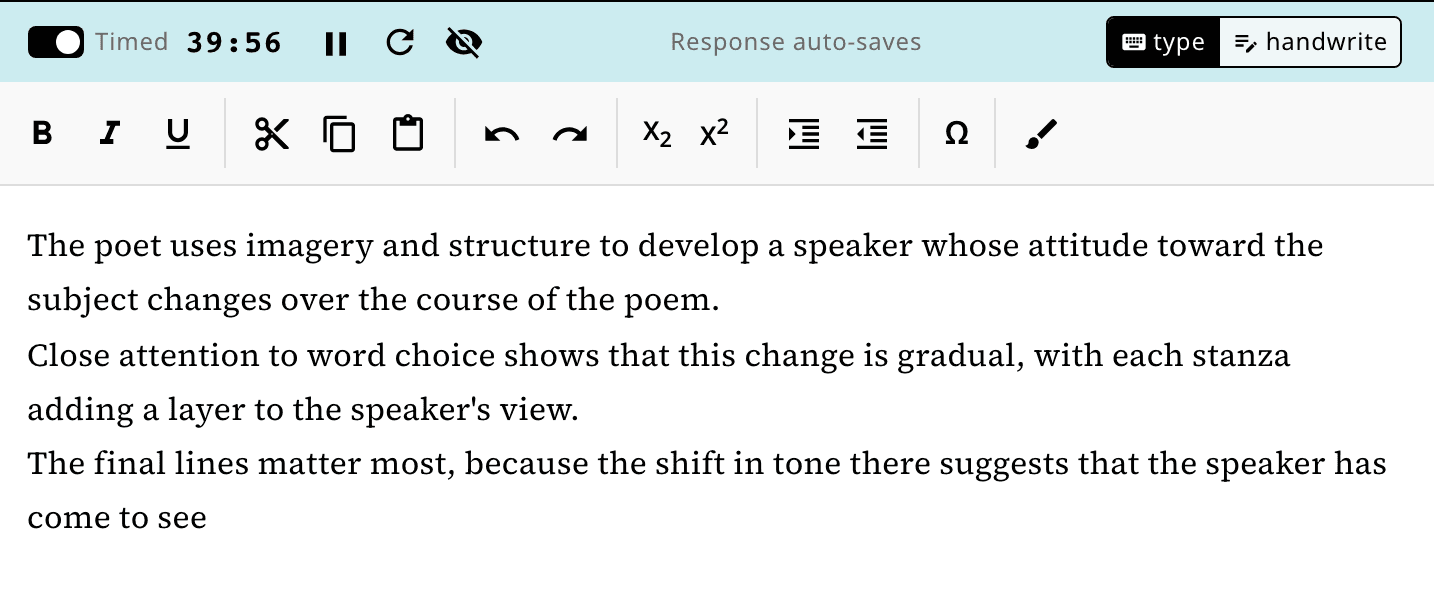
Write on a 40-minute timer
The time to plan for on exam day. Pause it or turn it off, and your response saves as you go.
Submit for a score out of 6
Your response is scored against the scoring guidelines written for that question. Your first score is included.
Feedback on every part
A summary at the top tells you what to work on next. Below it, each part shows whether you earned the point and what the scoring guidelines were looking for.
Detailed Feedback
Part A: 1/1 point
Earned the point. You provide a clear, defensible thesis at the end of your introduction that addresses the prompt: the speaker views the divine judgment as "justifiable punishment for their human folly" because the sinners ignored the warnings.
Part C: 0/1 point
Did not earn the point. While your introduction makes an interesting connection to "The Little Red Hen" and "Icarus," this comparison is not sustained throughout the essay to create a broader context. Your argument is clear and well-organized, but it remains a relatively straightforward analysis of the poem's narrative rather than exploring deeper tensions, complexities, or nuances in the speaker's attitude (such as the shift from the colloquial, almost humorous tone at the beginning to the apocalyptic terror at the end).
Questions about the Poetry Analysis Essay
How many responses can I get scored?
You can read every question without a plan. Your first scored response is included. A plan unlocks unlimited scoring.
Do I need to know the poem ahead of time?
No. The prompt gives you the context you need, and everything you analyze is on the page.
How is poetry analysis different from the prose essay?
Both use the same 6-point rubric. Poetry analysis rewards close attention to lines, sound, and form. The prose essay works with a longer passage and with narration, characterization, and pacing.
Are these real College Board questions?
No. We wrote them in the AP format, with the same 6-point rubric, and wrote scoring guidelines for each one.
Can I write my answer by hand?
Yes. Switch the editor to handwrite, write on paper, and add a photo of your page.
More AP English Literature practice
Literary Argument Essay practice
Literary argument prompts with the full list of suggested works.
AP English Literature FRQs
Every FRQ type for AP English Literature, with practice for each.
See the Poetry Analysis Essay rubric points students miss most, from responses scored on Fiveable.
Write your first Poetry Analysis Essay
Pick one from the list, or let us choose for you.
Teaching AP English Literature? Assign these Poetry Analysis Essays to your class