AP English Literature Literary Argument Essay Practice
171 literary argument prompts written in the AP format. Pick one, read the full prompt, and write about a work you know well. Fiveable scores each Literary Argument Essay response part by part on the AP rubric.
Your first scored response is included. A plan unlocks unlimited scoring.
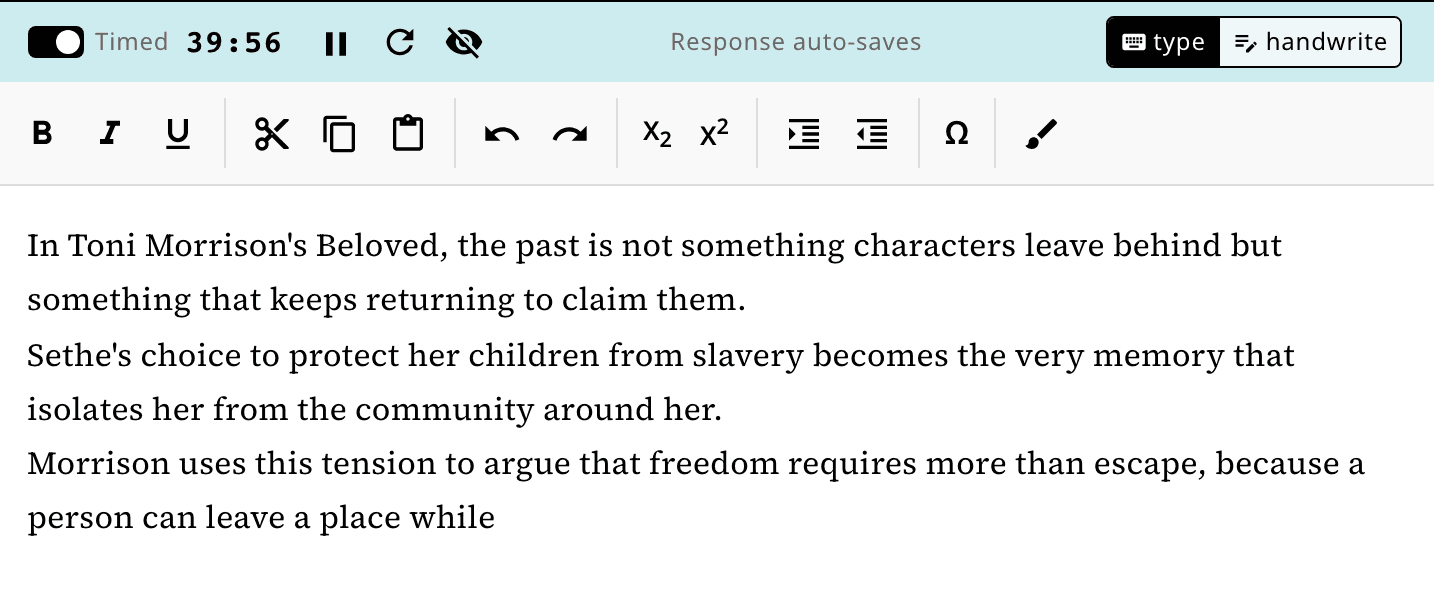

171 questions
sorted by unit
Physical, social, or historical setting as a constraint, e.g. Station Eleven
Unit 1: Intro to Short Fiction
In many works of literature, a specific setting—whether a physical location, a social environment, or a particular time period—exerts a profound influence on a character. The setting may constrain a character's actions, reflect their psychological state, provoke a significant change in their perspective, or serve as a source of conflict.
Either from your own reading or from the list below, choose a work of fiction in which a setting significantly influences a character. Then, in a well-written essay, analyze how the interaction between the character and the setting contributes to an interpretation of the work as a whole. Do not merely summarize the plot.
Respond to the prompt with a thesis that presents a defensible interpretation.
Provide evidence to support your line of reasoning.
Explain how the evidence supports your line of reasoning.
Use appropriate grammar and punctuation in communicating your argument.
1984
The Adventures of Huckleberry Finn
The Age of Innocence
Atonement
The Awakening
Beloved
Brave New World
The Call of the Wild
The Cherry Orchard
Crime and Punishment
Death of a Salesman
Ethan Frome
Frankenstein
The Grapes of Wrath
Great Expectations
The Great Gatsby
The Handmaid's Tale
Heart of Darkness
The House on Mango Street
Jane Eyre
The Jungle
Life of Pi
Lord of the Flies
The Metamorphosis
Never Let Me Go
The Piano Lesson
The Poisonwood Bible
A Raisin in the Sun
Room
Station Eleven
The Stranger
A Streetcar Named Desire
Sula
Their Eyes Were Watching God
Things Fall Apart
To Kill a Mockingbird
Where the Crawdads Sing
Wide Sargasso Sea
Wuthering Heights
What the Literary Argument Essay asks
The literary argument essay is FRQ 3 on the AP English Literature exam. There’s no passage. You choose a novel or play, from the list in the prompt or your own reading, and argue how an idea in the prompt contributes to an interpretation of the work as a whole.
- 40 min
- suggested time
- 6 points
- across rows A to C
- 55%
- of your score, across all three essays
Part A: Thesis
A defensible interpretation of your chosen work that answers the prompt
1 pt
Part B: Evidence and commentary
Specific moments from the work, recalled from memory, with commentary on their meaning
4 pts
Part C: Sophistication
A complex argument, sustained across the essay
1 pt
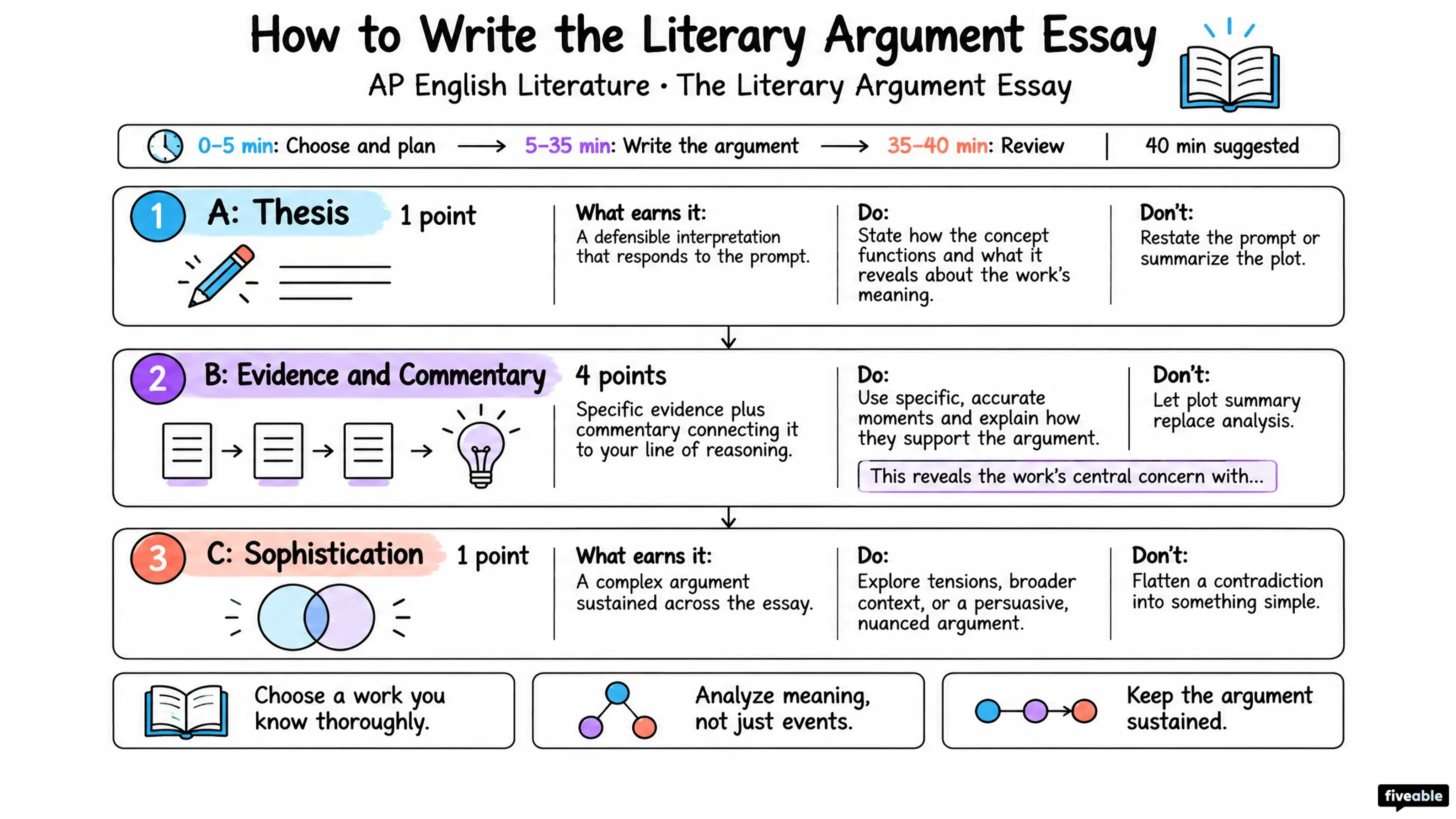
Literary Argument Essay skill sheet
Every rubric point on one page: what earns it, what to do and what to avoid. Tap the sheet to see it full size.
How Literary Argument Essay practice works
Each question follows the exam’s format, from the full prompt to a score on every part.
Read the prompt and the list
The prompt and its list of suggested works, laid out the way the exam shows them.
Write on a 40-minute timer
The time to plan for on exam day. Pause it or turn it off, and your response saves as you go.
Submit for a score out of 6
Your response is scored against the scoring guidelines written for that question. Your first score is included.
Feedback on every part
A summary at the top tells you what to work on next. Below it, each part shows whether you earned the point and what the scoring guidelines were looking for.
Detailed Feedback
Part A: 1/1 point
Earned the point. You provided a defensible thesis that responds to the prompt by arguing that Mariam's circumstances change her perspective on her duty, ultimately leading her to prioritize her desire to help her friend over her duty as a wife.
Part C: 0/1 point
Did not earn the point. The essay does not demonstrate a complex literary argument or sophistication of thought. The analysis relies on somewhat simplistic phrasing (e.g., "listen to what her heart wanted," "happily ever after") and straightforward plot summary rather than exploring the deeper nuances, tensions, or complexities of the novel's themes.
Questions about the Literary Argument Essay
How many responses can I get scored?
You can read every question without a plan. Your first scored response is included. A plan unlocks unlimited scoring.
Do I have to choose a work from the list?
No. You can write about a novel or play from your own reading. Pick one you know well enough to describe specific scenes from memory.
How should I prepare for the literary argument?
Choose four or five works you know closely and build a set of specific scenes for each. Then practice matching them to different prompts.
Are these real College Board questions?
No. We wrote them in the AP format, with a list of suggested works and the same 6-point rubric, and wrote scoring guidelines for each one.
Can I write my answer by hand?
Yes. Switch the editor to handwrite, write on paper, and add a photo of your page.
More AP English Literature practice
Poetry Analysis Essay practice
Poetry analysis prompts with the full poem and its context.
AP English Literature FRQs
Every FRQ type for AP English Literature, with practice for each.
See the Literary Argument Essay rubric points students miss most, from responses scored on Fiveable.
Write your first Literary Argument Essay
Pick one from the list, or let us choose for you.
Teaching AP English Literature? Assign these Literary Argument Essays to your class