AP English Literature Poetry Analysis Essay Practice
47 poetry analysis prompts written in the AP format. Pick one, read the full poem, and write your analysis. Fiveable scores each Poetry Analysis Essay response part by part on the AP rubric. Of 845 AP English Literature Poetry Analysis Essay responses scored on Fiveable from January to October 2026, Sophistication was the rubric point earned least often, on 7% of responses.
Your first scored response is included. A plan unlocks unlimited scoring.
47 questions
sorted by unit
Spiritual disillusionment and ancestral longing in poetry
Unit 2: Intro to Poetry
In Arna Bontemps's poem "Nocturne at Bethesda," published in 1927, the speaker reflects on a biblical site of healing while contemplating a sense of collective loss and exile. Read the poem carefully. Then, in a well-written essay, analyze how Bontemps uses literary elements and techniques to convey the complexity of the speaker's spiritual disillusionment and ancestral longing.
Respond to the prompt with a thesis that presents a defensible interpretation.
Select and use evidence to support your line of reasoning.
Explain how the evidence supports your line of reasoning.
Use appropriate grammar and punctuation in communicating your argument.
Nocturne at Bethesda
NOCTURNE AT BETHESDA1
I thought I saw an angel flying low,
I thought I saw the flicker of a wing
Above the mulberry trees; but not again.
Bethesda sleeps. This ancient pool that healed
A host of bearded Jews does not awake.
This pool that once the angels troubled does not move.
No angel stirs it now, no Saviour comes
With healing in His hands to raise the sick
And bid the lame man leap upon the ground.
The golden days are gone. Why do we wait
So long upon the marble steps, blood
Falling from our open wounds? and why
Do our black faces search the empty sky?
Is there something we have forgotten? some precious thing
We have lost, wandering in strange lands?
There was a day, I remember now,
I beat my breast and cried, “Wash me God,
Wash me with a wave of wind upon
The barley; O quiet One, draw near, draw near!
Walk upon the hills with lovely feet
And in the waterfall stand and speak.
“Dip white hands in the lily pool and mourn
Upon the harps still hanging in the trees
Near Babylon2 along the river’s edge,
But oh, remember me, I pray, before
The summer goes and rose leaves lose their red.”
The old terror takes my heart, the fear
Of quiet waters and of faint twilights.
There will be better days when I am gone
And healing pools where I cannot be healed.
Fragrant stars will gleam forever and ever
Above the place where I lie desolate.
Yet I hope, still I long to live.
And if there can be returning after death
I shall come back. But it will not be here;
If you want me you must search for me
Beneath the palms of Africa. Or if
I am not there then you may call to me
Across the shining dunes, perhaps I shall
Be following a desert caravan.
I may pass through centuries of death
With quiet eyes, but I’ll remember still
A jungle tree with burning scarlet birds.
There is something I have forgotten, some precious thing.
I shall be seeking ornaments of ivory,
I shall be dying for a jungle fruit.
Source: Arna Bontemps, Caroling Dusk, 1927
1 Bethesda: A pool in Jerusalem mentioned in the Bible where the sick gathered, believing an angel would occasionally stir the waters to provide miraculous healing.
2 Babylon: An ancient city; in the Bible, the Israelites were exiled to Babylon, where they mourned their lost homeland by the river.
What the Poetry Analysis Essay asks
The poetry analysis essay is FRQ 1 on the AP English Literature exam. You read a poem and write an essay analyzing how the poet uses literary elements and techniques to develop a complex idea.
- 40 min
- suggested time
- 6 points
- across rows A to C
- 55%
- of your score, across all three essays
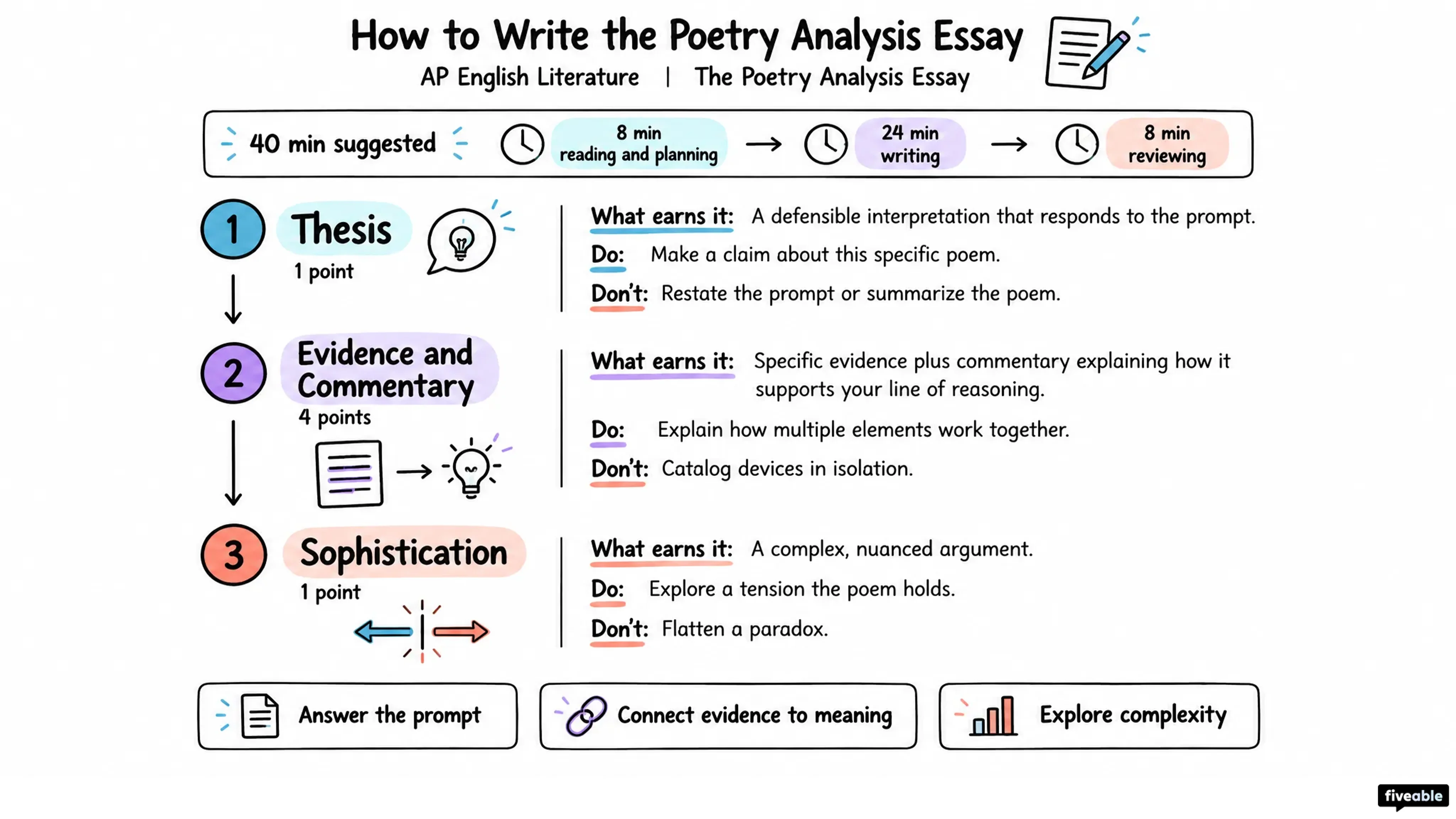
Part A: Thesis
A defensible interpretation of the poem that answers the prompt
1 pt
Part B: Evidence and commentary
Lines from the poem, with commentary on how several elements create meaning
4 pts
Part C: Sophistication
A complex reading, such as a tension the poem holds
1 pt
Poetry Analysis Essay skill sheet
Every rubric point on one page: what earns it, what to do and what to avoid. Tap the sheet to see it full size.
How Poetry Analysis Essay practice works
Each question follows the exam’s format, from the full prompt to a score on every part.
Read the poem and prompt
The prompt and the full poem, laid out the way the exam shows them.
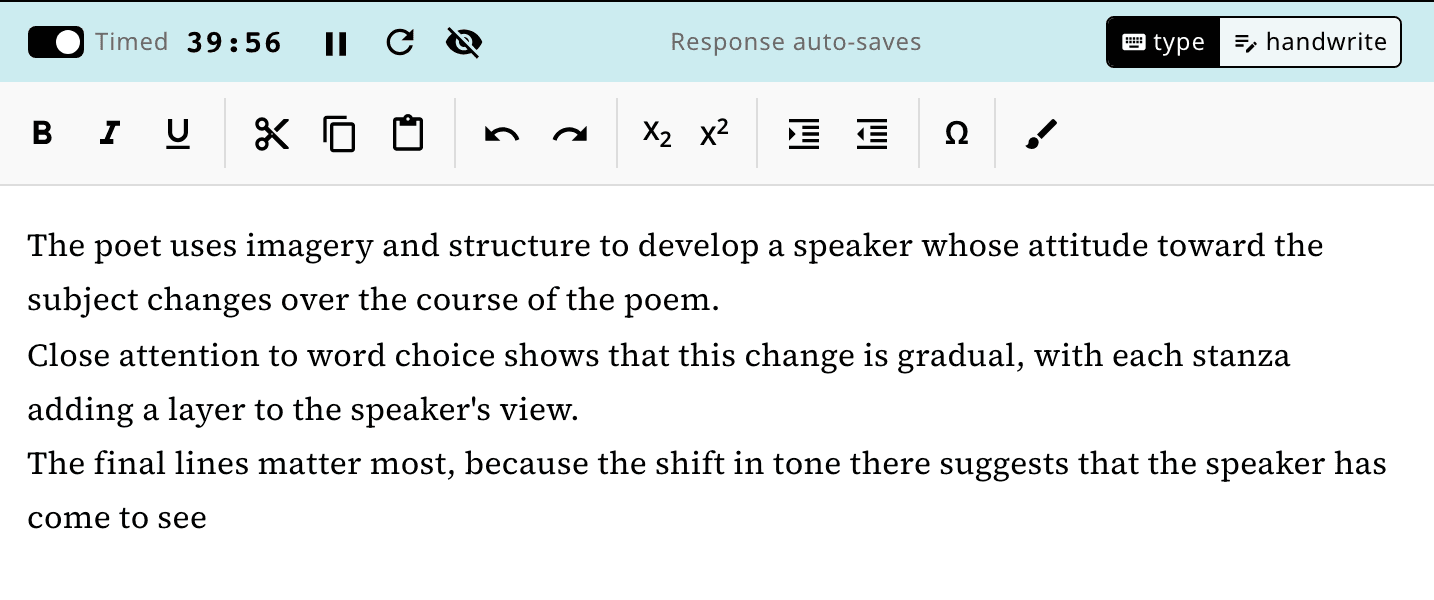
Write on a 40-minute timer
The time to plan for on exam day. Pause it or turn it off, and your response saves as you go.
Submit for a score out of 6
Your response is scored against the scoring guidelines written for that question. Your first score is included.
Feedback on every part
A summary at the top tells you what to work on next. Below it, each part shows whether you earned the point and what the scoring guidelines were looking for.
Detailed Feedback
Part A: 1/1 point
Earned the point. You provide a clear, defensible thesis at the end of your introduction that addresses the prompt: the speaker views the divine judgment as "justifiable punishment for their human folly" because the sinners ignored the warnings.
Part C: 0/1 point
Did not earn the point. While your introduction makes an interesting connection to "The Little Red Hen" and "Icarus," this comparison is not sustained throughout the essay to create a broader context. Your argument is clear and well-organized, but it remains a relatively straightforward analysis of the poem's narrative rather than exploring deeper tensions, complexities, or nuances in the speaker's attitude (such as the shift from the colloquial, almost humorous tone at the beginning to the apocalyptic terror at the end).
Questions about the Poetry Analysis Essay
How many responses can I get scored?
You can read every question without a plan. Your first scored response is included. A plan unlocks unlimited scoring.
Do I need to know the poem ahead of time?
No. The prompt gives you the context you need, and everything you analyze is on the page.
How is poetry analysis different from the prose essay?
Both use the same 6-point rubric. Poetry analysis rewards close attention to lines, sound, and form. The prose essay works with a longer passage and with narration, characterization, and pacing.
Are these real College Board questions?
No. We wrote them in the AP format, with the same 6-point rubric, and wrote scoring guidelines for each one.
Can I write my answer by hand?
Yes. Switch the editor to handwrite, write on paper, and add a photo of your page.
More AP English Literature practice
Literary Argument Essay practice
Literary argument prompts with the full list of suggested works.
AP English Literature FRQs
Every FRQ type for AP English Literature, with practice for each.
See the Poetry Analysis Essay rubric points students miss most, from responses scored on Fiveable.
Write your first Poetry Analysis Essay
Pick one from the list, or let us choose for you.
Teaching AP English Literature? Assign these Poetry Analysis Essays to your class