AP Human Geography Unit 4 Cheatsheet: Political Patterns and Processes

AP Human Geography Unit 4 Cheatsheet: Political Patterns and Processes

Start with the first 3 sections of the Unit 4 one-page cheatsheet below. The full sheet is a PDF you can print.

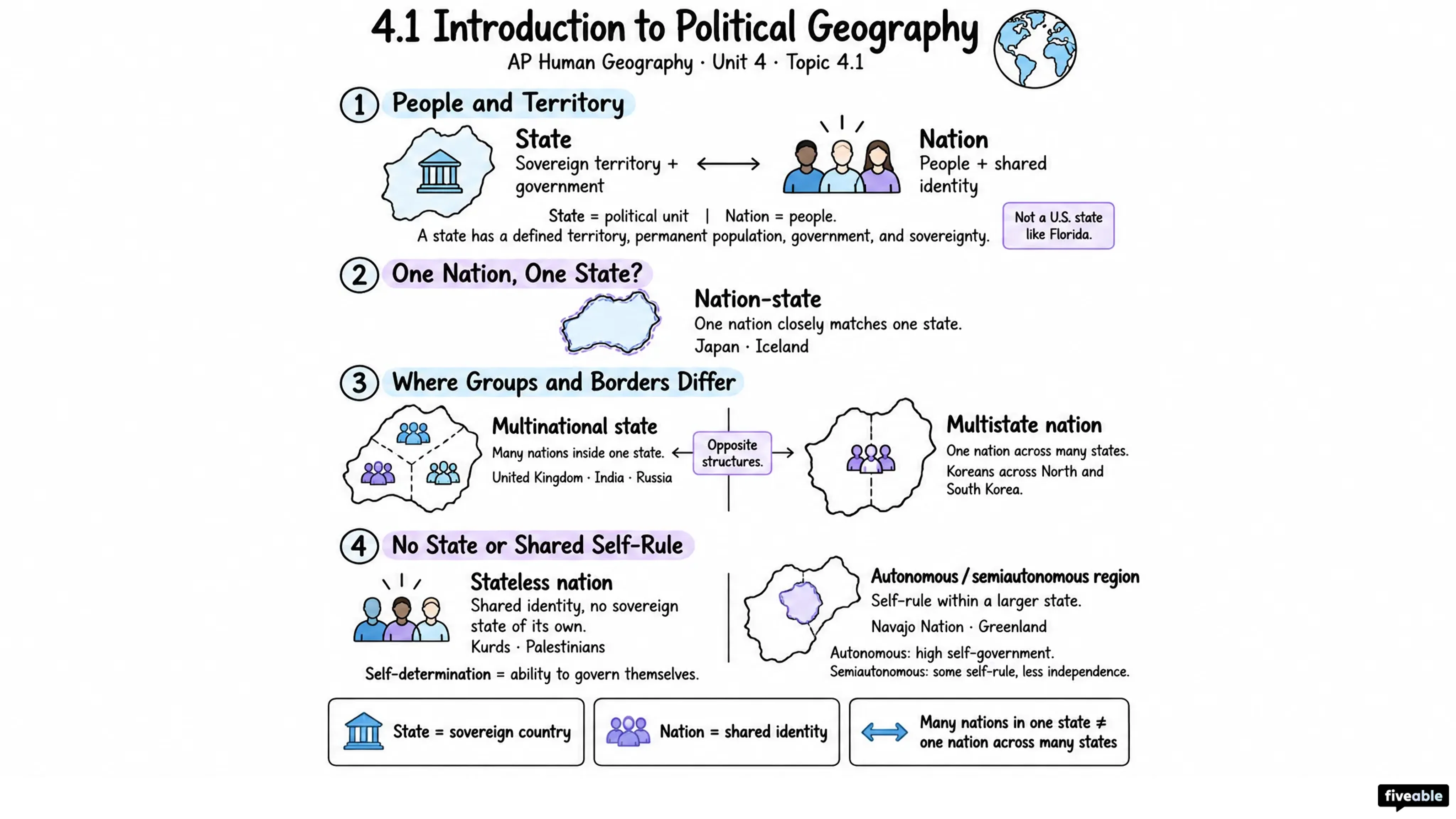
Political Entities & State Types

Independent states are the primary building blocks of the world political map.

  • Nation: Group sharing common culture, language, history, identity
  • Nation-state: Political unit where nation and state boundaries align
  • Stateless nation: Nation without its own independent state (e.g., Kurds, Palestinians)
  • Multinational state: One state containing multiple nations (e.g., Canada, Belgium)
  • Multistate nation: One nation spread across multiple states (e.g., Arabs)
  • Autonomous/semiautonomous regions: Areas with self-governance within a state (e.g., American Indian reservations, Catalonia)
Internal Boundaries & Governance

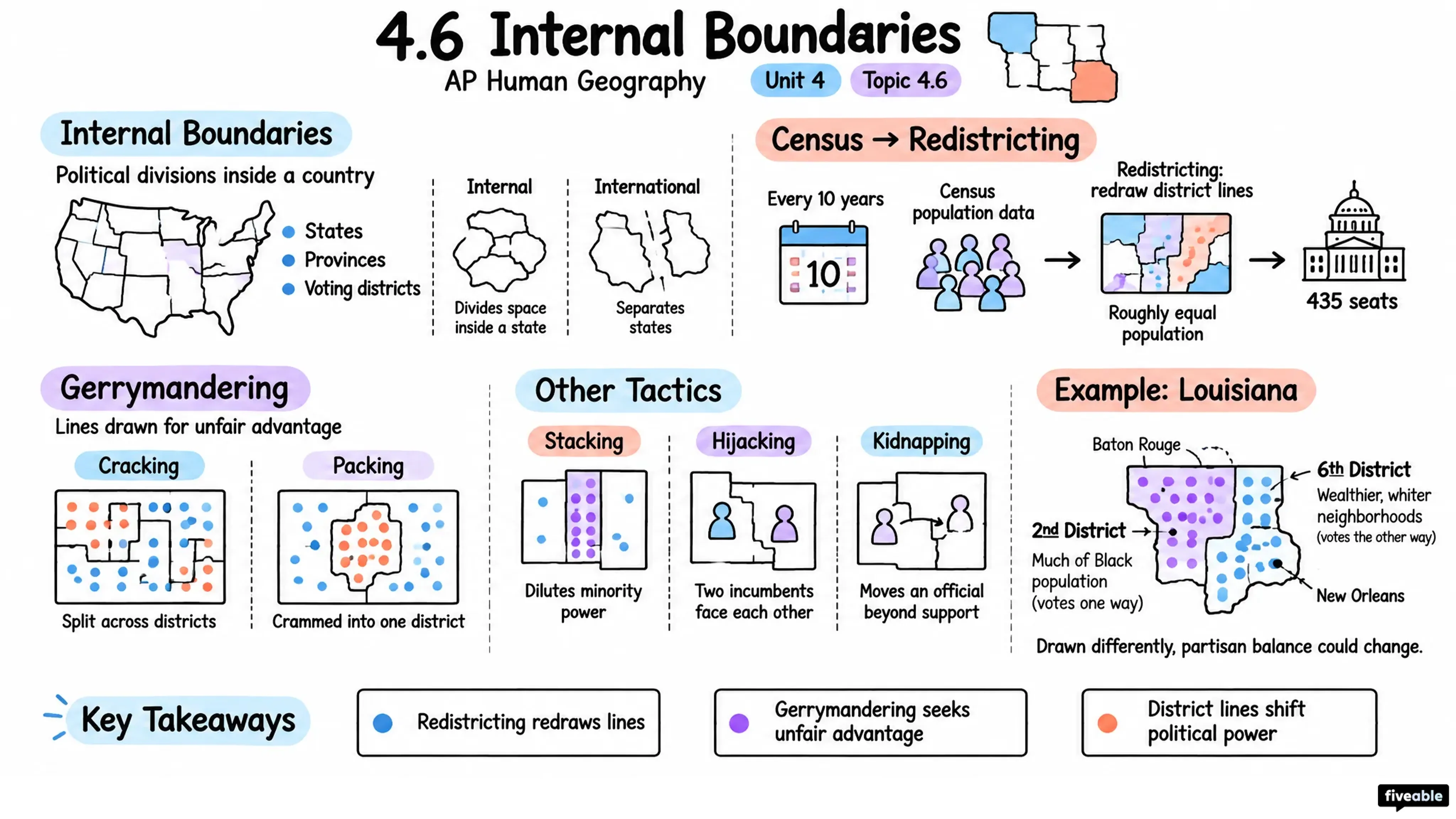
Voting districts & gerrymandering:

  • Redistricting redraws electoral boundaries after census
  • Gerrymandering manipulates district shapes to favor one party/group
  • Affects election results and representation at local/state/national scales

Forms of governance:

  • Unitary state: Power concentrated in central government; top-down control (e.g., France, Japan)
  • Federal state: Power divided between central and regional governments; dispersed power centers (e.g., USA, Germany, Australia)

Spatial organization: Federal systems allow more local autonomy and varied policies; unitary systems enforce uniform national policies.

Supranationalism & Sovereignty Challenges

Supranationalism: States voluntarily surrender some sovereignty to international organizations for collective benefit.

Major supranational organizations:

  • UN: Global governance, peacekeeping, humanitarian aid
  • NATO: Military alliance; collective defense
  • EU: Economic/political union; free movement of people/goods; common currency (euro) used by most but not all members
  • ASEAN: Regional cooperation; trade, security
  • African Union: Continental integration; development, conflict resolution
  • Arctic Council: Polar governance; environmental protection, indigenous rights

How they challenge sovereignty: Limit member states' economic/political actions; enforce international law; coordinate policy across borders.

Enabling factors: Communication technology facilitates coordination; transnational challenges (climate, pandemics, terrorism) require collective action; trade agreements create economies of scale.

The rest of the Unit 4 sheet

7 more sections are on the one-page PDF:

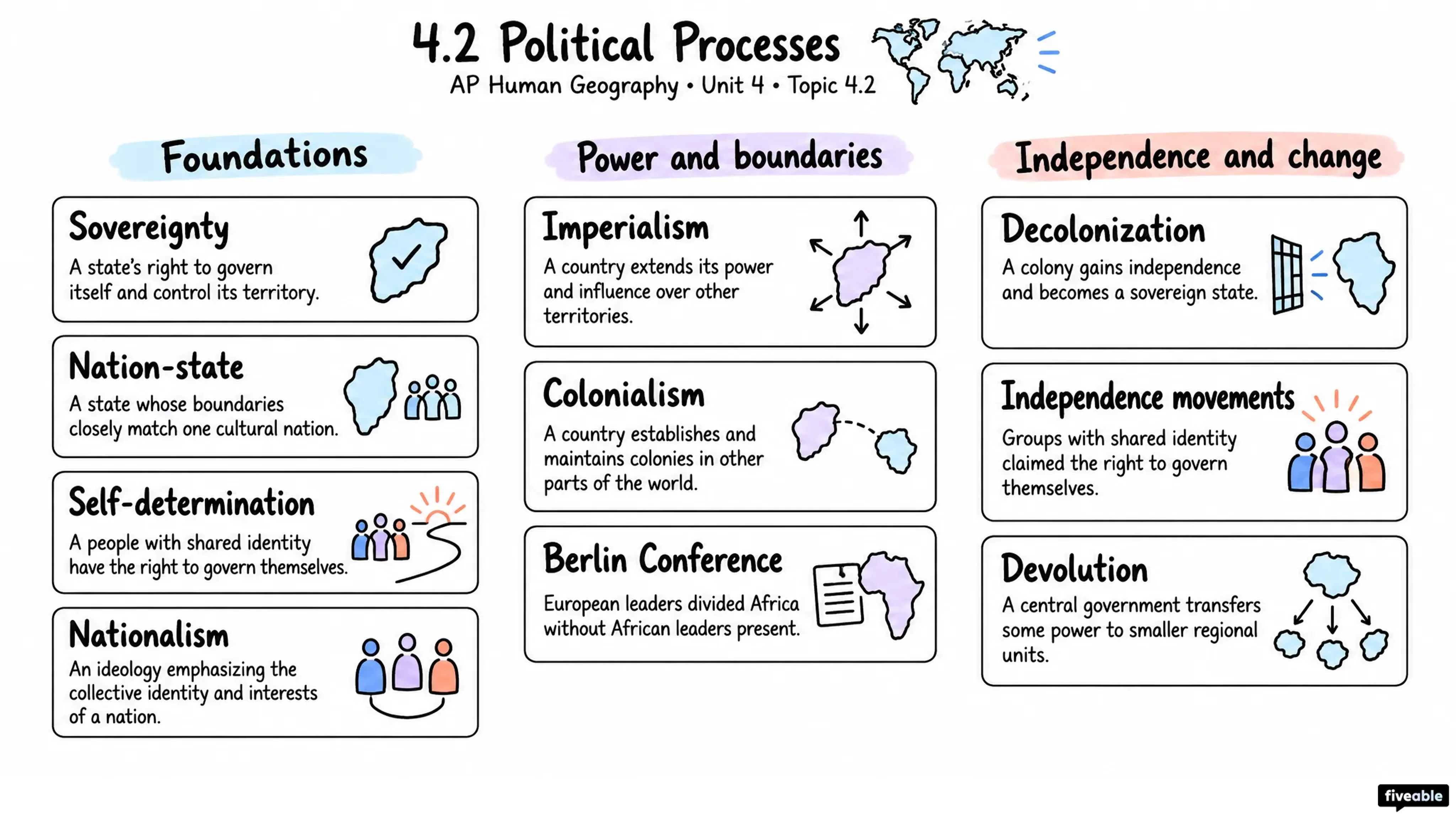
  • Sovereignty, Self-Determination & Historical Processes

  • Boundary Functions & Delimitation

  • Devolutionary Factors & State Fragmentation

  • Centrifugal vs. Centripetal Forces

  • Political Power & Territoriality

  • Types of Political Boundaries

  • Maritime Boundaries & Law of the Sea

Made by you

Visual Cheatsheets

Pick a Unit 4 topic and a format: flowchart, comparison chart, vocab sheet, Cornell notes and more. Ready in about a minute.

Printable PDF · from the Fiveable shop

AP Human Geography Unit 4 Cheatsheet

1 page · Political Patterns and Processes · PDF

Visual Cheatsheets

One topic, the format you pick, ready in about a minute

Format

Topic

Takes 30–60 seconds

Preview: Standard

Unit 4: Political Geography, topic by topic

Each topic has a full study guide. See the whole unit.