AP Environmental Science Unit 5 Cheatsheet: Land and Water Use

AP Environmental Science Unit 5 Cheatsheet: Land and Water Use

Start with the first 3 sections of the Unit 5 one-page cheatsheet below. The full sheet is a PDF you can print.

Tragedy of the Commons & Resource Depletion

Tragedy of the Commons: Individuals use shared resources in self-interest rather than for common good, leading to depletion.

Key concept: Personal gain vs. collective sustainability—the core tension in resource management.

Examples on test: Overfishing, aquifer depletion (Ogallala), overgrazing, deforestation.

Question strategy: When asked why a shared resource is depleted, identify the incentive for individual users to extract more than sustainable yield allows.
Urbanization & Impervious Surfaces

Effects of urbanization:

  • Resource depletion (freshwater, minerals)
  • Saltwater intrusion in hydrologic cycle
  • Increased CO₂ (fossil fuel burning, landfills)
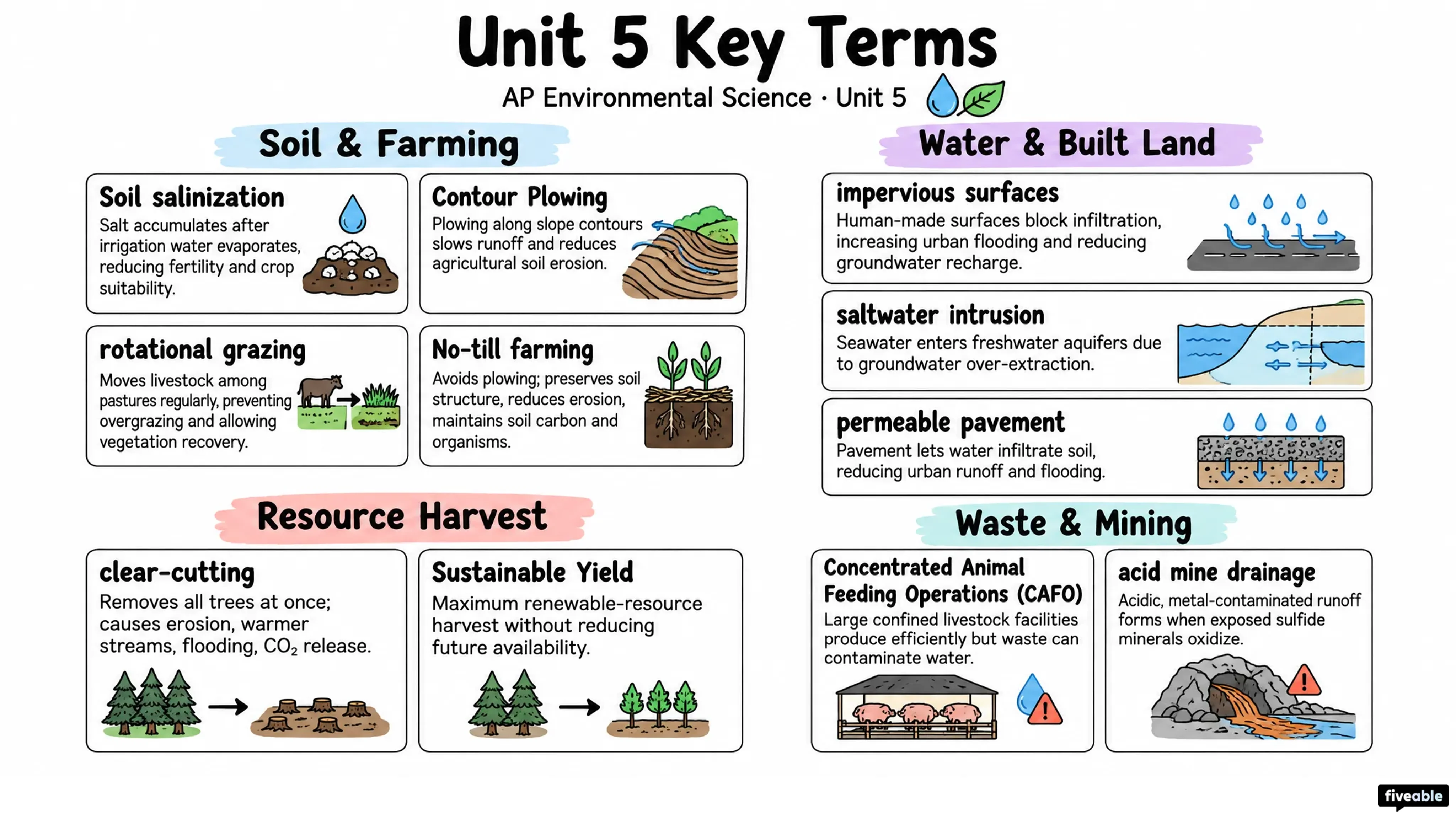
  • Impervious surfaces (roads, buildings, parking lots) prevent water infiltration → flooding
  • Urban sprawl: shift from high-density to low-density suburbs → habitat loss, resource strain

Mitigation methods:

  • Permeable pavement (replaces traditional pavement)
  • Tree planting (increases infiltration)
  • Public transportation (reduces emissions)
  • Build up, not out (reduces sprawl)

Sustainable Practices & Indicators

Sustainability: Human use of resources without depletion for future generations.

Sustainable yield: Amount of renewable resource that can be taken without reducing supply.

Environmental indicators: Biological diversity, food production, global surface temperature, CO₂ concentration, human population, resource depletion.

Ecological footprint: Compares resource demands and waste production per individual or society.

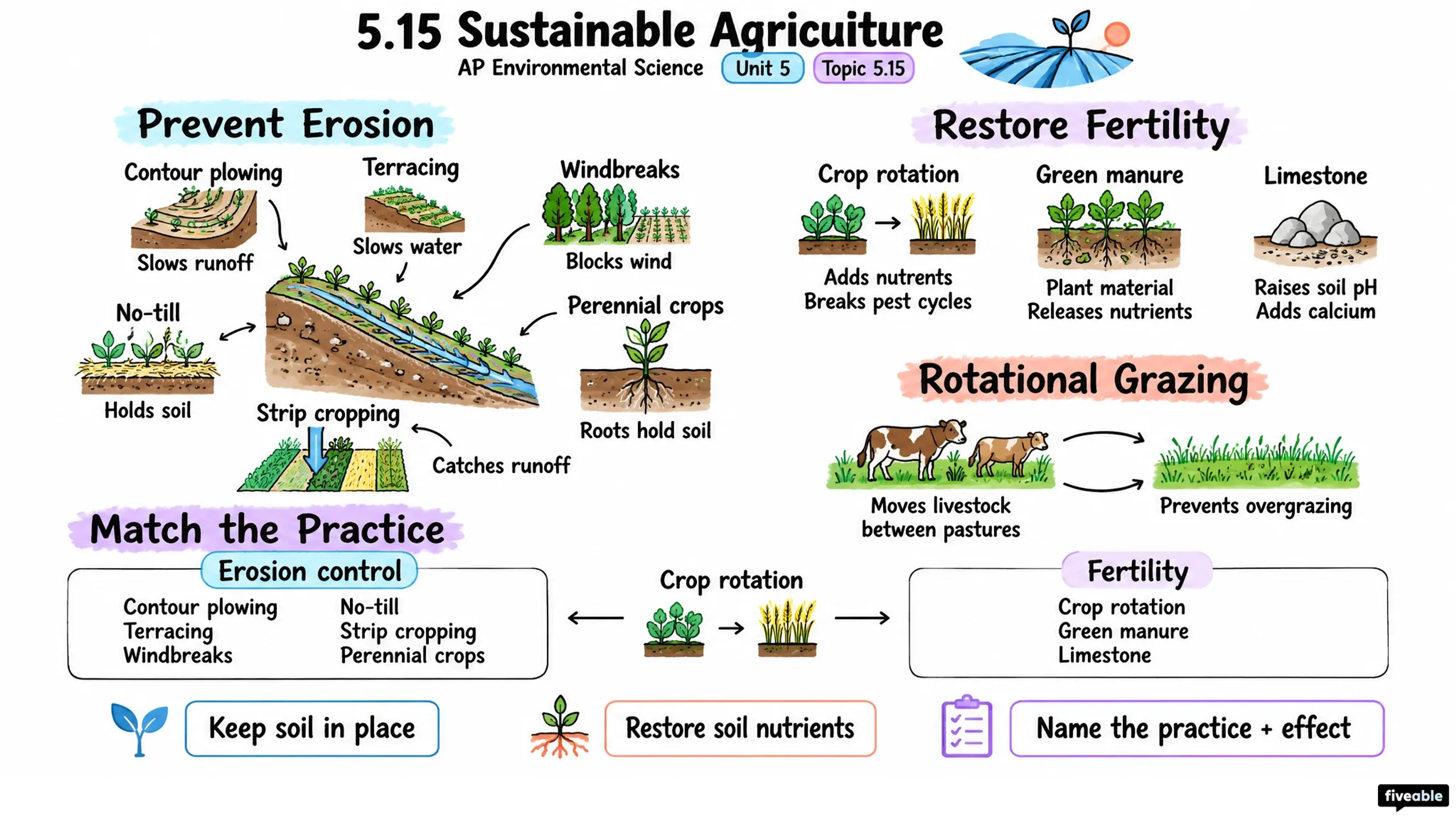
Soil conservation methods: Contour plowing, windbreaks, perennial crops, terracing, no-till agriculture, strip cropping.

Soil fertility improvement: Crop rotation, green manure, limestone addition.

Sustainable forestry: Reforestation, ecologically sustainable harvesting, wood reuse, IPM for pathogens/insects, prescribed burns (controlled fire to reduce natural fire risk).

Aquaculture: Efficient, small water area, low fuel. Drawbacks: wastewater contamination, escaped fish compete/breed with wild populations, disease transmission to wild fish.

The rest of the Unit 5 sheet

6 more sections are on the one-page PDF:

  • Clearcutting: Costs & Carbon

  • Irrigation Methods: Efficiency vs. Cost

  • Pest Control: Resistance & Genetic Engineering

  • Green Revolution: Methods & Trade-offs

  • Meat Production: CAFOs vs. Pasture Systems

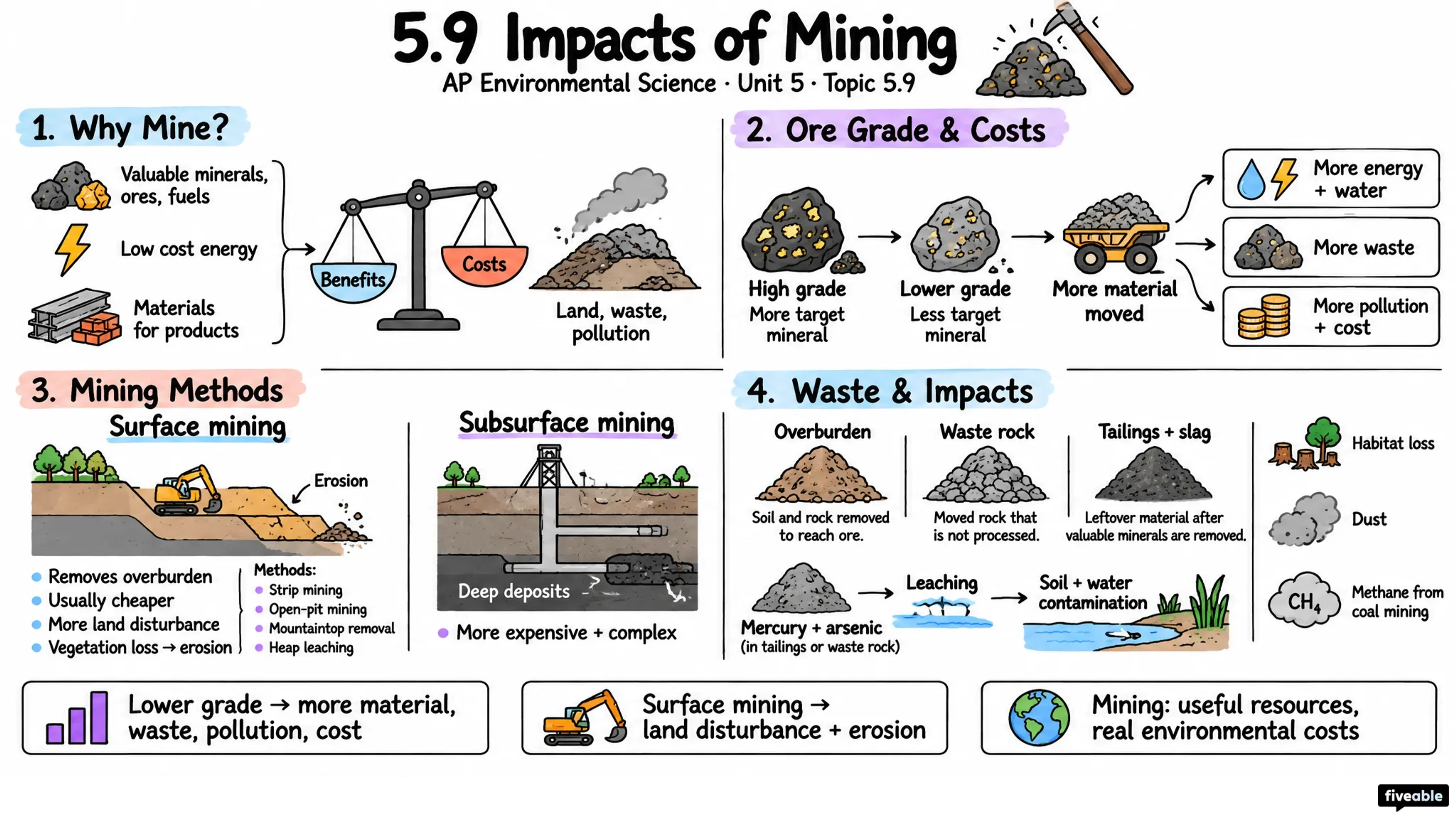
  • Mining & Resource Extraction

Made by you

Visual Cheatsheets

Pick a Unit 5 topic and a format: flowchart, comparison chart, vocab sheet, Cornell notes and more. Ready in about a minute.

Printable PDF · from the Fiveable shop

AP Environmental Science Unit 5 Cheatsheet

1 page · Land and Water Use · PDF

Visual Cheatsheets

One topic, the format you pick, ready in about a minute

Format

Topic

Takes 30–60 seconds

Preview: Standard

Unit 5: Land & Water Use, topic by topic

Each topic has a full study guide. See the whole unit.