AP Chemistry Unit 2 Cheatsheet: Compound Structure and Properties

AP Chemistry Unit 2 Cheatsheet: Compound Structure and Properties

Start with the first 3 sections of the Unit 2 one-page cheatsheet below. The full sheet is a PDF you can print.

Electronegativity & Bond Type

Electronegativity trends:

  • Increases left → right across period
  • Decreases down a group
  • Explained by atomic size and nuclear charge (Coulomb's law)

Bond classification by electronegativity difference:

  • Nonpolar covalent: Similar EN (e.g., C–H)
  • Polar covalent: Unequal EN → partial charges (δ+ and δ−)
  • Ionic: Metal + nonmetal; large EN difference

Key principle: Ionic–covalent bonding is a continuum, not distinct categories. Greater EN difference = stronger bond dipole in single bonds. Examine compound properties to confirm bond type.
Potential Energy & Bond Strength

PE vs. internuclear distance graph shows:

  • Equilibrium bond length: Distance at minimum PE
  • Bond energy: Energy required to separate atoms (break bond)

Factors affecting bond strength:

  • Bond order: Triple > double > single (shorter, higher energy)
  • Atomic size: Smaller atoms = shorter bonds, higher energy
  • Coulomb's law (ionic): Strength ∝ (charge₁ × charge₂) / distance²

Ionic interaction strength: Larger charges and smaller ions → stronger attractions.

Metallic Bonding & Alloys

Metallic bonding model: Array of cations surrounded by delocalized "sea" of valence electrons (not bound to individual atoms).

Interstitial alloys:

  • Atoms of significantly different radii
  • Smaller atoms fill spaces between larger atoms
  • Example: carbon in iron (steel)

Substitutional alloys:

  • Atoms of comparable radius
  • One atom replaces another in lattice
  • Example: zinc in copper (brass)

The rest of the Unit 2 sheet

6 more sections are on the one-page PDF:

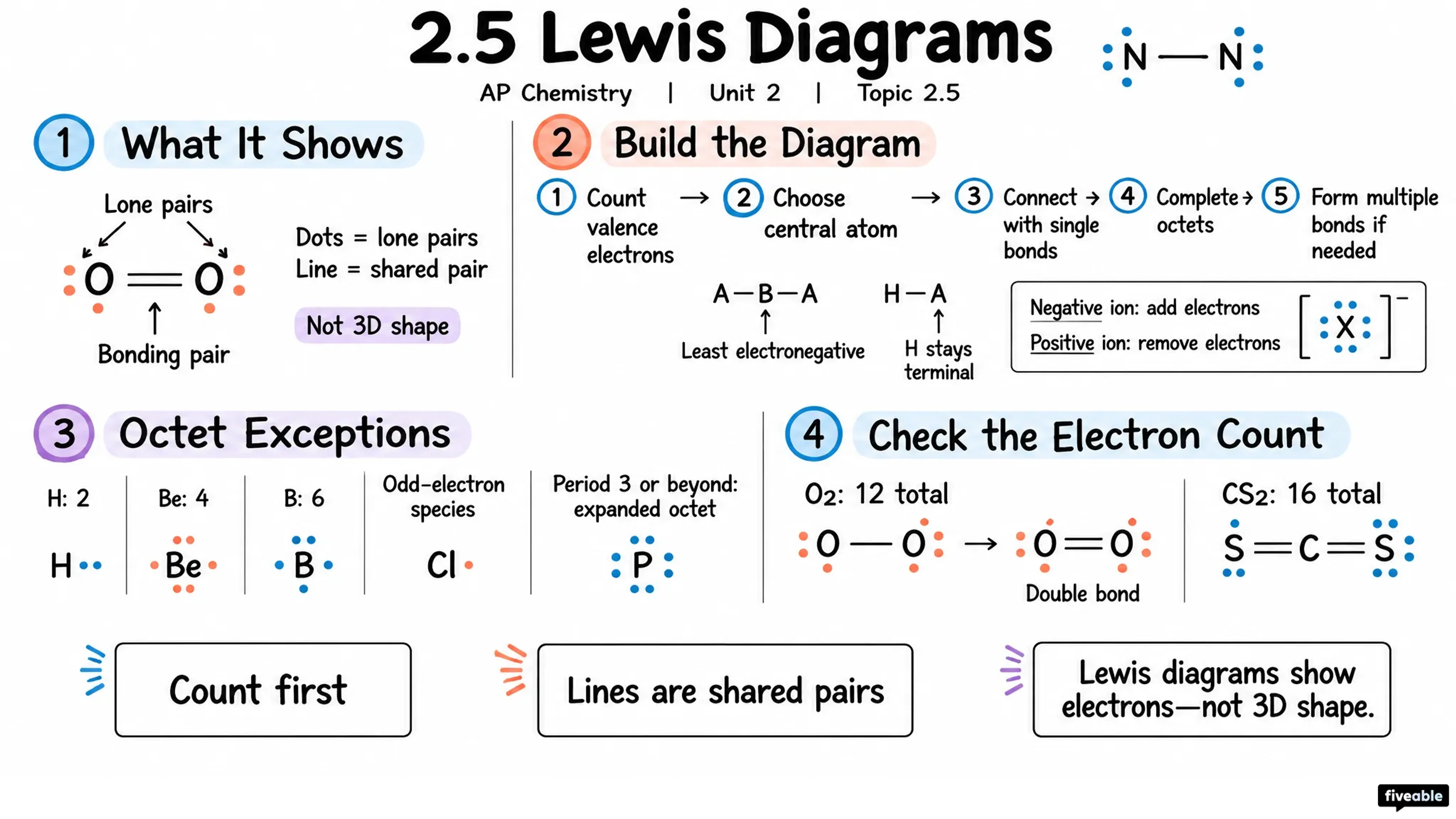
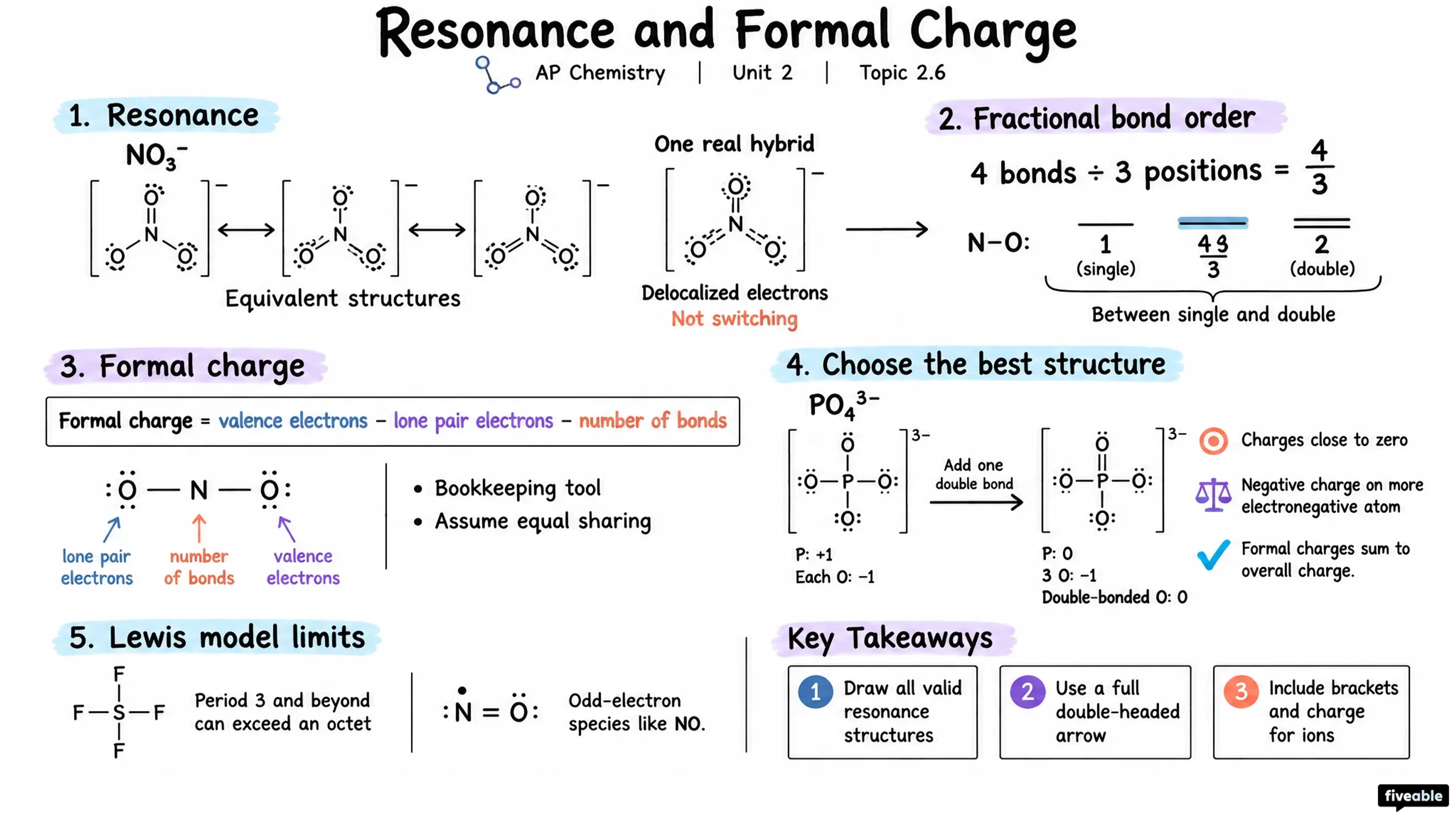
  • Lewis Structures & Resonance

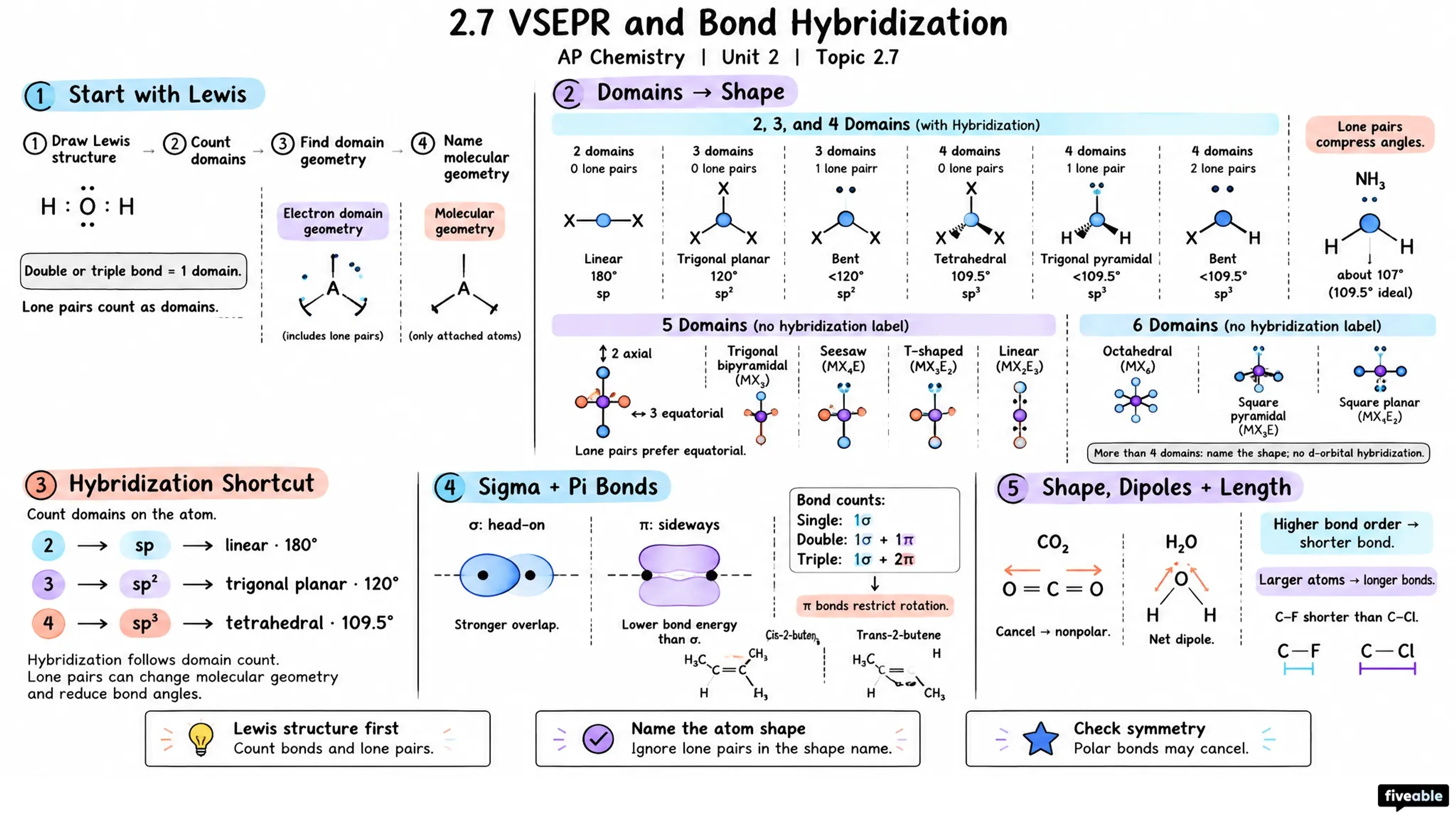
  • VSEPR Theory & Molecular Geometry

  • Sigma & Pi Bonds

  • Ionic Solids & Crystal Structure

  • Polarity & Dipole Moments

  • Test-Solving Strategy

Made by you

Visual Cheatsheets

Pick a Unit 2 topic and a format: flowchart, comparison chart, vocab sheet, Cornell notes and more. Ready in about a minute.

Printable PDF · from the Fiveable shop

AP Chemistry Unit 2 Cheatsheet

1 page · Compound Structure and Properties · PDF

Visual Cheatsheets

One topic, the format you pick, ready in about a minute

Format

Topic

Takes 30–60 seconds

Preview: Standard

Unit 2: Compound Structure and Properties, topic by topic

Each topic has a full study guide. See the whole unit.