
Cholesky factorization is a powerful tool for decomposing symmetric positive definite matrices. It's faster than LU factorization and has wide-ranging applications in linear algebra, optimization, and statistics.
This method breaks down a matrix into the product of a lower triangular matrix and its transpose. It's computationally efficient, numerically stable, and useful for solving linear systems and least-squares problems.
Cholesky Factorization Properties
Decomposition and Characteristics
- Cholesky factorization decomposes a symmetric positive definite matrix A into the product of a lower triangular matrix L and its transpose
- Symmetric positive definite matrices have positive eigenvalues and satisfy the property for all non-zero vectors x
- Cholesky factor L remains unique with positive diagonal entries ensuring numerical stability in computations
- Factorization only exists for positive definite matrices making it a useful test for this property
Applications and Efficiency
- Applicable in various fields (linear algebra, optimization, statistical computations)
- Useful for solving systems of linear equations, computing determinants, and generating random samples from multivariate normal distributions
- Computationally efficient requiring approximately floating-point operations for an n × n matrix
- Twice as fast as LU factorization for symmetric positive definite matrices
Cholesky Factorization Implementation
Standard and Blocked Algorithms
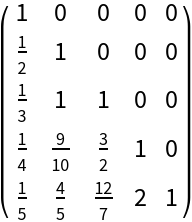
- Standard Cholesky algorithm computes lower triangular matrix L column by column using inner products and square roots
- Blocked versions improve cache efficiency on modern computer architectures
- Outer product form updates the entire matrix at each step as an alternative implementation
Variants and Specialized Implementations
- Modified Cholesky factorization handles symmetric matrices not necessarily positive definite
- Produces factorization of the form , where D represents a diagonal matrix
- Ensures factorization exists even for indefinite matrices useful in optimization algorithms
- Rank-one updates and downdates allow efficient dynamic updates to factorization as underlying matrix changes
- Parallel implementations take advantage of multi-core processors or distributed computing environments
- Sparse Cholesky factorization algorithms exploit sparsity patterns to reduce computational complexity and storage requirements
Applications of Cholesky Factorization
Solving Linear Systems and Least-Squares Problems
- Solves system Ax = b by first solving Ly = b for y, then solving for x
- Solution process involves forward substitution followed by backward substitution, each with complexity
- Applies to least-squares problems of the form using normal equations
- Numerically stable for well-conditioned A in least-squares problems
- Combines with iterative refinement to improve solution accuracy in presence of rounding errors
Optimization and Large-Scale Problems
- Used in optimization problems to solve linear systems arising in Newton's method or interior point methods
- Sparse Cholesky factorization with appropriate ordering techniques reduces computational cost for large, sparse systems
- Efficient for dynamic updates in optimization algorithms through rank-one updates and downdates
Efficiency vs Stability of Cholesky Factorization
Computational Complexity and Stability
- Time complexity for dense matrices more efficient than LU factorization for symmetric positive definite matrices
- Space complexity for storing lower triangular factor L
- Numerically stable without pivoting due to positive definiteness of the matrix
- Relative error in computed Cholesky factor L bounded by , where ε represents machine epsilon and κ(A) condition number of A
- Backward error analysis shows computed Cholesky factor as exact Cholesky factor of slightly perturbed matrix
Performance Considerations
- Accuracy degrades for ill-conditioned matrices but remains more stable than methods like Gaussian elimination
- Block algorithms improve cache efficiency and overall performance on modern computer architectures
- Parallel implementations achieve near-linear speedup on shared-memory systems for sufficiently large matrices