

ACT: Essay Section
When you sit down for the ACT, you'll have either 4 or 5 sections depending on whether you opted into the essay. If you did, the Writing/Essay section comes last, after everything else:
- English
- Math
- Reading
- Science
- Writing/Essay
The Writing/Essay portion is optional. You get 40 minutes to write a complete, well-developed essay. Your score on this section is reported separately and will not affect your multiple-choice scores or your composite score.

💬 Mastering the Prompt

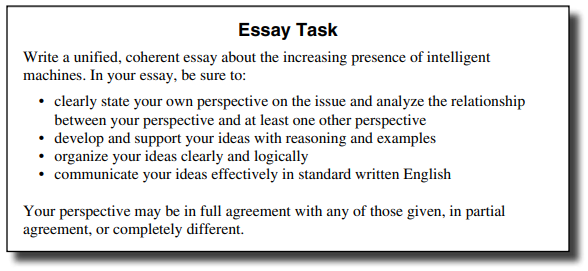
When you flip to the essay section, you'll always find the same structure:
- A debated or controversial topic with some background information
- 3 perspectives that take different stances on that topic. You may agree with one, refute them, or build your own argument.
- A set of instructions telling you exactly what to do
Those instructions connect directly to the rubric, so understanding the rubric is where the real strategy lives.
📄 Mastering the Rubric
Your essay is scored across 4 categories. Two graders independently score your essay on a scale of 1–6 for each category, and their scores are added together for a score out of 12 per category. Those four category scores are then averaged to produce your final essay score (minimum 2, maximum 12).
You can review the full rubric here, but below are the highlights for each category.
The ACT essay is very rubric-oriented. If you do exactly what the rubric asks, you'll score well. It's much more formulaic than most writing assignments you've done in school.

💭 Ideas and Analysis
Rubric descriptors for a score of 6:
- Writer generates an argument that critically engages with multiple perspectives on the given issue
- The argument's thesis reflects nuance and precision in thought and purpose
- The argument establishes and employs an insightful context for analysis of the issue and its perspectives
- The analysis examines implications, complexities and tensions, and/or underlying values and assumptions
Here's what that actually means in practice:
Step 1: Choose a perspective. Since the prompt gives you three perspectives, it's usually best to pick one of those. You can create an entirely new perspective, but the 40-minute time limit makes that risky unless you have deep knowledge of the topic.
Step 2: Refine your position. Don't just restate the perspective word-for-word. Add detail and complexity to it. Simply copying the given perspective will lower your score. Use it as a starting point, then build a more specific argument around it.
Step 3: Engage with the other perspectives. A low-scoring essay just says "I agree with Perspective 1 and disagree with 2 and 3" without explanation. A high-scoring essay explains why the other perspectives fall short. There should be a clear, reasoned connection between your stance and the alternatives, both in your introduction and throughout the essay.
Step 4: Discuss implications. Address the effects, tensions, or assumptions behind your perspective. What are the consequences of this viewpoint? What values does it rest on? This is what the rubric means by "implications, complexities, and tensions."
🙌 Development and Support
Rubric descriptors for a score of 6:
- Development of ideas and support for claims deepen insight and broaden context
- An integrated line of skillful reasoning and illustration effectively conveys the significance of the argument
- Qualifications and complications enrich and bolster ideas and analysis
This category is about evidence. You need to back up the claims you made with concrete, detailed support. Relying only on the background information provided in the prompt won't get you into the top score bands. You need to bring in outside knowledge or examples.
Here's a useful strategy: you can make up examples. The ACT graders will not fact-check you. If a statistic or study would strengthen your argument, you can invent one. For instance, you could write: "A study published by the New York Times found that 30% of American jobs could be displaced by automation over the next 40 years." That may not be a real study, but it supports your claim effectively.
The key is that your evidence needs to be detailed and integrated smoothly into your argument. A vague reference won't help. Specific numbers, named sources, and clear reasoning will.

📑 Organization
Rubric descriptors for a score of 6:
- Response exhibits a skillful organizational strategy
- Response is unified by a controlling idea or purpose
- Logical progression of ideas increases the effectiveness of the writer's argument
- Transitions between and within paragraphs strengthen the relationships among ideas
This is one of the most formulaic parts of the rubric. A few concrete things to do:
Structure your thesis to mirror your essay. If your thesis makes three claims, your three body paragraphs should address those claims in the same order. This creates a natural outline and keeps your essay organized.
Reference your controlling idea in every paragraph. Whether you're supporting your stance or addressing a counterargument, tie each paragraph back to your thesis. The rubric specifically looks for a "unified" essay, and repeating key elements of your thesis in each body paragraph accomplishes that.
Use transitions, even if it feels excessive. Include them at the beginning of paragraphs, at the end of paragraphs, and whenever you shift between ideas. Graders are actively looking for them. If you struggle with transitions, this resource from UNC has a solid list.
Separate your writing into clear paragraphs. Don't write one giant block of text. And an introduction and conclusion are not optional. These paragraphs tie your essay together and directly contribute to your organization score.
📝 Language Use
Rubric descriptors for a score of 6:
- Use of language enhances the argument
- Word choice is skillful and precise
- Sentence structures are consistently varied and clear
- Stylistic and register choices (voice, tone) are strategic and effective
- Few minor errors in grammar, usage, and mechanics don't impede understanding
This is the "traditional" writing quality category: grammar, vocabulary, and sentence variety. Here's how to maximize your score:
Watch your grammar. Avoid run-on sentences, subject-verb disagreement, and common mix-ups like there/their/they're. The practice you're doing for the ACT English section directly helps here.
Vary your sentence structure. Mix short, punchy sentences with longer, complex ones. Adding transitions naturally creates more sentence variety.
Use strong vocabulary. Instead of "it got worse," write "the situation was exacerbated." Instead of "harmful," try "detrimental." As you practice essays, use a thesaurus to find stronger alternatives for common words. Over time, these will come naturally during the exam.
Proofread. Save a few minutes at the end to read through your essay and catch errors. This is where you pick up easy points.
One great way to understand the scoring is to grade essays yourself. ACT has released 6 sample essays for the prompt shown above, each scoring differently on the rubric. Try using the rubric to figure out which essay earned 6s, 5s, 4s, 3s, 2s, and 1s before checking the answers.
😊 General ACT Essay Tips and Outlining
Before you start writing, spend time planning. Here's what to do as soon as the section begins:
- Read the background information and all three perspectives carefully.
- Choose your perspective (or a combination of perspectives) based on which one you can support with the most evidence.
- Brainstorm 2–3 examples that support your perspective, plus some possible counterarguments. These can be real or made up. Personal anecdotes work too.
- Write a thesis that provides a clear focus and creates a unified theme for your paper.
- Outline your essay structure. Bullet points are fine. Having a plan makes the actual writing much faster.
Here's a recommended essay structure:
-
Introduction: Thesis that states your perspective, plus sentences that cast doubt on the alternate perspectives
-
Body Paragraph 1: A reason your perspective is valid + 1–2 pieces of evidence
-
Body Paragraph 2: Another reason your perspective is valid + 1–2 pieces of evidence
-
Body Paragraph 3: Acknowledge the opposing stance and explain why your stance is stronger (a rebuttal), backed by evidence
- You should also discuss the implications of your perspective, either here or in body paragraphs 1 and 2.
-
Conclusion: Restate (don't just repeat) your thesis and tie together everything you've argued
Here's an example of restating vs. repeating a thesis:
- Original thesis: "Although the replacement of workers with machines may have negative short-term effects on the job market, in the long term, machines will accelerate our technological growth, push us toward new possibilities, and create a highly skilled workforce."
- Restated in conclusion: "In the short term, replacing workers with machines may not have entirely positive effects. However, in the future, machines will not only open new opportunities but also help us become more industrialized and develop a more capable workforce."
Note that this is only one way to structure the paper. Instead of devoting a whole paragraph to the counterargument, you could have 3 body paragraphs that each support your thesis and include a short counterargument at the end of each one. Either approach works, as long as it's well organized.
Timing: Try to start actually writing within 10 minutes of the section starting. That gives you about 30 minutes for the essay itself.
After you finish writing, proofread:
- Check for transitions. Add them at the beginning of paragraphs, the end of paragraphs, and around your rebuttal if they're missing.
- Check spelling and grammar. Read through and fix any obvious errors. This has its own section in the rubric.
- Make sure your paragraphs are clearly separated. Indent each new paragraph so graders can easily see your organizational structure.

You're Ready! 🥇
One final thing to keep in mind: many colleges no longer require the ACT essay. Check the admissions pages of the schools you're applying to before deciding whether to take it. A "good" score doesn't have to be a 12. Scores of 8 or 10 are solid, and since ACT writing scores carry less weight in admissions than they used to, this section gives colleges just one more data point to consider. It won't define your application.