
Algorithm analysis and Big O notation are essential tools for evaluating code efficiency. They help programmers understand how algorithms perform as input sizes grow, enabling better decision-making when choosing data structures and algorithms for specific problems.
These concepts form the foundation for comparing and optimizing algorithms. By mastering complexity analysis and Big O notation, you'll be equipped to design more efficient solutions and predict how your code will scale with larger datasets.
Complexity Analysis
Understanding Time and Space Complexity
- Time complexity measures algorithm efficiency based on input size
- Analyzes how execution time increases as input grows
- Space complexity evaluates memory usage relative to input size
- Considers both auxiliary space and input space requirements
- Asymptotic analysis focuses on algorithm behavior with large inputs
- Ignores constant factors and lower-order terms for simplification
Order of Growth and Asymptotic Behavior
- Order of growth describes how algorithm runtime scales with input size
- Classifies algorithms into broad categories (linear, quadratic, logarithmic)
- Asymptotic notation expresses upper, lower, and tight bounds
- Provides a standardized way to compare algorithm efficiency
- Helps predict performance for large-scale inputs
Advanced Analysis Techniques
- Amortized analysis evaluates average performance over a sequence of operations
- Useful for data structures with occasional expensive operations (dynamic arrays)
- Considers the overall cost rather than individual operation costs
- Three main methods: aggregate analysis, accounting method, potential method
- Provides more accurate efficiency assessment for certain algorithms and data structures
.jpg)
Big O Notation
Fundamentals of Big O Notation
- Big O notation describes upper bound of algorithm growth rate
- Represents worst-case scenario for algorithm performance
- Expressed as O(f(n)), where f(n) is a function of input size n
- Ignores constants and lower-order terms (O(2n^2 + 3n) simplifies to O(n^2))
- Allows for comparing algorithm efficiency across different implementations
Best, Average, and Worst Case Scenarios
- Best case represents optimal input configuration for fastest execution
- Often denoted as Ω (Omega) notation
- Average case describes expected performance for typical inputs
- Usually denoted as Θ (Theta) notation
- Worst case indicates maximum time or space required for any input
- Represented by O (Big O) notation
- Analyzing all cases provides comprehensive understanding of algorithm behavior
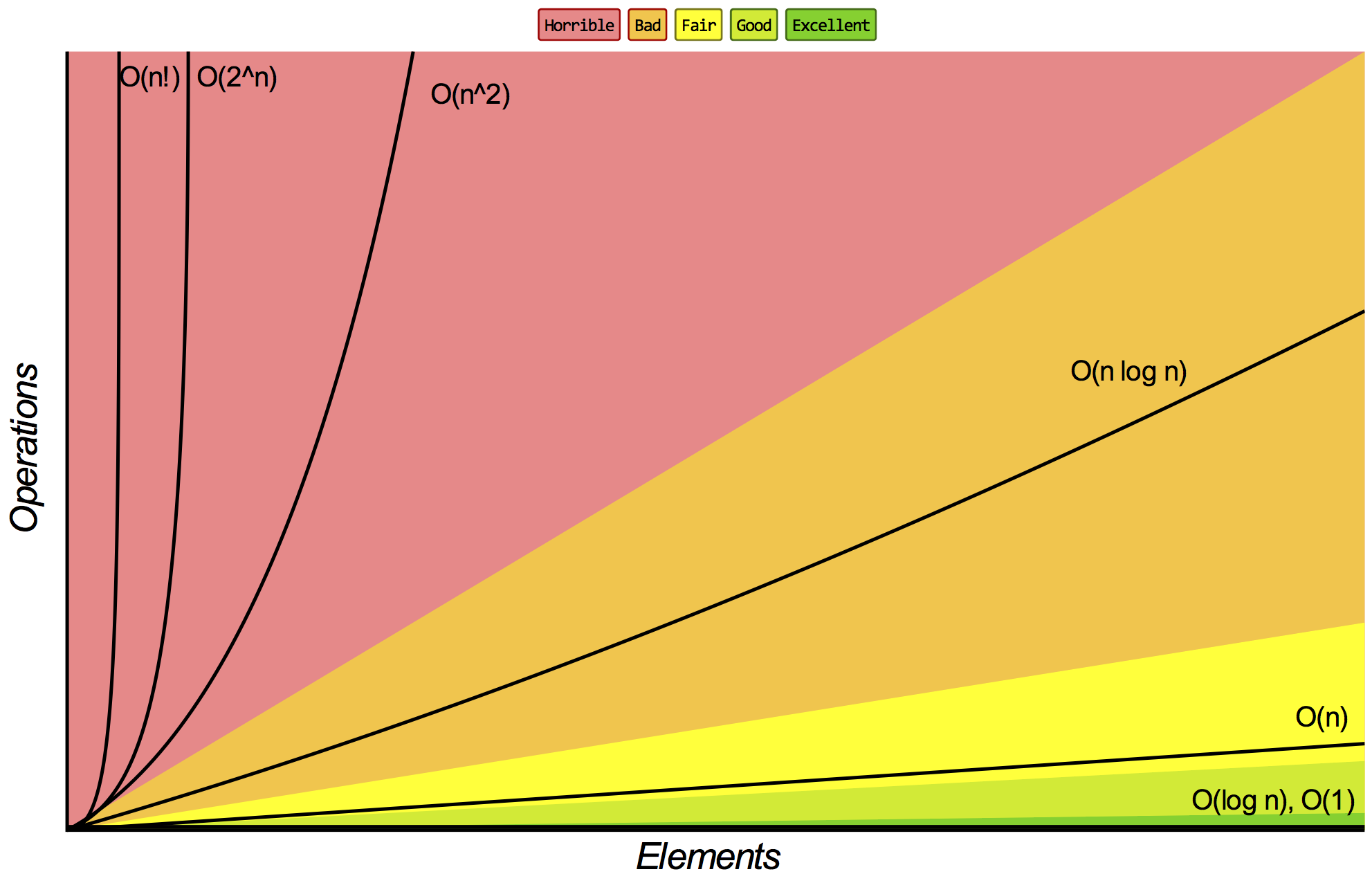
Practical Applications of Big O Analysis
- Helps developers choose appropriate algorithms for specific problems
- Guides optimization efforts by identifying performance bottlenecks
- Enables prediction of algorithm scalability for larger datasets
- Facilitates communication about algorithm efficiency among developers
- Assists in making informed trade-offs between time and space complexity
Common Time Complexities
Constant and Logarithmic Time Complexities
- Constant time O(1) algorithms have fixed execution time regardless of input size
- Includes array element access, basic arithmetic operations, hash table lookups
- Logarithmic time O(log n) algorithms exhibit sublinear growth
- Efficiency improves as input size increases (binary search, balanced tree operations)
- Often seen in divide-and-conquer algorithms that halve the problem size each iteration
Linear and Quadratic Time Complexities
- Linear time O(n) algorithms have runtime directly proportional to input size
- Includes simple iterations, linear search, single pass algorithms
- Performance degrades linearly as input grows
- Quadratic time O(n^2) algorithms have runtime proportional to square of input size
- Often involve nested loops or comparisons (bubble sort, simple matrix multiplication)
- Efficiency decreases rapidly for large inputs, limiting practical use for big datasets
Exponential and Other Time Complexities
- Exponential time O(2^n) algorithms have rapidly growing runtime as input increases
- Often seen in brute-force solutions to NP-hard problems (traveling salesman)
- Becomes impractical for even moderately sized inputs
- Other common complexities include O(n log n) (efficient sorting algorithms)
- Factorial time O(n!) (permutations, certain brute-force solutions)
- Polynomial time O(n^k) encompasses linear, quadratic, and higher-degree polynomials