
Abstract classes and methods are powerful tools in object-oriented programming. They provide a blueprint for other classes, allowing partial implementation of functionality and promoting code reuse. Abstract classes can't be instantiated directly but serve as a foundation for concrete subclasses.
Abstract methods, declared without implementation, create a contract for subclasses to fulfill. This enables polymorphism and supports the template method pattern. Abstract classes and methods strike a balance between interfaces and concrete classes, offering flexibility and structure in class hierarchies.
Abstract Classes
Understanding Abstract Classes and Their Purpose
- Abstract classes serve as blueprints for other classes, cannot be instantiated directly
- Contain both abstract and concrete methods, providing a common structure for related classes
- Enable partial implementation of functionality, allowing subclasses to complete the implementation
- Promote code reuse and maintain a consistent interface across related classes
- Support abstraction by hiding complex implementation details from the end-user
- Can have constructors, used to initialize common attributes in subclasses
Concrete Classes and Their Relationship to Abstract Classes
- Concrete classes extend abstract classes, providing full implementation of all abstract methods
- Inherit attributes and methods from the abstract parent class
- Can be instantiated to create objects with defined behaviors
- May override inherited methods to provide specialized functionality
- Utilize the template provided by the abstract class to ensure consistent structure
Abstract Class Implementation and Usage
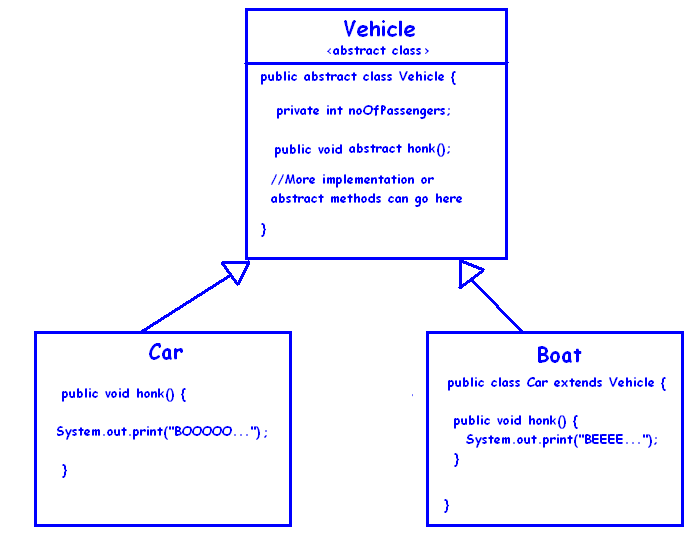
- Abstract classes are declared using the
abstractkeyword in most object-oriented programming languages - Cannot be instantiated directly, but can be used as reference types
- May contain instance variables, static variables, and concrete methods
- Abstract methods are declared without a body, ending with a semicolon
- Subclasses must implement all abstract methods or be declared abstract themselves
- Can have constructors to initialize common attributes, called using
super()in subclass constructors
Abstract Methods
Defining and Implementing Abstract Methods
- Abstract methods are declared without an implementation in abstract classes
- Provide a contract for subclasses to implement specific functionality
- Declared using the
abstractkeyword followed by the method signature and a semicolon - Must be implemented by all concrete subclasses of the abstract class
- Enable polymorphism by allowing different implementations in subclasses
- Cannot have a method body in the abstract class
Method Overriding and Polymorphism
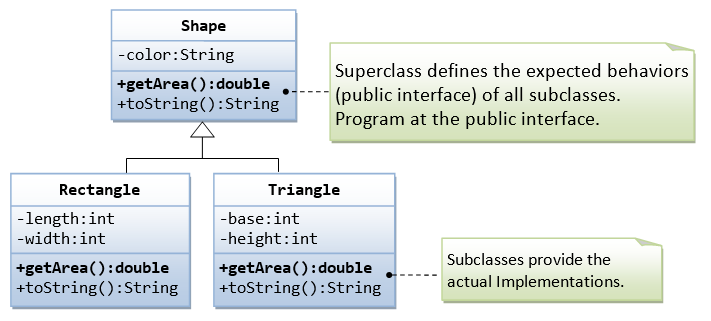
- Method overriding occurs when a subclass provides a specific implementation for an inherited method
- Overridden methods must have the same name, return type, and parameter list as the abstract method
- Enables runtime polymorphism, allowing objects to behave differently based on their actual type
- Supports the "is-a" relationship between abstract classes and their concrete subclasses
- Can be annotated with
@Overrideto ensure correct overriding and catch errors at compile-time
Template Method Pattern and Abstract Class Design
- Template Method Pattern uses abstract classes to define the skeleton of an algorithm
- Consists of a template method that calls abstract and concrete methods in a specific order
- Abstract methods in the pattern are implemented by subclasses to provide specific behavior
- Concrete methods in the abstract class provide common functionality for all subclasses
- Promotes code reuse by centralizing common logic in the abstract class
- Allows for easy extension of algorithms without modifying existing code
Inheritance and Code Reuse
Inheritance Fundamentals and Abstract Classes
- Inheritance establishes an "is-a" relationship between classes, creating a class hierarchy
- Abstract classes serve as base classes in inheritance hierarchies, defining common attributes and behaviors
- Subclasses inherit all non-private members (fields and methods) from their abstract superclass
- Enables code reuse by allowing subclasses to utilize and extend functionality from abstract classes
- Supports the principle of abstraction by hiding implementation details in the superclass
Code Reuse Strategies with Abstract Classes
- Abstract classes promote code reuse by centralizing common functionality in a single location
- Reduce code duplication by defining shared methods and attributes in the abstract class
- Allow for easy maintenance and updates by modifying the abstract class instead of multiple subclasses
- Support the DRY (Don't Repeat Yourself) principle in software development
- Enable the creation of extensible and modular code structures
Comparing Abstract Classes and Interfaces
- Abstract classes support partial implementation, while interfaces traditionally contain only method signatures
- A class can extend only one abstract class but can implement multiple interfaces
- Abstract classes can have constructors, instance variables, and non-abstract methods
- Interfaces are used to define a contract, while abstract classes provide a common base implementation
- Abstract classes are suitable for closely related classes, while interfaces work well for unrelated classes that share common behavior
- Both abstract classes and interfaces support polymorphism and can be used as reference types