
Arrays are fundamental data structures in programming, allowing efficient storage and manipulation of multiple elements. They provide a way to organize data of the same type into a contiguous block of memory, enabling quick access and operations on collections of values.
Multi-dimensional arrays extend this concept, allowing for the creation of grids, matrices, and higher-dimensional data structures. These arrays are crucial for representing complex data relationships and performing operations on structured data sets, making them essential in various programming applications.
Array Fundamentals
Declaration of one-dimensional arrays
- Declare arrays with data type, square brackets, and array name (int[] numbers)
- Specify size within brackets optionally (int[5] numbers)
- Initialize empty arrays (int[] numbers = new int[5])
- Initialize arrays with values (int[] numbers = {1, 2, 3, 4, 5})
- Use curly braces for initialization (String[] fruits = {"apple", "banana", "orange"})
- Create arrays of various data types (int, float, char, boolean)
- Define fixed-size arrays for static memory allocation
- Implement dynamic arrays for flexible sizing (ArrayList in Java)
Element access in arrays
- Use zero-based indexing to access elements (numbers[0] for first element)
- Retrieve values with array name and index in square brackets (int firstNumber = numbers[0])
- Modify elements by assigning new values to specific indices (numbers[2] = 10)
- Update elements based on existing values (numbers[i] *= 2 to double each element)
- Iterate through array elements with loops (for (int i = 0; i < numbers.length; i++))
- Find minimum or maximum values in arrays (int max = Arrays.stream(numbers).max().getAsInt())
- Calculate sum or average of array elements (double average = Arrays.stream(numbers).average().getAsDouble())
Multi-Dimensional Arrays
Creation of multi-dimensional arrays
- Declare multi-dimensional arrays using multiple sets of square brackets (int[][] matrix)
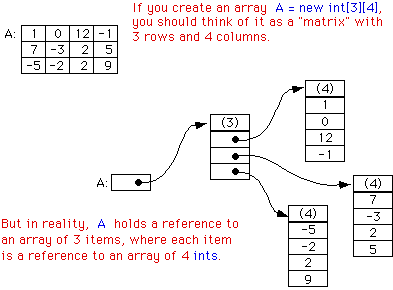
- Specify dimensions for each level (int[3][4] matrix creates a 3x4 grid)
- Initialize with nested curly braces (int[][] matrix = {{1, 2}, {3, 4}})
- Perform row-wise initialization (int[][] matrix = new int[3][3])
- Access elements using multiple indices (int element = matrix[1][2])
- Represent matrices for mathematical operations
- Store tabular data (spreadsheet-like structures)
- Process images with 2D arrays for pixel manipulation (grayscale values)
Traversal of multi-dimensional arrays
- Use nested loops for traversal (outer loop for rows, inner for columns)
- Implement row-major traversal (iterate rows first, then columns)
- Perform column-major traversal (iterate columns first, then rows)
- Apply element-wise operations (multiply each element by a scalar)
- Sum rows or columns (calculate totals for each row/column)
- Find specific elements or patterns (search for maximum value in the array)
Memory representation of arrays
- Allocate contiguous memory blocks for efficient access
- Store multi-dimensional arrays in row-major order (C, C++, Java)
- Calculate memory addresses using base address and index offsets
- Compare memory efficiency of one-dimensional vs multi-dimensional arrays
- Consider cache performance when designing array-based algorithms
- Ensure array bounds safety to prevent buffer overflows
- Handle potential issues with out-of-bounds access (ArrayIndexOutOfBoundsException in Java)