7.2 Commutative and Associative Properties

➕Pre-Algebra Unit 7 Review
7.2 Commutative and Associative Properties
➕ Pre-Algebra
Properties of Addition and Multiplication
The commutative and associative properties are two rules that let you rearrange and regroup numbers in addition and multiplication without changing the answer. They're the reason you can shuffle terms around in an expression to make simplifying easier.
These properties only work for addition and multiplication. Subtraction and division don't follow these rules, which is a common source of mistakes.
Commutative Property
The word "commutative" comes from "commute," meaning to move around. This property says you can swap the order of numbers when adding or multiplying and still get the same result.
- Addition:
- Example:
- Multiplication:
- Example:
This does not work for subtraction or division:
- , but . Those aren't equal.
- , but . Not equal either.
The commutative property is especially useful for rearranging terms in an expression so that like terms end up next to each other. For example:
You moved the term next to , which made it easy to combine them.
Associative Property
The word "associative" comes from "associate," meaning to group together. This property says you can change how numbers are grouped (where the parentheses go) when adding or multiplying, and the result stays the same.
- Addition:
- Example:
- Multiplication:
- Example:
Again, this does not work for subtraction or division:
- , but . Different answers.
- , but . Very different.
Regrouping with the associative property can make mental math and simplifying much easier:
Using Both Properties Together
Most of the time, you'll use the commutative and associative properties together to simplify expressions. Here's a step-by-step approach:
- Identify like terms in the expression (terms with the same variable and exponent, or constant terms).
- Rearrange terms using the commutative property so like terms are next to each other.
- Regroup using the associative property if needed to make combining easier.
- Combine the like terms.
Example: Simplify
-
Like terms: and are alike; and are alike.
-
Rearrange:
-
Group:
-
Combine:
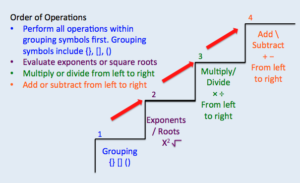
Always follow the order of operations (PEMDAS) when simplifying. These properties let you move and regroup terms, but they don't override the rules about which operations to perform first.
Additional Mathematical Properties
- The distributive property connects multiplication and addition: . You'll often use this alongside the commutative and associative properties when simplifying expressions.
- Together, the commutative, associative, and distributive properties are the core rules that govern how you can rearrange and simplify algebraic expressions.
See Fiveable more often in Google
Mark Fiveable as a preferred source and Google is more likely to show you our guides in Top Stories, with a "preferred" badge in AI Mode and AI Overviews.