7.3 Distributive Property

➕Pre-Algebra Unit 7 Review
7.3 Distributive Property
➕ Pre-Algebra
Distributive Property
Application of distributive property
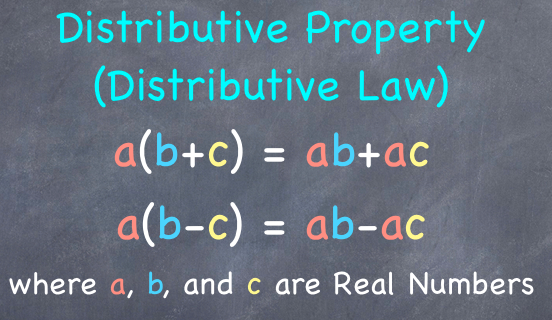
The distributive property lets you remove parentheses by multiplying a factor across a sum (or difference). The formal rule looks like this:
In plain terms: instead of adding first and then multiplying, you multiply the outside factor by each term inside the parentheses, then add the results. Both approaches give the same answer, but distributing often makes expressions much easier to work with.
To apply it:
- Identify the factor outside the parentheses.
- Multiply that factor by each term inside the parentheses, one at a time.
- Combine like terms if any exist.
Example: Simplify
- Multiply 3 by the first term:
- Multiply 3 by the second term:
- Write the result:
Efficient numerical expression evaluation
The distributive property also works in reverse. If two terms share a common factor, you can factor it out to make mental math faster.
- Spot a factor that appears in every term.
- Factor it out (write it in front of parentheses).
- Add or subtract the remaining parts inside the parentheses.
- Multiply.
Example: Evaluate
- Both terms share the factor 12, so factor it out:
- Add inside the parentheses:
- Multiply:
This is much quicker than computing separately. Look for this shortcut whenever a multiplication problem can be split into friendlier numbers.

Forms of distributive property
The distributive property works the same way with negative numbers and fractions. The process doesn't change; you just need to be careful with signs and arithmetic.
Distributing a negative factor:
When the factor outside is negative, each product flips sign compared to the original term.
Example: Simplify
- Multiply by :
- Multiply by : (negative times negative is positive)
- Result:
A common mistake here is forgetting to flip the sign on the second term. Watch for that.
Distributing a fraction:
Multiply the fraction by each term, then simplify.
Example: Simplify
- Result:
Related Properties
The distributive property works alongside two other properties you should know:
- Commutative property: The order of multiplication doesn't matter. . This means and give the same result.
- Associative property: The grouping of factors doesn't matter. . You can regroup without changing the product.
Together, these three properties are the main tools you'll use to rearrange and simplify algebraic expressions throughout this course and beyond.
See Fiveable more often in Google
Mark Fiveable as a preferred source and Google is more likely to show you our guides in Top Stories, with a "preferred" badge in AI Mode and AI Overviews.