2.2 Evaluate, Simplify, and Translate Expressions

➕Pre-Algebra Unit 2 Review
2.2 Evaluate, Simplify, and Translate Expressions
Evaluating and Simplifying Expressions
Algebraic expressions combine numbers, variables, and operations to represent quantities. Learning to evaluate, simplify, and translate these expressions gives you the foundation for solving equations later on.
Components of Algebraic Expressions
Before you can evaluate or simplify anything, you need to know the vocabulary.
- Terms are the parts of an expression separated by addition or subtraction. In , the three terms are , , and .
- Coefficients are the numbers multiplied by a variable in a term. In , the coefficient is 3. If no number is written, the coefficient is 1, so means the same thing as .
- Constants are terms with no variable at all, like .
- Like terms share the same variable raised to the same power. and are like terms because they both have to the first power. But and are not like terms because the exponents differ.

Evaluating Algebraic Expressions
Evaluating means plugging in given values for the variables and then calculating the result. Here's the process:
-
Substitute the given value for each variable. If and the expression is , replace with 3 to get .
-
Follow the order of operations (PEMDAS) to simplify:
- Parentheses first
- Exponents next
- Multiplication and Division, left to right
- Addition and Subtraction, left to right
-
Calculate to get your final answer. For : multiply first to get , then add to get .
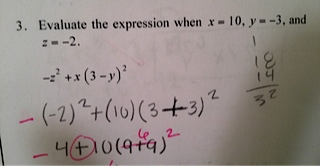
A slightly harder example: Evaluate when and .
-
Substitute:
-
Exponents first:
-
Multiply:
-
Subtracting a negative means adding:
Simplifying by Combining Like Terms
Simplifying means making an expression shorter by combining like terms. You can't solve it (there's no equals sign), but you can clean it up.
- Identify the like terms. Look for terms with the same variable and exponent.
- Add or subtract their coefficients. The variable part stays the same.
- Bring down any unlike terms as they are.
For example, simplify :
- Group the like terms:
- Combine coefficients:
- Clean it up:
Notice that you can regroup terms in any order thanks to the commutative and associative properties of addition. Just be careful to carry the sign in front of each term with it.
Translating Expressions
Translating means converting an English phrase into an algebraic expression. This is how word problems become math you can actually work with.
Steps for Translating
- Identify the unknown and assign it a variable. For example, "a number" becomes .
- Match key words to operations:
| Word/Phrase | Operation | Example Phrase | Expression |
|---|---|---|---|
| sum, plus, increased by, more than | Addition | "the sum of five and a number" | |
| difference, minus, decreased by, less than | Subtraction | "a number decreased by three" | |
| product, times, of | Multiplication | "the product of six and a number" | |
| quotient, divided by, per | Division | "a number divided by four" |
- Pay attention to order. Most phrases translate left to right, but watch out for "less than" and "subtracted from," which flip the order. "Three less than a number" is , not .
A few more translations to practice with:
- "twice a number, increased by seven" →
- "five less than three times a number" →
- "the quotient of a number and the sum of that number and two" →
That last one shows why parentheses matter. "The sum of a number and two" is a single quantity, so it needs to be grouped as in the denominator.
See Fiveable more often in Google
Mark Fiveable as a preferred source and Google is more likely to show you our guides in Top Stories, with a "preferred" badge in AI Mode and AI Overviews.