5.7 Simplify and Use Square Roots

➕Pre-Algebra Unit 5 Review
5.7 Simplify and Use Square Roots
Simplifying and Using Square Roots
The square root of a number asks: "What number, multiplied by itself, gives me this value?" The square root symbol represents this operation, and the number inside it is called the radicand. Square roots show up constantly when you're working with areas, distances, and equations, so getting comfortable with them now will pay off throughout algebra.
Simplification of Square Root Expressions
Some numbers are perfect squares, meaning their square roots come out as whole numbers:
, , , ,
When the radicand isn't a perfect square, you can still simplify it by pulling out perfect square factors. Here's how:
- Find the largest perfect square that divides evenly into the radicand.
- Rewrite the radicand as a product of that perfect square and the leftover factor.
- Take the square root of the perfect square and write it in front.
For example, to simplify :
- The largest perfect square factor of 18 is 9 (since ).
- Rewrite:
- Separate:
The term radical refers to any expression that uses a root symbol, including square roots.
Estimation of Square Roots
When you can't simplify a square root to a whole number, you can estimate it by finding which two perfect squares it falls between.
Take : since and , you know is somewhere between 3 and 4. Because 10 is close to 9, the answer is closer to 3. A rough estimate would be about 3.2 (the actual value is approximately 3.162).
A quick averaging method gives you a ballpark: . This isn't super precise, but it's useful for checking whether your answers are reasonable. For exact decimal values, use a calculator's button.
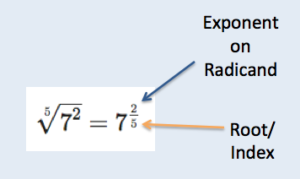
Multiplying and Dividing Square Roots
Square roots follow two handy properties that make them easier to work with:
- Multiplication:
- Example:
- Division:
- Example:
You can also combine like terms that have the same expression under the square root, just like combining like terms in algebra. For instance:
First simplify : since , you get . Now both terms match:
When a square root is raised to a power, multiply it out step by step:
(The first two 's multiply to give 2, and the third stays as .)
Square Roots in Real-World Applications
Finding a side length from an area: If a square has an area of 36 sq cm, each side is cm. If the area were 50 sq cm, the side length would be cm.
The Pythagorean theorem: In a right triangle, the relationship between the two legs ( and ) and the hypotenuse () is:
To find the hypotenuse when the legs are 3 and 4:
- Square each leg: and
- Add them:
- Take the square root:

Perfect Squares vs. Non-Perfect Squares
The first ten perfect squares are worth memorizing:
These have rational square roots (whole numbers, which can be written as a fraction like ).
Numbers that aren't perfect squares, such as 2, 3, 5, 7, and 10, have irrational square roots. Their decimal forms go on forever without repeating. For example, with no pattern. These non-terminating, non-repeating square roots are sometimes called surds.
Real Numbers and Square Roots
All the numbers you've been working with fall under the umbrella of real numbers, which include two categories:
- Rational numbers can be written as a fraction of two integers. This includes whole numbers, fractions, and decimals that terminate or repeat (like 0.75 or 0.333...).
- Irrational numbers cannot be written as a fraction of two integers. Square roots of non-perfect squares (like , ) fall here, along with numbers like .
Every square root you encounter is a real number. The distinction is just whether it comes out rational or irrational.
See Fiveable more often in Google
Mark Fiveable as a preferred source and Google is more likely to show you our guides in Top Stories, with a "preferred" badge in AI Mode and AI Overviews.