11.4 Understand Slope of a Line

➕Pre-Algebra Unit 11 Review
11.4 Understand Slope of a Line
Understanding Slope
Slope tells you two things about a line: how steep it is and which direction it goes. You'll use it constantly once you start working with linear equations, so getting comfortable with it now pays off.
Calculating Slope
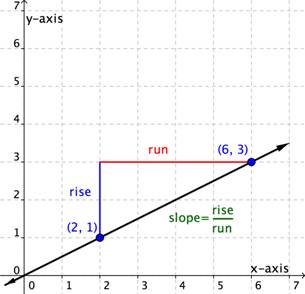
Slope is represented by in the slope-intercept form . It measures the steepness and direction of a line by comparing how much the line goes up or down (the rise) to how much it goes left or right (the run).
The formula is:
- Rise (the numerator) is the vertical change between two points, found by subtracting their -coordinates.
- Run (the denominator) is the horizontal change between the same two points, found by subtracting their -coordinates.
Example: Find the slope of the line through and .
The slope is , meaning the line rises 2 units for every 1 unit it moves to the right.
On a graph, you can also find slope by counting grid squares between two points where the line crosses exact grid intersections. Count the units up or down (rise), then count the units left or right (run), and write the ratio .
A few things to remember about direction:
- Positive slope: the line slants upward from left to right.
- Negative slope: the line slants downward from left to right.
- The steeper the line, the larger the absolute value of the slope.

Slope of Horizontal and Vertical Lines
Horizontal lines have a slope of . Every point on the line has the same -coordinate, so the rise is always . Their equation looks like , where is the -value of every point on the line.
Vertical lines have an undefined slope. Every point has the same -coordinate, so the run is always , and dividing by zero is undefined. Their equation looks like , where is the -value of every point on the line.
A common mistake: students sometimes say vertical lines have a slope of "zero." Zero slope is a horizontal line. Vertical lines have no slope (undefined).
Graphing with a Point and Slope
If you're given a point and a slope, you can graph the line without needing a second point ahead of time.
-
Plot the given point on the coordinate plane.
-
Use the slope to find your next point:
- If the slope is a fraction like , move up 3 units (rise) and right 4 units (run) from your starting point.
- If the slope is negative, like , move down 2 units and right 5 units.
- If the slope is a whole number like , think of it as : move up 3 and right 1.
-
Plot that new point.
-
Connect the points with a straight line using a ruler, and extend it in both directions with arrows to show the line continues infinitely.
You can repeat step 2 to plot a third point as a check. If all three points don't line up, go back and recount your rise and run.
Relationships Between Lines
- Parallel lines have the same slope. They never intersect because they rise and run at the same rate.
- Perpendicular lines have slopes that are negative reciprocals of each other. For example, if one line has a slope of , a line perpendicular to it has a slope of . When you multiply negative reciprocals together, you always get .
- Direct variation is a special case where the line passes through the origin . The equation simplifies to (no term), meaning is directly proportional to .
See Fiveable more often in Google
Mark Fiveable as a preferred source and Google is more likely to show you our guides in Top Stories, with a "preferred" badge in AI Mode and AI Overviews.