4.1 Interactions Within and Across Cultures in Later European and American Art

🖼AP Art History Unit 4 Review
4.1 Interactions Within and Across Cultures in Later European and American Art
🖼 AP Art History
TLDR
In AP Art History, Topic 4.1 is about how cultural practices, belief systems, settings, and contact between cultures shaped art in Europe and the Americas from about 1750 to 1980. This was a time of fast change driven by the Enlightenment, industrialization, revolutions, war, and colonialism, which pushed artists into new roles and produced a flood of movements often grouped under modernism. Knowing why these styles emerged helps you explain how context shapes art, not just memorize names.
What Cultural Interactions Shaped Later European and American Art?
Later European and American art was shaped by Enlightenment ideas, Romantic critiques, industrialization, urbanization, migration, war, social movements, colonialism, and artists' exposure to diverse cultures. These forces helped produce revival styles, modernist movements, avant-garde roles for artists, and new ways of thinking about progress, identity, and power.
On the AP Art History exam, connect the interaction or context to evidence in a work. Name the force, then explain how it affects subject, style, material, or meaning.
Topic 4.1 covers how cultural practices, belief systems, and contact between cultures shaped European and American art from about 1750 to 1980. Free-response question 5 gives you a work from outside the required image set, and you link its features, purpose, or function to a required work.
What Reshaped European and American Art After 1750
- From the mid-1700s to 1980 CE, Europe and the Americas changed quickly because of industrialization, urbanization, economic upheaval, migration, and war, plus women's and civil rights movements.
- The Enlightenment promoted scientific inquiry and human rights; Romanticism then pushed back against Enlightenment thinking and industrialization.
- Artists took on new roles, and styles multiplied into movements often grouped under modernism, including neoclassicism, romanticism, realism, impressionism, post-impressionism, symbolism, expressionism, cubism, constructivism, abstraction, surrealism, abstract expressionism, pop art, performance art, and earth and environmental art.
- The ideas of Marx, Darwin, Freud, and Einstein, and later postmodern theory, reshaped how artists and scholars thought about art.
- Architecture cycled through revival styles, including classical, Gothic, Renaissance, and Baroque.
- Colonialism exposed artists to diverse cultures, and that exposure influenced how they made art.
How Cultural Context Shaped Art in This Period
The big idea here is that art does not appear in a vacuum. Across this period, artists responded to dramatic events and new ideas, and the contact between cultures changed what art looked like.
Events and Ideas That Drove Change
- Industrialization and urbanization transformed daily life, work, and cities. Artists captured modern subjects like railroads and crowds. Monet's The Saint-Lazare Station (1877) shows a train station as a subject worth painting.
- The Enlightenment valued reason, science, and human rights. Scientific investigation encouraged careful observation and empirical evidence as ways to uncover and understand the physical world. Wright of Derby's A Philosopher Giving a Lecture on the Orrery (c. 1763-1765) reflects fascination with scientific inquiry.
- Revolutions and political upheaval gave artists charged subjects. Faith in knowledge and progress helped bring about revolutions and a new focus on human rights, and nations and their governments were reconstituted along the way. Delacroix's Liberty Leading the People (1830) responds to political change in France.
- Romanticism reacted against Enlightenment reason and industrial life, often emphasizing emotion and the individual.
- The avant-garde describes varied artists who shared a commitment to innovation, even when their styles looked very different.
- New ideas from Marx, Darwin, Freud, and Einstein, and later postmodern theory, shifted worldviews and shaped how artists and scholars interpreted art.
Cross-Cultural Influence and Colonialism
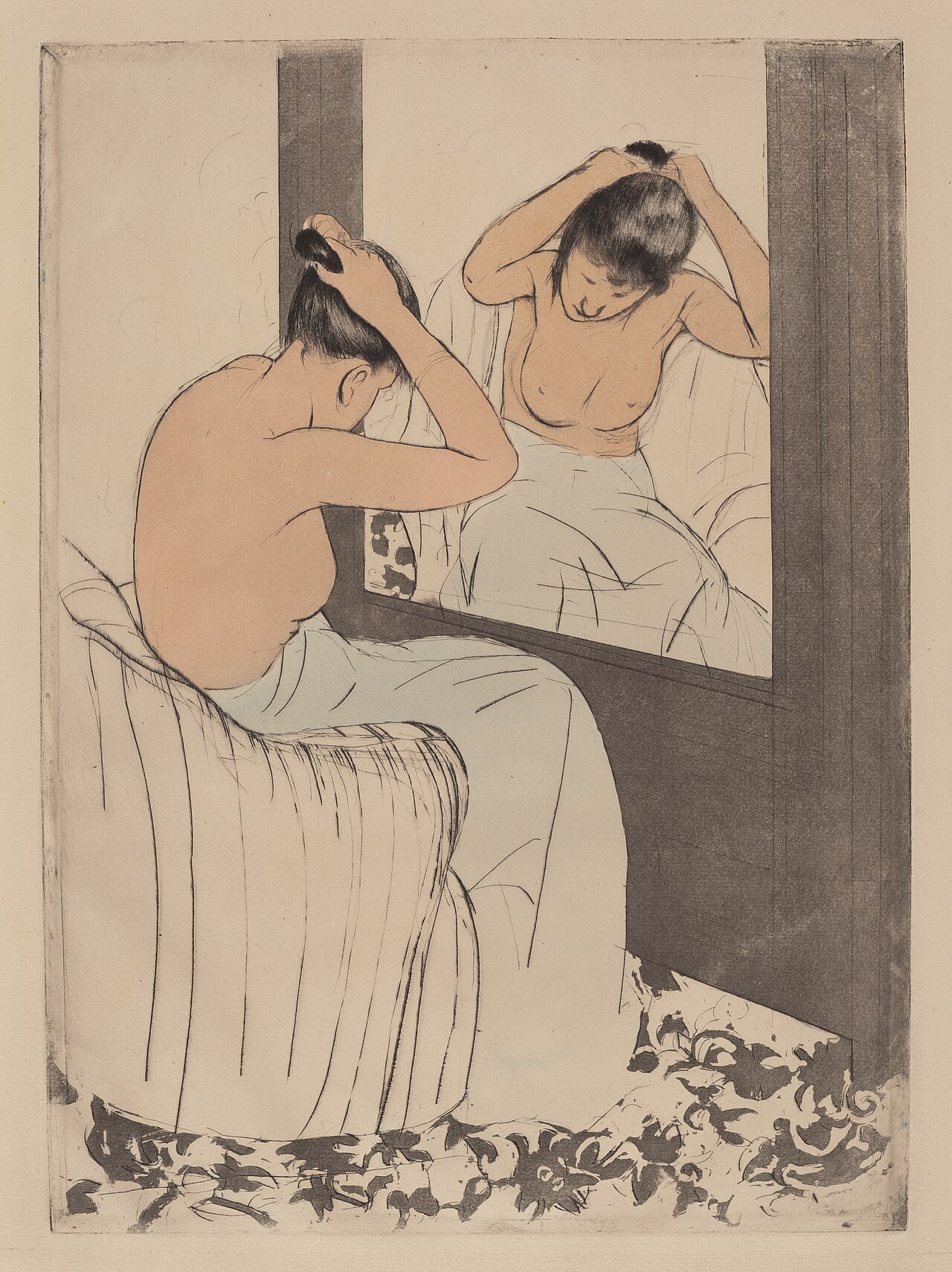
Colonialism brought European and American artists into contact with art from other parts of the world, and that exposure changed their work. A few useful examples from the required works:
- Mary Cassatt's The Coiffure (1890-1891), made with drypoint and aquatint, reflects the influence of Japanese prints on composition and line.
- Picasso's Les Demoiselles d'Avignon (1907) shows the impact of non-Western objects that circulated in European collections during the colonial era.
- Wifredo Lam's The Jungle (1943) draws on Afro-Cuban heritage and diaspora, blending modernist style with the artist's own background.
Frame these as examples of how contact between cultures shaped art. The exam wants you to explain the connection, not just name the influence.
Revival Styles in Architecture
Architecture in this period revisited earlier styles. The Palace of Westminster (Houses of Parliament) in London (1840-1870) by Charles Barry and Augustus W. N. Pugin is a Gothic Revival building. Jefferson's Monticello in Virginia (1768-1809) draws on classical and Palladian ideas. These revivals show artists and architects looking back to older traditions while building for their own time.
Using Context to Explain and Connect Works
Contextual Analysis: When a question asks how context shaped a work, name the specific force and connect it to what you see. For example, link Monet's train station to industrialization and urban modernity, or link Delacroix's painting to revolution. Avoid generic claims and use one clear cause with evidence from the work.
Comparison: Be ready to explain similarities and differences in how two works convey meaning. You can compare how different movements respond to the same pressures, like how realism and romanticism both react to modern life but in different ways.
Attribution (Free-Response Question 5): For the unknown-work question, identify a required work that shares features, purpose, or function with the unfamiliar piece. Describe specific traits that match, such as style, subject, or how cross-cultural influence shows up. Connecting an unknown work to something like The Coiffure or Les Demoiselles d'Avignon through shared influence is exactly the kind of move this question rewards.
Common Trap: Do not just list movement names. The exam wants you to explain why a style emerged and how context or cross-cultural contact shaped it. A short, specific reason beats a long list of terms.
Common Misconceptions
- Misconception: Modernism is one single style.Actually: Modernism is a broad heading that covers many movements, from realism to cubism to pop art. They share a drive toward innovation but look very different.
- Misconception: The Enlightenment and Romanticism are the same mood.Actually: The Enlightenment emphasized reason, science, and progress. Romanticism pushed back against those ideas and against industrialization, often focusing on emotion and the individual.
- Misconception: Cross-cultural influence means artists fully understood the cultures they borrowed from.Actually: Much of this contact came through colonialism and collecting, so European and American artists often adapted objects and images without full context. Describe the influence accurately rather than assuming deep understanding.
- Misconception: Revival architecture is just copying the past.Actually: Revival styles reinterpret earlier traditions, like Gothic or classical, for new buildings and new purposes, such as a modern seat of government.
- Misconception: You only need to memorize titles and dates.Actually: Identification matters, but the exam rewards explaining how context and cultural interaction shaped each work.
Related AP Art History Guides
Practice Questions for 4.1
1 of 10
A landscape uses thick visible brushstrokes, broken vibrant color, and depicts a railway station. Identify two technical or compositional features it shares with Monet's The Saint-Lazare Station that support an Impressionist attribution.
A.
Smooth polished brushwork with idealized forms and classical composition
B.
Dramatic chiaroscuro emphasizing deep shadows and theatrical lighting effects
C.
Hard-edged contours and sculptural modeling of solid forms
D.
Visible broken brushstrokes capturing fleeting light and an industrial subject
Vocabulary
The following words are mentioned explicitly in the AP® course framework for this topic.Term | Definition |
|---|---|
abstract expressionism | An artistic movement combining abstraction with expressive, gestural brushwork and emphasis on the artist's emotional and physical process. |
abstraction | An artistic approach that simplifies or stylizes forms rather than representing them realistically, found throughout prehistoric art history. |
artistic movements | Organized groups of artists and styles united by common philosophies, techniques, or goals during a particular historical period. |
avant-garde | Artists and artistic practices that push boundaries and pioneer new styles and approaches ahead of mainstream acceptance. |
Baroque revival | An architectural and artistic style that revived the dramatic, ornate, and emotionally expressive characteristics of Baroque art and architecture. |
belief systems | Organized sets of religious, spiritual, or philosophical ideas that guide how a culture understands the world and conducts itself. |
classical revival | An architectural and artistic style that revived elements and principles from ancient Greek and Roman art and architecture. |
colonialism | The historical practice of establishing political and economic control over other territories and peoples, whose waning through independence movements has influenced global art production and representation. |
constructivism | An artistic movement that emphasized geometric forms, industrial materials, and social and political engagement. |
cubism | An artistic movement that fragmented and reassembled subjects from multiple viewpoints, challenging traditional perspective. |
cultural practices | The customs, rituals, and traditional activities of a society that are reflected in and inform artistic and architectural creation. |
earth and environmental art | An artistic practice that uses natural materials and landscapes as the medium, often addressing environmental concerns. |
Enlightenment | An intellectual movement emphasizing scientific inquiry, empirical evidence, and human rights that shaped artistic and cultural values from the mid-1700s onward. |
expressionism | An artistic movement that prioritized emotional experience and subjective interpretation over realistic representation. |
Gothic revival | An architectural and artistic style that revived medieval Gothic elements, characterized by pointed arches, ornate details, and vertical emphasis. |
impressionism | An artistic movement focused on capturing light, color, and momentary impressions through loose brushwork and contemporary subjects. |
industrialization | The development of industries and manufacturing on a large scale, which transformed society and inspired artistic responses. |
modernism | A broad artistic and cultural movement emphasizing innovation, experimentation, and rejection of traditional forms and values. |
neoclassicism | An artistic style that drew inspiration from classical Greek and Roman art, emphasizing order, harmony, and idealized forms. |
performance art | An artistic practice in which the artist's actions, presence, and body become the primary medium of artistic expression. |
physical setting | The geographic location, environment, and landscape that influences the creation and function of art. |
pop art | An artistic movement that incorporated imagery from popular culture, mass media, and consumer goods into fine art. |
post-impressionism | An artistic movement that built upon impressionism while emphasizing form, structure, and symbolic content. |
postmodern theory | A philosophical approach that questions grand narratives, embraces plurality and irony, and challenges modernist assumptions in art and culture. |
realism | An artistic movement that sought to depict subjects and scenes from everyday life with accuracy and without idealization. |
Renaissance revival | An architectural and artistic style that revived the principles and aesthetics of the Renaissance period, emphasizing humanism and classical proportions. |
revival styles | Architectural and artistic movements that deliberately revived and reinterpreted historical styles from previous periods, such as classical, Gothic, Renaissance, and Baroque forms. |
Romanticism | An artistic and philosophical movement that critiqued Enlightenment rationalism and industrialization, emphasizing emotion, nature, and individual experience. |
surrealism | An artistic movement that explored the unconscious mind, dreams, and irrational imagery influenced by Freudian psychology. |
symbolism | An artistic movement that used symbols and metaphorical imagery to express ideas, emotions, and spiritual concepts. |
urbanization | The growth and development of cities and urban areas, creating new subjects and contexts for artistic practice. |
See Fiveable more often in Google
Mark Fiveable as a preferred source and Google is more likely to show you our guides in Top Stories, with a "preferred" badge in AI Mode and AI Overviews.