4.1 Biodiversity: Genetic, Species, and Ecosystem Diversity

🌿Intro to Environmental Science Unit 4 Review
4.1 Biodiversity: Genetic, Species, and Ecosystem Diversity
🌿 Intro to Environmental Science
Biodiversity is the variety of life on Earth, encompassing genetic, species, and ecosystem diversity. These interconnected levels form the foundation of life, supporting adaptation, ecosystem stability, and vital services for all living things.
Measuring biodiversity involves quantifying species richness, evenness, and diversity across scales. Key species and ecosystems play crucial roles in maintaining biodiversity, from keystone species shaping entire habitats to biomes representing large-scale ecological zones.
Types of Biodiversity

Top images from around the web for Defining Biodiversity and Its Components
ESS Topic 3.1: Introduction to Biodiversity - AMAZING WORLD OF SCIENCE WITH MR. GREEN View original
Is this image relevant?
Taxonomy | Biology for Non-Majors I View original
Is this image relevant?
ESS Topic 3.1: Introduction to Biodiversity - AMAZING WORLD OF SCIENCE WITH MR. GREEN View original
Is this image relevant?
ESS Topic 3.1: Introduction to Biodiversity - AMAZING WORLD OF SCIENCE WITH MR. GREEN View original
Is this image relevant?
Taxonomy | Biology for Non-Majors I View original
Is this image relevant?
Defining Biodiversity and Its Components
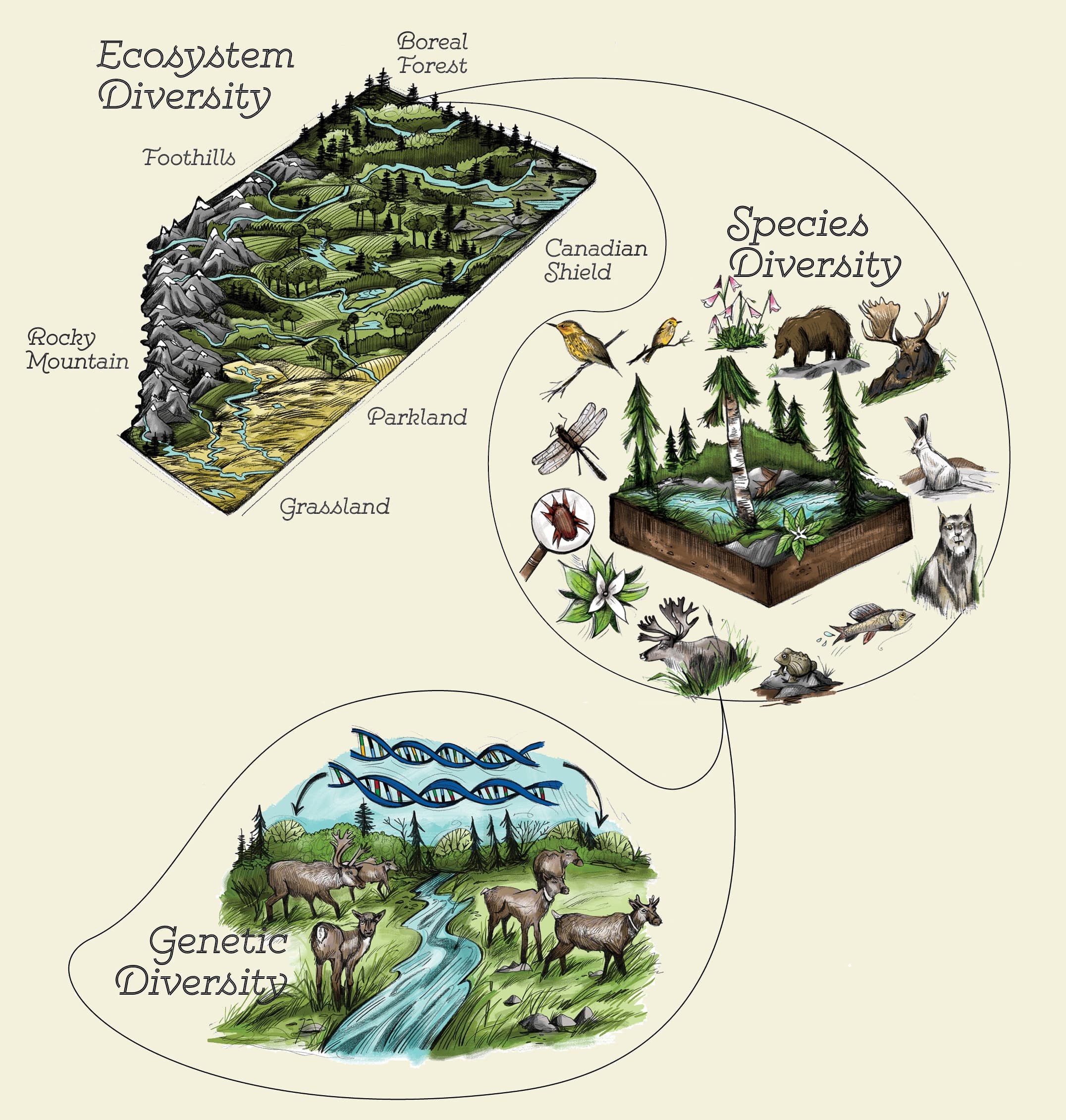
Biodiversity encompasses the variety of life on Earth at all levels of organization. Scientists break it into three main types:
Genetic diversity is the variation in genes within a species or population. This includes different alleles, gene combinations, and heritable traits. A good example: the sickle cell trait in humans. In regions where malaria is common, carrying one copy of the sickle cell allele actually provides resistance to the disease. That kind of variation within a species is genetic diversity at work, and it's what gives populations the raw material to adapt over time.
Species diversity refers to the number and relative abundance of different species in an ecosystem. You measure it by counting distinct species and looking at how their populations compare to one another. Some ecosystems are packed with species diversity (coral reefs and tropical rainforests are the classic examples), while others, like arctic tundra, have far fewer species.
Ecosystem diversity describes the variety of habitats, communities, and ecological processes across a landscape. Think of how different a mangrove swamp is from an alpine meadow or a deep-sea hydrothermal vent. Each of these ecosystems (marine, terrestrial, freshwater) supports its own web of interactions between species and their physical environment.
Importance and Interconnections of Biodiversity Types
Each type of biodiversity supports the others, and together they create a resilient web of life.
- Genetic diversity supports species adaptation to changing environments. It enables evolution through natural selection and increases resistance to diseases and environmental stressors. A population with low genetic diversity is more vulnerable because if one individual can't survive a new threat, chances are none of them can.
- Species diversity contributes to ecosystem stability and function. Different species perform different roles: pollination, seed dispersal, nutrient cycling, decomposition. The more species filling these roles, the more resilient the ecosystem is when disturbances hit.
- Ecosystem diversity provides a range of ecosystem services, including climate regulation, water purification, and soil formation. Diverse landscapes offer varied habitats where different species can thrive.
These levels are deeply connected. Genetic diversity influences species diversity through speciation (when populations diverge genetically enough to become separate species). Species diversity in turn shapes ecosystem diversity by determining community structures and the ecological processes that occur within them.

Measuring Species Diversity
Quantifying Species Richness and Evenness
Two core components go into measuring species diversity: richness and evenness.
Species richness is simply the total number of different species in a given area. If you count 12 bird species in one park and 30 in another, the second park has higher species richness. Richness can be determined through field surveys, sampling techniques, or DNA analysis (environmental DNA, or eDNA, is increasingly used to detect species from water or soil samples).
Species evenness assesses how balanced the population sizes are across species. Imagine two forests, each with 5 tree species and 100 total trees. In Forest A, each species has about 20 trees. In Forest B, one species has 96 trees and the other four have 1 each. Both have the same richness, but Forest A has much higher evenness. Evenness matters because a community dominated by a single species is functionally less diverse.
Alpha diversity combines richness and evenness at a local scale to represent the species diversity within a specific habitat or ecosystem. It's the measure you'd use to compare biodiversity between two different sites.

Analyzing Diversity Across Scales
Ecologists also measure diversity at broader scales:
- Beta diversity measures the difference in species composition between ecosystems. It quantifies how much species turnover occurs as you move from one habitat to another along an environmental gradient (like moving from a valley floor up a mountainside). Higher beta diversity means the two sites share fewer species.
- Gamma diversity encompasses the total species diversity of a large geographic area. It combines the alpha diversity of individual ecosystems with the beta diversity between them, giving a regional or landscape-level picture.
Diversity indices integrate richness and evenness into a single numerical value, making comparisons easier:
- The Shannon-Wiener Index (, where is the proportion of each species) accounts for both richness and evenness. Higher values mean greater diversity.
- Simpson's Index () emphasizes dominance. It tells you the probability that two randomly selected individuals belong to different species.
You don't need to memorize the formulas for an intro course, but understanding what each index emphasizes (evenness vs. dominance) will help you interpret results.
Important Species and Ecosystems
Key Species in Ecosystem Functioning
Not all species contribute equally to how an ecosystem operates. Three categories are especially worth knowing:
Keystone species exert a disproportionately large influence on their ecosystem relative to their abundance. Sea otters in Pacific kelp forests are the textbook example: otters eat sea urchins, which graze on kelp. Remove the otters, and urchin populations explode, devouring the kelp forests and collapsing the entire habitat. The key idea is that losing a keystone species triggers cascading effects far beyond what you'd expect.
Endemic species are found naturally in one specific geographic location and nowhere else. The Galápagos giant tortoises, for instance, evolved in isolation on the Galápagos Islands and exist only there. Because their range is so limited, endemic species are often especially vulnerable to habitat loss or invasive species.
Indicator species reflect the health and condition of an ecosystem because they're sensitive to environmental changes. Lichens are a classic example: they absorb nutrients and pollutants directly from the air, so their presence (or absence) signals air quality. Amphibians serve a similar role in freshwater systems because their permeable skin makes them highly sensitive to water contamination.
Understanding Biomes and Ecosystem Diversity
Biomes are large-scale ecological zones defined by distinct climate patterns and dominant vegetation types. Terrestrial biomes include tropical rainforests, deserts, temperate grasslands, and tundra, among others. Aquatic biomes (freshwater and marine) are classified by factors like salinity, depth, and water flow.
Within any single biome, ecosystem diversity varies based on local factors. Differences in topography, soil types, and microclimates create a mosaic of habitats, each supporting different species assemblages. A single mountain within a temperate forest biome, for example, might contain distinct communities at different elevations.
Ecotones are transition zones where two biomes or ecosystems meet. The edge between a forest and a grassland is a common example. These zones often exhibit high biodiversity because species from both adjacent communities overlap there, and some species are specifically adapted to edge habitats.
See Fiveable more often in Google
Mark Fiveable as a preferred source and Google is more likely to show you our guides in Top Stories, with a "preferred" badge in AI Mode and AI Overviews.