11.3 Recycling and Waste Reduction Strategies

🌿Intro to Environmental Science Unit 11 Review
11.3 Recycling and Waste Reduction Strategies
🌿 Intro to Environmental Science
Recycling and waste reduction are core strategies for dealing with the growing waste problem. They help transform used materials into new products, cutting the demand for virgin resources and reducing how much ends up in landfills.
These strategies follow a clear priority system called the waste hierarchy, which ranks options from most to least preferred: prevent waste first, then reuse, then recycle, and only dispose as a last resort. Understanding this hierarchy is the backbone of this section.
Recycling Methods
Recycling Process and Facilities
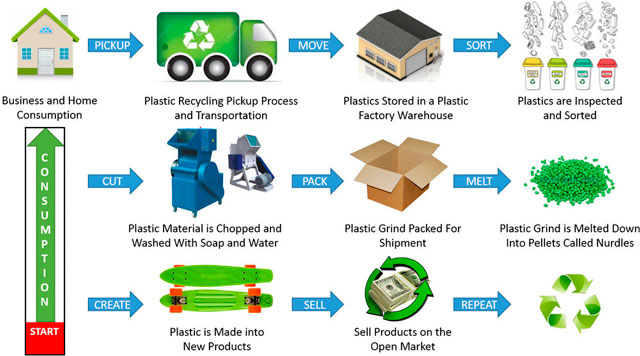
Recycling isn't just tossing something in a blue bin. It's a multi-step industrial process that turns used materials back into usable raw materials.
The steps look like this:
- Collection from homes, businesses, and drop-off sites
- Sorting at a materials recovery facility (MRF)
- Processing the sorted materials (cleaning, shredding, melting, etc.)
- Manufacturing new products from the processed material
A materials recovery facility (MRF) is the centralized plant where recyclables are received, sorted, and prepared for reprocessing. MRFs use conveyor belts, optical sorters, magnets, and manual labor to separate different material types (paper, glass, plastics, metals).
Most curbside programs today use single-stream recycling, where all recyclable materials go into one container. This is more convenient, so participation rates tend to be higher. The tradeoff: contamination rates also go up, because non-recyclable items or food-soiled materials get mixed in. Contamination can cause entire batches of recyclables to be sent to a landfill instead.
Innovative Recycling Approaches
Not all recycling produces the same quality of material. The distinction between upcycling and downcycling matters here.
- Upcycling transforms waste into something of higher quality or value. For example, reclaimed wood gets turned into furniture, or old electronic components become artisan jewelry. The end product is worth more than the original waste.
- Downcycling converts materials into products of lower quality. Plastic bottles become fleece clothing, or office paper gets recycled into lower-grade packaging material. The material is still being reused, but it can't cycle back to its original form.
Both approaches extend the lifecycle of materials and reduce demand for virgin resources. But upcycling is generally preferred because it preserves or increases value, while downcycled materials will eventually reach a point where they can't be recycled further.

Waste Reduction Strategies
Source Reduction and Reuse
The most effective way to deal with waste is to never create it in the first place. That's the idea behind source reduction: minimizing waste at the point of origin, before a product even reaches the consumer.
Source reduction strategies include:
- Using less packaging (think concentrated detergent vs. a full jug of diluted product)
- Designing products to last longer so they don't need frequent replacement
- Improving manufacturing efficiency to produce less scrap and waste
Reuse is the next best option. Instead of discarding an item after one use, you use it multiple times. Refillable water bottles, reusable shopping bags, and donating used clothing are all examples. Reuse conserves resources, reduces waste volume, and is often cheaper than buying single-use alternatives repeatedly.
Extended Producer Responsibility and the Waste Hierarchy
Extended producer responsibility (EPR) shifts the burden of dealing with a product's end-of-life from consumers and municipalities to the manufacturer. The logic is straightforward: if a company knows it'll be responsible for disposal costs, it has a financial incentive to design products that are easier to recycle, longer-lasting, or less toxic.
EPR shows up in practice through take-back programs. For instance, many electronics manufacturers now accept old devices for recycling rather than letting them end up in landfills where heavy metals can leach into soil and groundwater.
The waste hierarchy ranks all waste management options by environmental impact, from most to least preferred:
- Prevention — avoid creating waste entirely
- Minimization — reduce the amount or toxicity of waste produced
- Reuse — use products again for the same or different purpose
- Recycling — reprocess materials into new products
- Energy recovery — extract energy from waste (e.g., incineration or anaerobic digestion)
- Disposal — landfilling or other final disposal
The top of the hierarchy (prevention and minimization) is always preferred because it avoids environmental costs altogether. Energy recovery sits near the bottom because, while it captures some value, it still destroys the material and can release pollutants. Disposal is the last resort.
See Fiveable more often in Google
Mark Fiveable as a preferred source and Google is more likely to show you our guides in Top Stories, with a "preferred" badge in AI Mode and AI Overviews.