2.3 Scientific Notation and Significant Figures

⚗️Physical Science Unit 2 Review
2.3 Scientific Notation and Significant Figures
⚗️ Physical Science
continue practicing 2.3
Multiple choice
Scientific Notation and Standard Form
Scientific notation gives you a way to write extremely large or small numbers without all those zeros. It uses powers of 10 to compress numbers into a compact form, which makes calculations and comparisons much more manageable. Significant figures, on the other hand, tell you how precise a measurement actually is. Together, these two tools keep scientific work accurate and honest.
Understanding Scientific Notation
Scientific notation expresses any number as a value between 1 and 10 multiplied by a power of 10:
where and is an integer.
The coefficient () captures the meaningful digits, while the exponent () tells you the scale. A positive exponent means a large number; a negative exponent means a small one.
Why bother? Compare these two ways of writing the speed of light:
- Standard form: 299,792,458 m/s
- Scientific notation: m/s
Or the gravitational constant:
- Standard form: 0.0000000000667 N·m²/kg²
- Scientific notation: N·m²/kg²
The scientific notation versions are easier to read, compare, and plug into calculations.
Converting Between Standard Form and Scientific Notation
Standard form to scientific notation:
- Place the decimal point so the number is between 1 and 10.
- Count how many places you moved the decimal.
- That count becomes your exponent. Moved left → positive exponent. Moved right → negative exponent.
Example: Convert 45,000,000 to scientific notation. Move the decimal 7 places to the left →
Scientific notation to standard form:
- Look at the exponent.
- Positive exponent → move the decimal that many places to the right.
- Negative exponent → move the decimal that many places to the left.
- Fill in zeros as needed.
Example: Convert to standard form. Move the decimal 4 places to the left → 0.00032

Working with Exponents in Scientific Notation
When you calculate with numbers in scientific notation, the exponent rules do the heavy lifting.
Multiplication: Multiply the coefficients, then add the exponents.
Notice that isn't proper scientific notation (the coefficient must be between 1 and 10), so you adjust it to .
Division: Divide the coefficients, then subtract the exponents.
Addition and Subtraction: You must convert both numbers to the same exponent first, then add or subtract the coefficients.
Rewrite as , then add:
Significant Figures and Precision
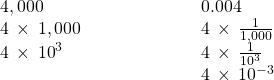
Understanding Significant Figures
Significant figures (sig figs) are the digits in a measurement that actually carry meaning about its precision. More sig figs means a more precise measurement.
Rules for counting significant figures:
- All non-zero digits are significant.
- Zeros between non-zero digits are significant (e.g., 1002 has 4 sig figs).
- Leading zeros are never significant. They're just placeholders (e.g., 0.00456 has 3 sig figs).
- Trailing zeros after a decimal point are significant because they show precision (e.g., 1.200 has 4 sig figs).
- Trailing zeros in a whole number with no decimal point are ambiguous. The number 1200 is typically read as having 2 sig figs. Writing it as makes it clear there are 4.
| Number | Significant Figures | Why |
|---|---|---|
| 1234 | 4 | All non-zero digits count |
| 1200 | 2 | Trailing zeros, no decimal point |
| 0.00456 | 3 | Leading zeros don't count |
| 1.200 | 4 | Trailing zeros after decimal count |
| 1020 | 3 | Zero between non-zero digits counts; trailing zero does not |
Rounding and Significant Figures
After a calculation, you'll often need to round your answer so it reflects the right level of precision.
How to round:
- Decide how many significant figures you need.
- Look at the digit just after your last significant figure.
- If that digit is 5 or greater, round up. If it's less than 5, round down.
Example: 3.14159 rounded to 3 significant figures → 3.14
Rounding rules for calculations:
- Addition/Subtraction: Your answer should have the same number of decimal places as the measurement with the fewest decimal places.
- → round to one decimal place → 46.9
- Multiplication/Division: Your answer should have the same number of significant figures as the measurement with the fewest sig figs.
- → 2.4 has 2 sig figs, so round to 2 sig figs → 7.6
The distinction between these two rules trips people up. For adding and subtracting, think about decimal places. For multiplying and dividing, think about sig figs.
Precision in Measurements and Calculations
Precision refers to how close repeated measurements are to each other. It depends on the tool you're using and how carefully you use it.
Different instruments give different levels of precision:
- A standard ruler (1 mm markings) might give you 10.2 cm
- A caliper (0.01 mm markings) might give you 10.23 cm
The caliper reading has more significant figures because the instrument is more precise.
Why this matters for calculations: Your result can never be more precise than your least precise measurement. Reporting extra digits creates false precision, which suggests your answer is more accurate than it really is.
Example: You measure a rectangle as 2.3 cm long and 1.45 cm wide. The area calculation gives cm². But 2.3 has only 2 sig figs, so you round the area to 3.3 cm². Reporting 3.335 cm² would imply a level of precision your length measurement doesn't support.
See Fiveable more often in Google
Mark Fiveable as a preferred source and Google is more likely to show you our guides in Top Stories, with a "preferred" badge in AI Mode and AI Overviews.