11.2 Convergence culture and the blurring of media boundaries

📺Film and Media Theory Unit 11 Review
11.2 Convergence culture and the blurring of media boundaries
📺 Film and Media Theory
Convergence Culture and its Implications
Henry Jenkins coined the term convergence culture to describe how content now flows across multiple media platforms, and how audiences actively participate in that flow. Understanding convergence is central to grasping how storytelling, business models, and audience behavior have all shifted in the digital media landscape.

Top images from around the web for The Flow of Content Across Multiple Media Platforms
"Why K-Pop Will Continue to Dominate Social Media: Jenkins' Convergence Culture in Action" by ... View original
Is this image relevant?
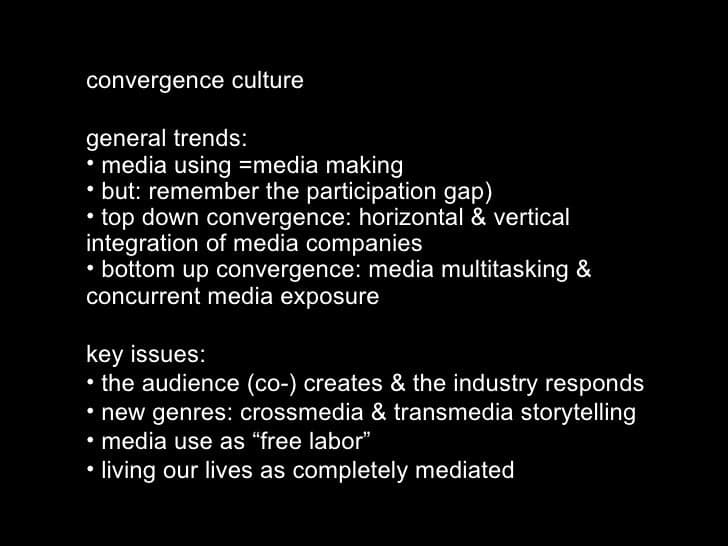
Convergence Culture View original
Is this image relevant?
"Why K-Pop Will Continue to Dominate Social Media: Jenkins' Convergence Culture in Action" by ... View original
Is this image relevant?
Convergence Culture View original
Is this image relevant?
The Flow of Content Across Multiple Media Platforms
Convergence culture describes a world where every important story gets told, every brand gets sold, and every consumer gets courted across television, film, music, video games, and the web. Content doesn't stay locked in one medium anymore.
- A movie franchise like Harry Potter doesn't just live in theaters. It extends into video games, theme parks, a dedicated fan wiki, merchandise, and a stage play, each entry expanding the story world for different audiences.
- This cross-platform flow isn't accidental. Media companies design it deliberately to maximize engagement and revenue across channels.
The Blurring of Media Boundaries and Transmedia Storytelling
As content gets shared and repurposed across platforms, the lines between distinct media forms dissolve. A television show might have a companion web series or mobile app that delivers additional storylines and interactivity. A podcast might spin off into a Netflix series, which then generates a social media fandom producing its own content.
Transmedia storytelling takes this further: a single narrative is told across multiple media forms, and each platform contributes something unique that the others don't.
- The Marvel Cinematic Universe is the go-to example. Films, Disney+ series like WandaVision, comic books, and tie-in games each add distinct narrative threads. You can enjoy one film on its own, but the full story world only emerges when you engage across platforms.
- The key distinction: transmedia storytelling isn't just repurposing the same content everywhere. Each medium does what it does best while contributing to a larger whole.
Implications for Media Companies and Creative Expression
- Media companies have had to rethink their business models. Cross-platform content strategies and partnerships across industries (film studios working with game developers, for instance) are now standard practice.
- Audiences are no longer passive receivers. Fan communities generate content, provide feedback, and shape how stories evolve. This is valuable for engagement but also requires careful management, especially around moderation and brand consistency.
- Convergence enables genuinely new forms of creative expression. Interactive documentaries that combine video, text, and data visualizations (like those produced by the New York Times or the National Film Board of Canada) simply weren't possible before media forms could be layered together digitally.
Interconnectedness of Media Forms
The Integration of Text, Audio, Video, and Interactive Elements
Digital technology makes it possible to blend text, audio, video, and interactive components into a single experience. This isn't just a technical novelty; it changes what storytelling can do.
- A news article on a major outlet might embed video interviews, audio clips, and interactive maps or data visualizations, all within the same page. The reader chooses how deeply to engage with each layer.
- Video games have absorbed techniques from film, music, and social platforms. The Red Dead Redemption series, for example, combines open-world gameplay with cinematic narrative, an original soundtrack, and online multiplayer, creating an experience that no single traditional medium could deliver alone.
Social Media as Hubs for Content Dissemination
Social media platforms function as central nodes where content from all other media converges. A film trailer debuts on YouTube, gets discussed on X (formerly Twitter), generates memes on TikTok, and drives traffic back to a streaming service.
- Platforms like X became primary sources for real-time news, with journalists, politicians, and public figures using them to break stories and interact with audiences directly.
- Streaming services have further blurred the line between television and film. Netflix, Amazon, and others produce original programming (like Stranger Things or The Bear) that competes with theatrical releases for cultural attention and critical recognition. The old distinction between "TV show" and "movie" matters less when both live on the same platform.
The Emergence of New Genres and Formats
When media forms interconnect, new genres emerge that don't fit neatly into old categories.
- Podcasts blend journalism, comedy, drama, and documentary into an audio format that didn't exist as a mainstream medium two decades ago. A show like Serial combined investigative journalism with serialized narrative in a way that felt genuinely new.
- Web series offer episodic storytelling with shorter runtimes and lower production costs than traditional TV. Early examples like Felicia Day's The Guild proved that dedicated audiences could be built entirely online, paving the way for the creator economy on YouTube and beyond.

Impact of Convergence on Audiences
Active Participation and User-Generated Content
Convergence doesn't just change how media is produced; it changes what audiences do with it. Viewers, readers, and players have become participants.
- Fanfiction communities on platforms like Archive of Our Own allow fans to write and share their own stories set in popular fictional universes. This isn't a fringe activity; AO3 hosts millions of works and won a Hugo Award in 2019.
- Live-tweeting during television broadcasts became a widespread practice, turning individual viewing into a collective, real-time conversation. Shows like Game of Thrones generated massive simultaneous online discussion that became part of the viewing experience itself.
- Social media gives audiences the power to make content go viral, effectively redistributing media attention in ways that studios and networks can't fully control.
Changes in Consumption Habits and Binge-Watching
On-demand access has fundamentally reshaped how people consume media. Audiences now expect to watch, listen, or read what they want, when they want.
- Streaming music services like Spotify replaced the album-purchase model with vast on-demand libraries, changing how listeners discover and engage with music.
- Binge-watching became a defining consumption pattern after Netflix began releasing entire seasons at once. Shows like Breaking Bad (which gained much of its audience through Netflix catch-up viewing) and House of Cards were early beneficiaries. This model changes how writers structure narratives, since they can assume viewers won't wait a week between episodes.
Audience Fragmentation and Tailored Media Consumption
With so much content available across so many platforms, audiences have splintered. People curate highly personalized media diets based on specific interests rather than relying on a handful of broadcast channels.
- This fragmentation challenges the old mass-media model, where a single show or publication could reach a huge, unified audience. Today, a "hit" show might have a fraction of the viewership that a moderately popular show drew in the 1990s.
- Advertisers and content creators have responded with targeted advertising and algorithmic recommendations, attempting to reach specific audience segments rather than broadcasting to everyone at once. The trade-off is that shared cultural experiences become rarer when everyone is watching something different.
Challenges and Opportunities of Blurred Boundaries
Adaptation and Competition for Traditional Media Companies
Traditional media companies face real pressure to adapt or lose relevance.
- Print newspapers have had to build digital presences and experiment with revenue models like paywalls, sponsored content, and newsletter subscriptions. Many haven't survived the transition.
- The sheer volume of content across platforms creates information overload. On YouTube alone, over 500 hours of video are uploaded every minute. Standing out and building a loyal audience in that environment is a significant challenge for individual creators and established companies alike.
Copyright and Intellectual Property Complexities
Convergence makes intellectual property law far more complicated. When content is easily shared, remixed, and repurposed across platforms, the boundaries of ownership get blurry.
- The rise of user-generated content and remix culture has intensified debates over fair use: when does a fan video or mashup cross the line from creative tribute to copyright infringement?
- Media companies handle this tension differently. Lucasfilm has historically encouraged Star Wars fan films and creations, seeing them as community-building. Other franchises have issued takedown notices aggressively. There's no settled consensus, and the legal landscape continues to evolve.
Opportunities for Creative Innovation and Immersive Experiences
The blurring of boundaries also opens up genuinely new creative territory.
- Virtual reality (VR) and augmented reality (AR) technologies enable immersive storytelling experiences that place the audience inside the narrative. Projects like the VR film Carne y Arena by Alejandro González Iñárritu show what's possible when filmmakers work beyond the traditional screen.
- Alternate reality games (ARGs) blend online puzzles, real-world events, and collaborative problem-solving. The ARG for The Dark Knight (2008) had players solving puzzles across websites, phone calls, and physical locations, deepening engagement with the film's world months before release.
- New monetization models have emerged alongside these creative forms: subscription streaming, shoppable content that integrates e-commerce directly into media experiences, and cross-platform advertising strategies that follow audiences wherever they go.
See Fiveable more often in Google
Mark Fiveable as a preferred source and Google is more likely to show you our guides in Top Stories, with a "preferred" badge in AI Mode and AI Overviews.