12.2 Cognitivism and Non-Cognitivism in Ethics

🥸Ethics Unit 12 Review
12.2 Cognitivism and Non-Cognitivism in Ethics
🥸 Ethics
Cognitivism vs Non-cognitivism

Top images from around the web for Truth-Aptness and Belief-Expression
Lifespan Theories: Moral Development | Introductory Psychology View original
Is this image relevant?
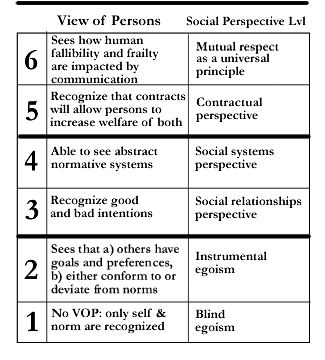
Lawrence Kohlberg's stages of moral development - Wikipedia View original
Is this image relevant?
Lifespan Theories: Moral Development | Introductory Psychology View original
Is this image relevant?
Lawrence Kohlberg's stages of moral development - Wikipedia View original
Is this image relevant?
Truth-Aptness and Belief-Expression
The core question here is simple: when you say something like "Lying is morally wrong," what kind of statement are you making?
Cognitivists say moral statements are truth-apt, meaning they express beliefs that can be true or false. "Lying is morally wrong" works just like "The Earth orbits the Sun." It's making a claim about reality, and that claim has a truth value.
Non-cognitivists deny that moral statements are truth-apt. Instead, they see moral statements as expressions of emotions, attitudes, or prescriptions. On this view, "Lying is morally wrong" is more like saying "Boo, lying!" or "Don't lie!" You're expressing disapproval or issuing a command, not stating a fact that could be verified.
Descriptivism vs Expressivism
This distinction maps onto a deeper divide about what moral language does:
- Cognitivist theories treat moral statements as descriptive claims about moral facts or truths that exist independently of what anyone thinks.
- Non-cognitivist theories treat moral statements as expressions of subjective mental states (emotions, attitudes) or as prescriptions/imperatives, not descriptions of objective facts.
Major cognitivist theories include:
- Moral naturalism: moral facts are a type of natural fact, discoverable through empirical investigation
- Moral non-naturalism: moral facts are real but sui generis (one of a kind), not reducible to natural properties
Major non-cognitivist theories include:
- Emotivism (Ayer, Stevenson): moral statements express emotions ("Stealing is wrong" ≈ "Stealing? Yuck!")
- Prescriptivism (Hare): moral statements function as universal imperatives ("Don't steal")
- Norm-expressivism (Gibbard): moral statements express acceptance of norms governing feelings and actions
Relationship to Moral Realism and Anti-Realism
Cognitivism and non-cognitivism tend to align with moral realism and anti-realism, respectively, but the mapping isn't perfect.
- Cognitivism + Realism: If moral statements describe objective moral reality, that presupposes such a reality exists. This is the most natural pairing.
- Non-cognitivism + Anti-realism: If moral statements merely express attitudes or norms rather than describing facts, there's no need to posit an objective moral reality.
But there are important exceptions:
- Some cognitivists are anti-realists. Subjectivists, for example, think moral statements express truth-apt beliefs, but those truths are mind-dependent ("Lying is wrong" means something like "I disapprove of lying," which can be true or false).
- Some non-cognitivists are quasi-realists. Expressivists like Blackburn argue we can "earn the right" to realist-sounding moral talk from within an expressivist framework. More on this below.
Strengths and Weaknesses of Ethical Theories
Intuitive Appeal and Common Sense
Cognitivism has a clear advantage in matching how people ordinarily talk about morality. We say things like "It's true that torture is wrong" or "You're mistaken about that." This language presupposes that moral claims have truth values.
Non-cognitivism struggles with this. If moral statements are just expressions of attitude, it's hard to explain why we naturally treat them as genuine assertions that can be correct or incorrect.
On the other hand, non-cognitivism captures something cognitivism can miss: morality feels deeply tied to emotions, attitudes, and action. When you judge something wrong, you don't just note a fact the way you'd note the temperature outside. You feel disapproval and are moved to act. Cognitivism's treatment of moral claims as purely descriptive can seem to leave out this motivational, emotional dimension.
Moral Knowledge and Moral Progress
If moral statements can be true or false, as cognitivism holds, then moral knowledge is straightforward: it's justified true moral belief, just like any other knowledge. Moral progress means discovering moral truths we didn't previously recognize (e.g., coming to understand that slavery is wrong).
Non-cognitivism has a harder time here. If moral statements aren't truth-apt, what does it even mean to "know" a moral claim or to say we've made moral "progress"? Quasi-realists have tried to reconstruct these concepts within an expressivist framework, but this remains a difficult and contested project.
Moral Disagreement and Moral Debate
This is where non-cognitivism has a genuine edge. If moral judgments express attitudes, then disagreement is just a clash of attitudes. People's sentiments naturally differ, even when they agree on all the empirical facts. That's not mysterious at all.
Cognitivism, by contrast, implies that in any moral disagreement, at least one side must be wrong. Given how persistent and widespread moral disagreement is, even among thoughtful, well-informed people, this can be hard to accept. Cognitivists respond that moral truths may simply be difficult to discover, and that bias, cultural conditioning, or limited perspective can explain why disagreement persists.
However, cognitivism has an easier time explaining why moral debate feels substantive. If we're trying to discover moral truth, then moral reasoning has a clear purpose: marshaling evidence and arguments to get closer to the right answer. Non-cognitivism must work harder to explain what moral reasoning is for if there's no truth to converge on. Sophisticated non-cognitivists like Gibbard have developed accounts of moral reasoning as a practical activity aimed at coordinating norms, but the challenge remains.

Cognitivism/Non-cognitivism and Moral Realism
Metaphysical and Epistemological Challenges for Realism
Moral realism faces two big questions that non-cognitivist anti-realism simply sidesteps:
- The metaphysical question: What are objective moral facts? How do they fit into a world described by the natural sciences? Moral facts don't seem to be physical objects or forces, so where do they exist?
- The epistemological question: How do we know moral facts? We can't observe them under a microscope or detect them with instruments. What cognitive faculty gives us access to moral reality?
Non-cognitivist anti-realism avoids both problems by denying that objective moral facts exist in the first place. There's nothing mysterious to explain.
Worth noting: cognitivist anti-realism (subjectivism, relativism) also avoids these challenges while still treating moral statements as truth-apt. The metaphysical and epistemological burdens fall specifically on realist versions of cognitivism.
Fitting Attitudes and Moral Motivation
Cognitivist realism offers a fairly clean account of moral motivation. If judging an action right means believing it has the objective property of rightness, it makes sense that this belief would tend to motivate you to perform it.
For non-cognitivists, the connection between moral judgment and motivation is less straightforward. If a moral judgment is just an attitude or prescription, why should it reliably motivate action without a supporting belief? Some non-cognitivists, like Stevenson, have argued that moral attitudes are inherently motivational in a way that ordinary descriptive beliefs are not, but this claim remains controversial.
Cognitivist anti-realists can also account for motivation: believing an action is right relative to your own standards or the norms you accept can motivate you accordingly.
Quasi-Realist Challenges to the Cognitivism/Realism Link
Quasi-realism is one of the most ambitious moves in this debate. Non-cognitivists like Blackburn and Gibbard argue that you can start from an expressivist foundation and still end up with everything that sounds like moral realism: moral truths, moral knowledge, moral progress.
The basic idea: the linguistic practices that expressivism explains naturally evolve to take on a realist character for good practical reasons. So an expressivist can say "There are moral truths" without contradicting their own theory. They just understand that claim differently than a cognitivist realist would.
If quasi-realism succeeds, it would undermine one of cognitivism's biggest selling points: its ability to make sense of realist moral talk. But whether quasi-realism fully delivers on this promise is still hotly debated.
Implications for Moral Discourse and Disagreement
The Nature of Moral Disagreement
- Cognitivism implies moral disagreements are disagreements in belief about objective facts. At least one party must be mistaken. This makes persistent disagreement somewhat puzzling: if there are moral facts, why can't we settle these questions?
- Non-cognitivism implies moral disagreements are clashes of attitude, more like differences in taste than differences in factual belief. This makes disagreement less mysterious, but it also risks making it seem shallow. If there's no fact of the matter, there may be no sense in which one side is "right."
The Function of Moral Discourse and Reasoning
On the cognitivist picture, moral discourse aims at discovering and communicating moral truths. Moral arguments work like arguments in any other domain: you present evidence and reasoning to show that certain claims are true or false, justified or unjustified.
Non-cognitivism makes the purpose of moral discourse less obvious. If we're not seeking moral truth, what are we doing when we argue about morality? Non-cognitivists have proposed that moral reasoning is a practical activity: we're trying to resolve disagreements in attitude, coordinate our feelings, and align our behavior. But there's a persistent worry that denying truth-apt moral beliefs undermines the substance of moral debate.
Accommodating Moral Phenomenology
Both views struggle to capture the full lived experience of moral thought:
- Cognitivism captures the objective purport of moral claims. When you say "Torture is wrong," it genuinely feels like you're stating a fact about the world, not just venting. But cognitivism has trouble explaining why moral judgments are so tightly bound up with emotion and motivation. Believing "torture is wrong" isn't like believing "water boils at 100°C." It carries emotional weight and a pull toward action.
- Non-cognitivism captures the practical and expressive dimensions of morality. It explains why moral judgments feel emotionally charged and action-guiding. But it struggles with the fact that moral language sounds descriptive and truth-oriented. We say "It's a fact that slavery is wrong," not "I hereby express disapproval of slavery."
Quasi-realism tries to bridge this gap by showing how expressivism can accommodate realist-sounding language. Whether it fully succeeds remains one of the central open questions in metaethics.
See Fiveable more often in Google
Mark Fiveable as a preferred source and Google is more likely to show you our guides in Top Stories, with a "preferred" badge in AI Mode and AI Overviews.