5.2 Compound Sentences: Coordination and Conjunctions

📏English Grammar and Usage Unit 5 Review
5.2 Compound Sentences: Coordination and Conjunctions
📏 English Grammar and Usage
Coordinating Conjunctions
A compound sentence joins two independent clauses (complete thoughts that could each stand alone as a sentence). The most common way to do this is with a coordinating conjunction and a comma. Understanding how these conjunctions work gives you precise control over how your ideas connect to each other.
Understanding Coordinating Conjunctions and Their Usage
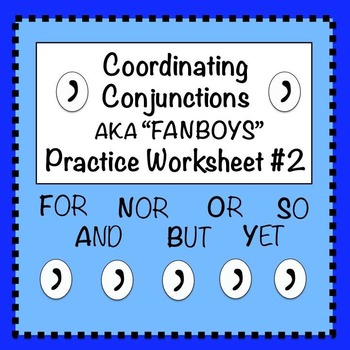
Coordinating conjunctions connect words, phrases, or clauses of equal grammatical importance. The mnemonic FANBOYS covers all seven:
- For introduces a reason: I brought an umbrella, for it might rain.
- And adds information: She likes coffee and tea.
- Nor connects two negative ideas: He doesn't like swimming, nor does he enjoy hiking. (Notice the inverted word order after "nor.")
- But introduces a contrast: The movie was long but entertaining.
- Or presents alternatives: Would you prefer pizza or pasta?
- Yet introduces something unexpected: The sun was shining, yet it was cold.
- So indicates a result: It was raining, so we stayed indoors.
Each conjunction signals a specific relationship between ideas. Choosing the right one makes your meaning clear. "But" and "yet" both show contrast, but "yet" carries a stronger sense of surprise.
Common Errors and Proper Usage
The most frequent mistake with compound sentences is the comma splice, where two independent clauses are joined by only a comma with no conjunction.
- Incorrect: The sun was setting, the temperature dropped quickly.
- Correct: The sun was setting, and the temperature dropped quickly.
When you join two independent clauses with a coordinating conjunction, place a comma before the conjunction:
- I enjoy reading books, and I often visit the library.
If you're only connecting two words or short phrases (not full independent clauses), skip the comma: I enjoy reading books and magazines.
Coordinating conjunctions can start a sentence for emphasis. But use this technique sparingly in formal writing.
Punctuation in Compound Sentences
Using Semicolons Effectively
A semicolon joins two closely related independent clauses without a conjunction. It signals that the two ideas are connected, but it lets the reader infer the exact relationship.
- With a conjunction: The movie was long, but it was entertaining.
- With a semicolon: The movie was long; it was entertaining.
Notice how the semicolon version feels different. Without "but," the contrast is implied rather than stated. This can be a stylish choice when the connection between clauses is obvious.
Semicolons also separate items in a list when those items already contain commas:
- The conference had attendees from Paris, France; London, England; and Rome, Italy.
Avoid stringing multiple semicolons together in the same paragraph. Overuse makes writing feel choppy.

Identifying and Correcting Comma Splices
A comma splice is two independent clauses joined by only a comma. It's one of the most common grammar errors, and it's worth knowing multiple ways to fix it.
Given this comma splice: I love coffee, I drink it every morning.
You have four options:
- Add a coordinating conjunction after the comma: I love coffee, and I drink it every morning.
- Replace the comma with a semicolon: I love coffee; I drink it every morning.
- Separate into two sentences: I love coffee. I drink it every morning.
- Restructure with a subordinating conjunction (this turns it into a complex sentence): Because I love coffee, I drink it every morning.
Each fix changes the rhythm and emphasis slightly. Pick the one that fits the tone of your writing.
Advanced Compound Sentences
Incorporating Conjunctive Adverbs
Conjunctive adverbs are transition words that connect independent clauses while showing a specific relationship between them. Common ones include however, therefore, moreover, nevertheless, consequently, and furthermore.
The punctuation pattern is consistent: semicolon before, comma after.
- The project was challenging; however, the team persevered.
One useful feature of conjunctive adverbs is that they can move within the second clause for variety:
- The project was challenging; the team, however, persevered.
- The project was challenging; the team persevered, however.
This flexibility makes them a great tool for varying your sentence rhythm. Just remember that the semicolon always goes between the two independent clauses, regardless of where the conjunctive adverb lands.
Constructing Compound-Complex Sentences
A compound-complex sentence contains at least two independent clauses and at least one dependent clause. These sentences let you express layered ideas and relationships.
Here's an example broken down:
- When I arrived home, I made dinner, and my roommate washed the dishes.
- Dependent clause: When I arrived home
- Independent clause 1: I made dinner
- Independent clause 2: my roommate washed the dishes
Compound-complex sentences are useful for showing cause-effect relationships or adding context. But they require careful punctuation to stay readable. If a compound-complex sentence starts feeling unwieldy, that's a sign to break it into shorter sentences.
The best writing mixes sentence types. A compound-complex sentence has more impact when it follows a few simple or compound sentences, rather than being stacked alongside other long structures.
See Fiveable more often in Google
Mark Fiveable as a preferred source and Google is more likely to show you our guides in Top Stories, with a "preferred" badge in AI Mode and AI Overviews.