10.1 End Punctuation and Commas

📏English Grammar and Usage Unit 10 Review
10.1 End Punctuation and Commas
📏 English Grammar and Usage
End Punctuation and Commas
End punctuation and commas are the foundation of sentence-level clarity. Periods, question marks, and exclamation points tell readers where thoughts end, while commas organize the parts within a sentence. Getting these right makes your writing easier to read and harder to misunderstand.

Top images from around the web for Types and Functions of End Punctuation
Punctuation | College Composition View original
Is this image relevant?
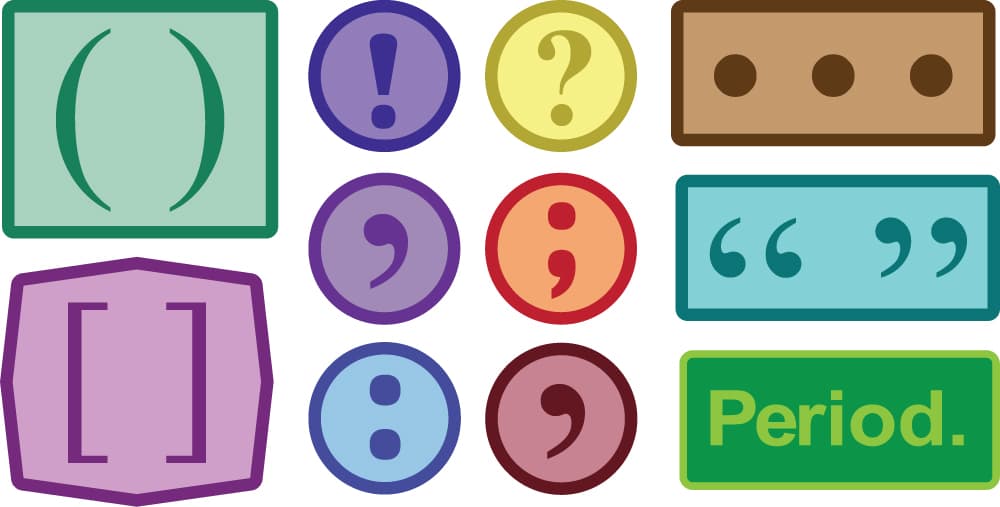
Introduction to Punctuation | English Composition I View original
Is this image relevant?
Ending Punctuation | Guide to Writing View original
Is this image relevant?
Punctuation | College Composition View original
Is this image relevant?
Introduction to Punctuation | English Composition I View original
Is this image relevant?
End Punctuation
Types and Functions of End Punctuation
Periods mark the end of declarative sentences (statements) and imperative sentences (commands). They signal that a thought is complete.
- The train arrives at noon. (declarative)
- Please close the door. (imperative)
- Periods also appear in abbreviations (Dr., Mr., etc.) and in ellipses (...) to show omitted text or trailing thoughts.
Question marks end interrogative sentences, which ask direct questions.
- What time does the movie start?
- An important distinction: direct questions get a question mark, but indirect questions do not. Compare these two:
- Direct: What time is it?
- Indirect: He asked what time it was. (This is a statement about a question, so it ends with a period.)
Exclamation points express strong emotion, emphasis, or urgency.
- Watch out for that car!
- Use these sparingly in formal writing. When everything is emphasized, nothing is.
Proper Usage and Common Mistakes
- Avoid stacking end punctuation marks together. Write Who said that? rather than Who said that?! In formal writing, choose one mark.
- In American English, periods and commas go inside quotation marks: "The cat is black," she said.
- Question marks and exclamation points go inside quotation marks only when they belong to the quoted material:
- She asked, "Are you coming?" (the question mark is part of the quote)
- Did he really say "I quit"? (the question mark belongs to the outer sentence, not the quote)

Comma Usage with Clauses and Phrases
Introductory Elements and Coordinating Conjunctions
When a sentence begins with an introductory word, phrase, or clause, place a comma after it to separate it from the main clause. This gives readers a moment to shift from the setup to the main point.
- After eating dinner, we went for a walk.
- Unfortunately, the store was already closed.
Coordinating conjunctions connect independent clauses. The mnemonic FANBOYS covers all seven: for, and, nor, but, or, yet, so. When a coordinating conjunction joins two independent clauses (each could stand alone as a sentence), place a comma before the conjunction.
- The sun was setting, and the birds were returning to their nests.
- If the conjunction joins two words or phrases rather than two full clauses, skip the comma: She grabbed her coat and walked out the door. ("walked out the door" has no subject, so it's not an independent clause.)
Dependent Clauses and Parenthetical Expressions
A dependent clause has a subject and verb but can't stand alone as a sentence. It usually starts with a subordinating conjunction like because, although, when, while, or if.
The comma rule depends on where the dependent clause falls:
- Before the independent clause → use a comma: While I was sleeping, the phone rang.
- After the independent clause → no comma needed: The phone rang while I was sleeping.
Parenthetical expressions are words, phrases, or clauses that interrupt a sentence to add extra information. They get commas on both sides because you could remove them without changing the sentence's core meaning.
- The concert, believe it or not, was completely sold out.
- My neighbor, who moved in last year, is a chef.

Appositives and Related Constructions
An appositive is a noun or noun phrase that renames or explains another noun right beside it. The comma rule hinges on whether the appositive is essential to identifying the noun.
- Non-essential appositive (extra info, could be removed): My sister, a talented musician, performed at the recital. You already know which sister because you only have one; the appositive just adds detail.
- Essential appositive (needed to identify the noun): The author John Steinbeck wrote "The Grapes of Wrath." Removing "John Steinbeck" would leave The author wrote..., which doesn't tell you which author. No commas.
Items in a series of three or more are separated by commas:
- She bought apples, oranges, and bananas.
- This applies to words, phrases, or clauses listed together.
Comma Errors and Conventions
Common Comma Mistakes and Their Corrections
Comma splices are one of the most frequent errors. A comma splice happens when two independent clauses are joined by only a comma, with no conjunction.
- Incorrect: The sun was setting, the temperature was dropping.
- Three ways to fix it:
- Add a coordinating conjunction: The sun was setting, and the temperature was dropping.
- Use a semicolon: The sun was setting; the temperature was dropping.
- Make two separate sentences: The sun was setting. The temperature was dropping.
Don't separate a subject from its verb with a comma, even when the subject is long.
- Incorrect: The long and winding road, led us to the mountain.
- Correct: The long and winding road led us to the mountain.
Don't put a comma between parts of a compound subject or compound predicate.
- Incorrect: The cat, and the dog chased each other.
- Correct: The cat and the dog chased each other.
Stylistic Choices and Regional Differences
The serial comma (also called the Oxford comma) is the comma placed before the final "and" or "or" in a list of three or more items.
- With serial comma: red, white, and blue
- Without serial comma: red, white and blue
Some style guides (like APA and Chicago) require it; others (like AP, used in journalism) omit it. The serial comma can prevent genuine ambiguity. Consider this dedication: To my parents, Beyoncé and God. Without the serial comma, it reads as though your parents are Beyoncé and God. Adding the comma clears it up: To my parents, Beyoncé, and God.
American vs. British English handle punctuation with quotation marks differently:
- American English places commas and periods inside quotation marks.
- British English places them outside unless they're part of the quoted material.
When in doubt, follow the style guide your class or publication requires and stay consistent throughout your writing.
See Fiveable more often in Google
Mark Fiveable as a preferred source and Google is more likely to show you our guides in Top Stories, with a "preferred" badge in AI Mode and AI Overviews.