
Elliptic curve L-functions are complex analytic functions that encode crucial arithmetic and geometric information about elliptic curves. They play a vital role in number theory and cryptography, providing insights into the structure and properties of these curves.
The study of L-functions involves analytic continuation, functional equations, and special values. The modularity theorem connects elliptic curves to modular forms, enabling powerful analytical techniques. Understanding L-functions is key to solving important problems in number theory.
Definition of elliptic curve L-functions
- Elliptic curve L-functions are complex analytic functions associated to elliptic curves defined over number fields
- They encode important arithmetic and geometric information about the elliptic curve
- Understanding the properties of L-functions is crucial for solving many problems in number theory and cryptography
Hasse-Weil L-function
- The Hasse-Weil L-function is defined as an Euler product over the primes of the number field
- For each prime , the local factor is determined by the number of points on the elliptic curve modulo
- It is initially defined as a Dirichlet series convergent in a half-plane
- The coefficients of the L-function are related to the trace of Frobenius on the elliptic curve
Analytic continuation
- One of the key properties of L-functions is that they admit an analytic continuation to the entire complex plane
- This means the L-function can be extended beyond its initial domain of convergence
- The analytic continuation is achieved using the functional equation and the Phragmén-Lindelöf principle
- Analytic continuation allows studying the behavior of L-functions at critical points, such as
Functional equation
- Elliptic curve L-functions satisfy a functional equation relating values at and
- The functional equation involves a gamma factor and a root number (sign of the functional equation)
- The functional equation is a key tool in proving the analytic continuation of L-functions
- It also provides a symmetry in the distribution of zeros and special values of the L-function
Modularity theorem for elliptic curves
- The modularity theorem states that every elliptic curve over is modular
- This means the L-function of the elliptic curve coincides with the L-function of a modular form
- Modularity establishes a deep connection between elliptic curves and modular forms
- It has significant consequences for the study of L-functions and the arithmetic of elliptic curves
Taniyama-Shimura conjecture
- The Taniyama-Shimura conjecture, now a theorem, asserts the modularity of all elliptic curves over
- It was first posed in the 1950s and became a central problem in number theory
- The conjecture relates two seemingly different objects: elliptic curves and modular forms
- Its proof has far-reaching consequences, including the proof of Fermat's Last Theorem
Wiles' proof
- In 1995, Andrew Wiles proved the Taniyama-Shimura conjecture for semistable elliptic curves
- The proof was completed by Taylor-Wiles for all elliptic curves over
- Wiles' proof uses the Langlands-Tunnell theorem and Galois representations associated to modular forms
- The key idea is to establish a "Galois-theoretic" modularity lifting theorem using deformation theory
Consequences for L-functions
- The modularity theorem implies that the L-function of an elliptic curve over is entire
- This means it extends to an analytic function on the whole complex plane
- Modularity also provides a way to compute the coefficients of the L-function using modular symbols
- It enables the study of special values and zeros of L-functions using tools from the theory of modular forms
Special values of L-functions
- Special values of L-functions, particularly at , have significant arithmetic meaning
- They are related to important invariants of the elliptic curve, such as the rank and the Tate-Shafarevich group
- Conjectures like the Birch and Swinnerton-Dyer conjecture aim to understand these special values
- Computing and studying special values is a central problem in the theory of elliptic curves
Birch and Swinnerton-Dyer conjecture
- The BSD conjecture relates the rank of an elliptic curve to the order of vanishing of its L-function at
- It predicts that the rank equals the analytic rank (the order of the zero at )
- The conjecture also expresses the leading coefficient of the Taylor expansion at in terms of arithmetic invariants
- These invariants include the Tate-Shafarevich group, the regulator, and the real period
- BSD is one of the most important open problems in number theory, with significant progress made in special cases
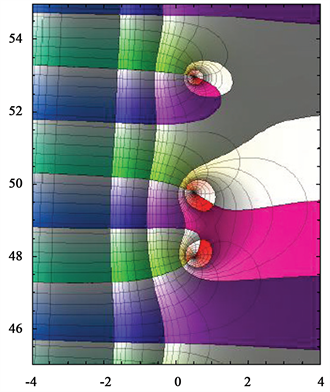
L-function at s=1
- The value of the L-function at is of particular interest, as it encodes arithmetic information
- When the rank is zero, the L-function is non-zero at , and its value is related to the Tate-Shafarevich group
- In the rank zero case, the BSD conjecture predicts the precise value of the L-function at
- This has been proved for elliptic curves with complex multiplication and in some other special cases
- Computing the value of the L-function at is a challenging problem, often relying on analytic techniques
Relation to elliptic curve rank
- The rank of an elliptic curve is the rank of its Mordell-Weil group (the group of rational points)
- It measures the number of independent infinite order points on the curve
- The BSD conjecture predicts a direct relation between the rank and the order of vanishing of the L-function at
- A zero of order at should correspond to a rank elliptic curve
- Proving the BSD conjecture would provide a way to determine the rank of an elliptic curve analytically
Zeros of L-functions
- The distribution of zeros of L-functions encodes important information about the elliptic curve
- The location of zeros is related to questions about the distribution of prime numbers and the size of the Tate-Shafarevich group
- Studying the zeros of L-functions is a central problem in analytic number theory
- Conjectures like the Riemann hypothesis for elliptic curves aim to understand the distribution of zeros
Distribution of zeros
- The Generalized Riemann Hypothesis (GRH) for elliptic curve L-functions states that all non-trivial zeros lie on the line
- This is an analog of the classical Riemann hypothesis for the Riemann zeta function
- GRH has significant consequences for the distribution of prime numbers and the growth of arithmetic invariants
- It implies optimal bounds for the error term in the prime number theorem for the elliptic curve
- Unconditionally, it is known that a positive proportion of zeros lie on the critical line
Riemann hypothesis for elliptic curves
- The Riemann hypothesis for elliptic curve L-functions is a special case of the GRH
- It asserts that all non-trivial zeros of the L-function have real part equal to
- The Riemann hypothesis has been verified numerically for many elliptic curves
- However, it remains unproved in general, even for a single elliptic curve
- Proving the Riemann hypothesis would have significant implications for the distribution of prime numbers and the size of the Tate-Shafarevich group
Consequences for elliptic curve arithmetic
- The distribution of zeros of L-functions has important consequences for the arithmetic of elliptic curves
- It controls the distribution of prime numbers p for which the elliptic curve has a given number of points modulo p
- The Riemann hypothesis implies optimal bounds for the error term in the prime number theorem for the elliptic curve
- This means the number of points on the elliptic curve modulo p is well-approximated by the prime number theorem
- Zeros of L-functions also appear in the Birch and Swinnerton-Dyer conjecture, relating the rank to the order of vanishing at
Twists of L-functions
- Twists of L-functions are obtained by modifying the Euler factors at a finite set of primes
- They correspond to twists of the elliptic curve by characters of the Galois group
- Studying twists of L-functions provides insight into the arithmetic of the original elliptic curve
- Different types of twists, such as quadratic twists and higher order twists, have specific arithmetic interpretations
Quadratic twists
- Quadratic twists are the most well-studied type of twist, corresponding to quadratic characters
- The quadratic twist of an elliptic curve by a squarefree integer is the curve defined by the equation
- The L-function of is related to the L-function of by a simple factor
- The sign of the functional equation of is related to the sign of and the sign of
- Quadratic twists are used to study the rank and the Tate-Shafarevich group of elliptic curves
Higher order twists
- Higher order twists correspond to characters of higher order, such as cubic or quartic characters
- They are defined similarly to quadratic twists, by modifying the defining equation of the elliptic curve
- The L-functions of higher order twists are related to the L-function of the original curve by a twist factor
- The functional equation and analytic properties of the twisted L-function can be deduced from those of the original L-function
- Higher order twists are used to study the distribution of ranks and the structure of the Tate-Shafarevich group

Relation to elliptic curve isogenies
- Twists of elliptic curves are related to isogenies, which are morphisms between elliptic curves that preserve the group structure
- Quadratic twists correspond to isogenies of degree 2, while higher order twists correspond to isogenies of higher degree
- The L-functions of isogenous elliptic curves are closely related
- They have the same degree and share many analytic properties
- Studying twists and isogenies provides insight into the arithmetic and geometric structure of elliptic curves
L-functions and modular forms
- The modularity theorem establishes a deep connection between L-functions of elliptic curves and L-functions of modular forms
- It states that every elliptic curve over is modular, meaning its L-function coincides with the L-function of a modular form
- This connection allows the use of powerful tools from the theory of modular forms to study elliptic curve L-functions
- Many properties of L-functions, such as analytic continuation and functional equation, can be proved using modularity
Modularity of L-functions
- The L-function of a modular form is defined as a Dirichlet series with coefficients given by the Fourier coefficients of
- It shares many properties with the L-function of an elliptic curve, such as analytic continuation and functional equation
- The modularity theorem implies that the L-function of an elliptic curve over is the L-function of a modular form
- This allows the use of techniques from the theory of modular forms to study elliptic curve L-functions
- Modularity also provides a way to compute the coefficients of the L-function using modular symbols
Hecke operators and eigenforms
- Hecke operators are linear operators acting on the space of modular forms
- They are defined using the Fourier coefficients of modular forms and have important arithmetic properties
- Eigenforms are modular forms that are eigenvectors for all Hecke operators
- They play a crucial role in the theory of modular forms and have a simple L-function
- The coefficients of the L-function of an eigenform are given by its Hecke eigenvalues
- This provides a way to compute the L-function of a modular form and, by modularity, the L-function of an elliptic curve
Congruences between modular forms
- Congruences between modular forms are relations between their Fourier coefficients modulo a prime or a prime power
- They are related to congruences between the coefficients of the corresponding L-functions
- Studying congruences between modular forms provides insight into the arithmetic of elliptic curves
- It allows the use of techniques from modular forms to study the Tate-Shafarevich group and the Birch and Swinnerton-Dyer conjecture
- Congruences also play a role in the proof of the modularity theorem, through the use of Galois representations and modularity lifting theorems
Computational aspects of L-functions
- Computing values and properties of L-functions is a challenging problem, requiring a combination of analytic and algebraic techniques
- Efficient algorithms for L-function evaluation are essential for numerical investigations and applications
- Numerical computation of L-functions is used to test conjectures and guide theoretical research
- L-functions also have important applications in cryptography, such as the construction of elliptic curve cryptosystems
Efficient algorithms for L-function evaluation
- Evaluating L-functions requires computing the coefficients of the Dirichlet series and summing the series efficiently
- This can be done using techniques from analytic number theory, such as approximate functional equations and Riemann-Siegel type formulas
- For elliptic curve L-functions, modularity provides a way to compute the coefficients using modular symbols
- This leads to efficient algorithms for computing the L-function and its special values
- Efficient algorithms for L-function evaluation are implemented in computer algebra systems and specialized software packages
Numerical verification of conjectures
- Numerical computation of L-functions is used to test conjectures and provide evidence for theoretical results
- This includes verifying the Riemann hypothesis for specific elliptic curves and testing the Birch and Swinnerton-Dyer conjecture
- Numerical data can guide the search for proofs and counterexamples
- It can also suggest new conjectures and research directions
- High-precision computation of L-functions requires advanced techniques from numerical analysis and rigorous error control
Applications to cryptography
- Elliptic curve cryptography relies on the difficulty of the discrete logarithm problem on elliptic curves
- The security of elliptic curve cryptosystems depends on the distribution of prime numbers and the size of the Tate-Shafarevich group
- L-functions of elliptic curves are used to study the distribution of prime numbers and the growth of arithmetic invariants
- This provides a way to assess the security of elliptic curve cryptosystems and guide the selection of parameters
- Computational techniques for L-functions, such as efficient algorithms for evaluation and numerical verification of conjectures, are used in the analysis and design of elliptic curve cryptosystems