AP World History: Modern DBQ Practice
69 Document-Based Questions written in the AP format. Pick one, read the prompt and all seven documents, and write your essay. Fiveable scores each DBQ response part by part on the AP rubric.
Your first scored response is included. A plan unlocks unlimited scoring.

69 questions
sorted by unit
Rulers' use of law, administration, moral authority
Unit 1: The Global Tapestry, 1200-1450
Evaluate the extent to which rulers across Afro-Eurasia relied on law, administration, and moral authority to maintain and legitimize political power from 1200 to 1450.
Respond to the prompt with a historically defensible thesis or claim that establishes a line of reasoning.
Describe a broader historical context relevant to the prompt.
Support an argument using at least four of the provided documents.
Use at least one additional piece of specific historical evidence beyond the documents.
For at least two documents, explain how or why the document's point of view, purpose, historical situation, or audience is relevant.
Demonstrate a complex understanding through sophisticated argumentation and/or effective use of evidence.
Document 1
Source: King John of England, Magna Carta, charter agreed with rebellious barons,1215,clauses14,39,and40. Translation reproduced by Yale Law School, Avalon Project. The charter describes protections for freemen and elite consultation, not universal suffrage.
-
And for obtaining the common counsel of the kingdom anent the assessing of an aid (except in the three cases aforesaid) or of a scutage, we will cause to be summoned the archbishops, bishops, abbots, earls, and greater barons, severally by our letters; and we will moveover cause to be summoned generally, through our sheriffs and bailiffs, and others who hold of us in chief, for a fixed date, namely, after the expiry of at least forty days, and at a fixed place; and in all letters of such summons we will specify the reason of the summons. And when the summons has thus been made, the business shall proceed on the day appointed, according to the counsel of such as are present, although not all who were summoned have come.
-
No freemen shall be taken or imprisoned or disseised or exiled or in any way destroyed, nor will we go upon him nor send upon him, except by the lawful judgment of his peers or by the law of the land.
-
To no one will we sell, to no one will we refuse or delay, right or justice.
Document 2
Source: Ganapatideva, ruler of the South Indian Kakatiya state, edict, circa 1245 C.E.
By the glorious king Ganapatideva the following edict assuring safety has been granted to sea traders starting for and arriving from all continents, islands, foreign countries, and cities:
Formerly kings used to take away by force the whole cargo—elephants, horses, gems, etc.—carried by ships and vessels which, after they had started from one country to another, were attacked by storms and wrecked ashore.
But We, out of mercy, for the sake of glory and merit, hereby pledge to leave everything except the fixed duty to those who have incurred the great risk of a sea-voyage with the thought that wealth is more valuable than even life.
The rate of this duty is one thirtieth on all exports and imports.
Document 3
Source: Ibn Battuta's account of trade customs and royal ceremonies in Mogadishu, 1331.
When a vessel reaches the port, it is met by sumbuqs, which are small boats, in each of which are a number of young men, each carrying a covered dish containing food. He presents this to one of the merchants on the ship saying “This is my guest,” and all the others do the same. Each merchant on disembarking goes only to the house of the young man who is his host, except those who have made frequent journeys to the town and know its people well; these live where they please. The host then sells his goods for him and buys for him, and if anyone buys anything from him at too low a price, or sells to him in the absence of his host, the sale is regarded by them as invalid. This practice is of great advantage to them. ...
We stayed there [in Mogadishu] three days, food being brought to us three times a day, and on the fourth, a Friday, the qadi [an Islamic magistrate or judge] and one of the wazirs [vizier, high-ranking minister] brought me a set of garments. We then went to the mosque and prayed behind the [sultan’s] screen. When the Shaykh [sultan] came out I greeted him and he bade me welcome. He put on his sandals, ordering the qadi and myself to do the same, and set out for his palace on foot. All the other people walked barefooted. Over his head were carried four canopies of coloured silk, each surmounted by a golden bird. After the palace ceremonies were over, all those present saluted and retired.
Document 4
Source: Emperor Charles IV of the Holy Roman Empire, The Golden Bull, decree issued in 1356.
Inasmuch as we, through the office by which we possess the imperial dignity, are doubly—both as emperor and by the electoral right which we enjoy—bound to put an end to future danger of discords among the electors themselves, ... we have promulgated, decreed and recommended for ratification, the subjoined laws for the purpose of cherishing unity among the electors, and of bringing about a unanimous election, and of closing all approach to the aforesaid detestable discord and to the various dangers which arise from it. This we have done in our solemn court at Nuremberg, in session with all the electoral princes, ecclesiastical and secular, and amid a numerous multitude of other princes, counts, barons, magnates, nobles and citizens...
We decree, moreover, that our successor, the king for the time being of Bohemia, shall have the same right ... of coining gold and silver money and of circulating it in every way and manner observed up to this time in this same kingdom of Bohemia in such matters ...
We prohibit also each and every unjust war and feud, and all unjust burnings, spoliations and rapines, unlawful and unusual tolls and escorts, and the exactions usually extorted for such escorts, under the penalties by which the sacred laws prescribe that the foregoing offenses, and any one of them, are to be punished...
Moreover the imperial or royal table ought so to be arranged that it shall be elevated above the other tables in the hall by a height of six feet. And at it, on the day of a solemn court, shall sit no one at all except alone the emperor or king of the Romans...
Document 5
Source: Ibn Khaldun, Arab scholar and historian writing about the Mamluk dynasty of Egypt, late fourteenth century.
It was by the grace of God, glory be to Him, that He came to the rescue of Islam, by reviving its last breath and restoring in Egypt the unity of the Muslims [in the mid-thirteenth century]. He did this by sending the Mamluks to the Muslims as guardian rulers and devoted defenders, who were imported as slaves from the lands of the heathen Qipchaq Turks. The Turkish slaves embrace Islam with the determination of true believers, while retaining their nomadic virtues.
The slave merchants bring them to Egypt in batch after batch. Then the rulers lodge them in the royal chambers, and give them a careful upbringing, including the study of the Qur’an. Then they train them in the use of the bow and the sword, in riding horses, and in fighting with the lance until they become tough and seasoned soldiers. When the rulers are convinced that they are prepared to defend and die for them, they increase their pay, lands, and incomes. Then they appoint them to high offices of state, and even sultans are chosen from them who direct the affairs of the Muslims.
Document 6
Source: Official court portrait of the Hongwu Emperor (reigned 1368-1398), founder of the Ming dynasty, China; hanging scroll, color on silk, 14th century; National Palace Museum, Taipei.
Document 7
Source: Yun Hoe, Korean Confucian scholar and adviser to the Korean Choson monarchy, On the Harmfulness of Buddhism, 1424
We consider Buddhists to be a direct threat. For over 1500 years, Buddhism has been spreading in our kingdom, yet neither happiness nor profit has been gained. This is recorded in the historical books, which Your Majesty has certainly studied thoroughly. Must you wait for your ministers to tell you? We think of all the unorthodox teachings, Buddhism is the worst. The Buddhists live alone with their barbaric customs, apart from the common productive population; yet they cause the people to be poor and to steal. What is worse than their crimes? Beasts and birds that damage grain are certainly chased away because they harm the people. Yet even though beasts and birds eat the people’s food, they are nevertheless useful to the people. Buddhists, however, sit around and eat, and there has not yet been a visible profit.
What the DBQ asks
The Document-Based Question is the AP World History: Modern essay built on documents. You get seven documents and write an essay that argues a defensible thesis, using the documents and your own knowledge.
- 60 min
- 15 reading, 45 writing
- 7 points
- across rows A to D
- 25%
- of your exam score
Part A: Thesis
A defensible claim that sets up a line of reasoning
1 pt
Part B: Contextualization
Broader developments that frame the prompt
1 pt
Part C: Evidence
Four documents used to support the argument, plus one example beyond them
3 pts
Part D: Analysis and reasoning
Sourcing for two documents, and a complex understanding of the topic
2 pts
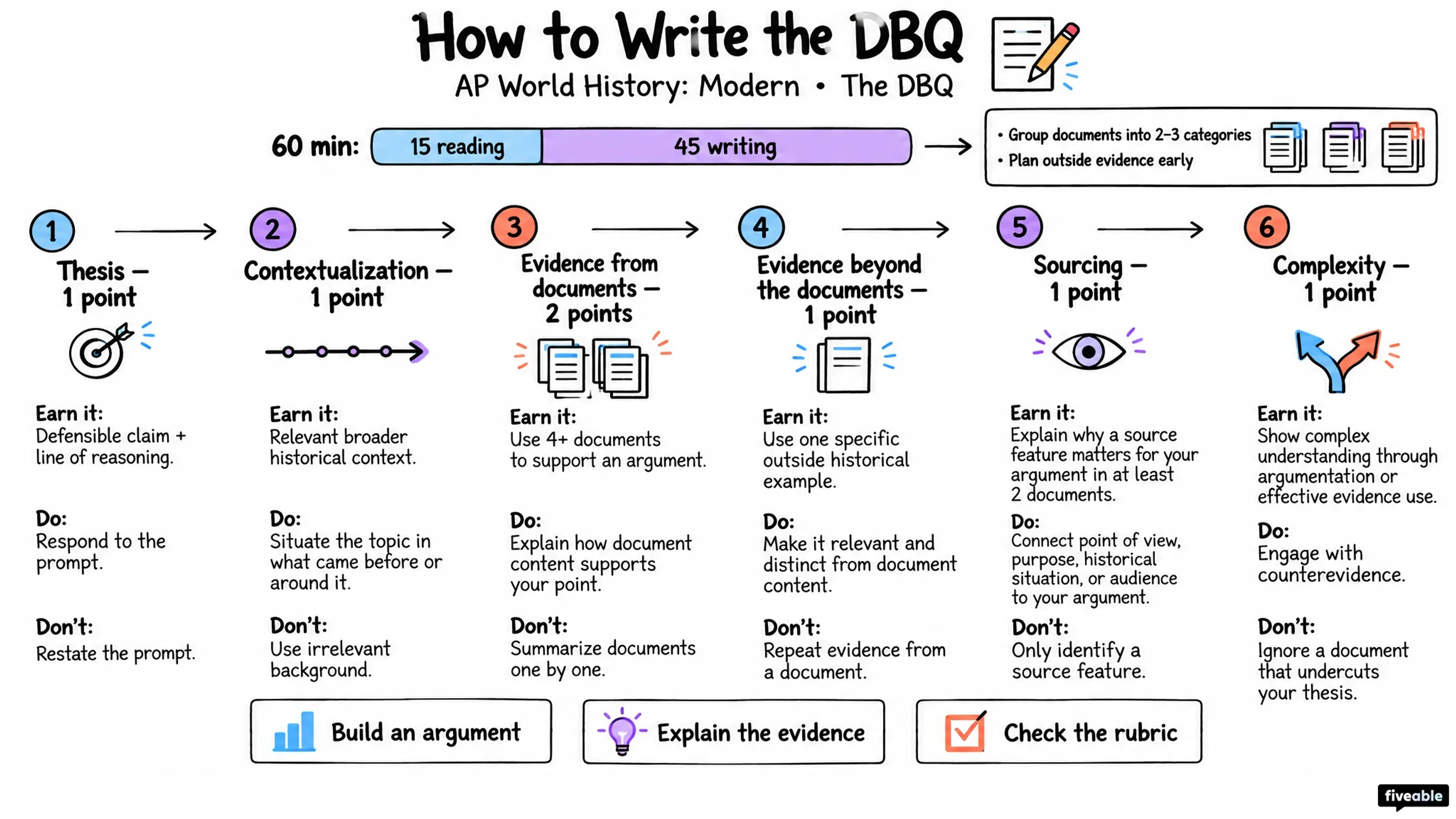
DBQ skill sheet
Every rubric point on one page: what earns it, what to do and what to avoid. Tap the sheet to see it full size.
How DBQ practice works
Each question follows the exam’s format, from the full prompt to a score on every part.
Read the prompt and documents
The prompt and all seven documents, laid out the way the exam shows them.
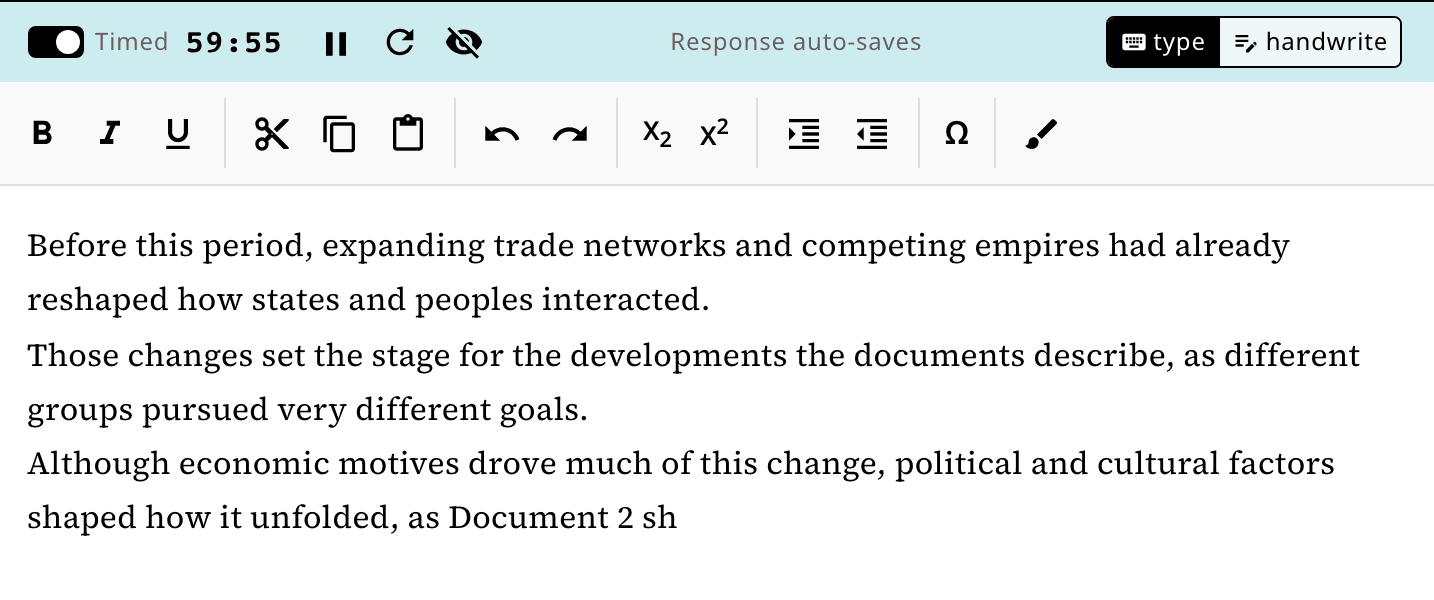
Write on a 60-minute timer
The time to plan for on exam day, reading period included. Pause it or turn it off, and your response saves as you go.
Submit for a score out of 7
Your response is scored against the scoring guidelines written for that question. Your first score is included.
Feedback on every part
A summary at the top tells you what to work on next. Below it, each part shows whether you earned the point and what the scoring guidelines were looking for.
Detailed Feedback
Part A: 1/1 point
Earned the point. You provided a clear, historically defensible thesis at the end of your introduction that establishes a line of reasoning. You argued that political and ideological factors drove expansion to a larger extent than economic motivations, categorizing your argument into military conquest, ideological unity/rights, and control of workers.
Part B: 1/1 point
Earned the point. You provided strong contextualization in your opening sentences by discussing the Industrial Revolution, the introduction of the steam engine, and the rise of Social Darwinism as broader historical developments that set the stage for imperial expansion.
Part C3: 0/1 point
Did not earn the point. To earn this point, you needed to provide a specific piece of historical evidence beyond the documents that is relevant to the prompt's time period (1850-1931). While you attempted to bring in outside knowledge, the Jizya tax is from a completely different historical era and was used as an analogy, and the Green Revolution occurred after the time period of the prompt. Your mentions of the Industrial Revolution and Social Darwinism were already counted for contextualization and cannot be double-counted here.
What 387 scored DBQs show
Patterns from the practice DBQs students have turned in on Fiveable. Students lose the most points on Part D: analysis and reasoning.
A: Thesis
87%
B: Contextualization
80%
C: Evidence
69%
D: Analysis and reasoning
41%
21%
of responses earned all 7 points
4.5 of 7
average score
+1.2 points
average gain when students rewrote the same DBQ after feedback
387 practice responses from 261 students, scored on Fiveable through October 26, 2026.
Questions about the DBQ
How many responses can I get scored?
You can read every question without a plan. Your first scored response is included. A plan unlocks unlimited scoring.
How many documents do I need to use?
Using four documents to support your argument earns both document evidence points. Explaining the point of view, purpose, situation, or audience of two of them earns the sourcing point.
Can document work earn the complexity point?
Yes. Using all seven documents well, or sourcing four of them, is one way to earn it. A nuanced argument that weighs counterevidence is another.
How is the DBQ different from the LEQ?
The DBQ gives you seven documents to build your argument from. The LEQ has no documents, so all of your evidence comes from what you know, and the exam gives it 40 minutes.
Can I write my answer by hand?
Yes. Switch the editor to handwrite, write on paper, and add a photo of your page.
More AP World History: Modern practice
AP World History: Modern FRQs
Every FRQ type for AP World History: Modern, with practice for each.
See the DBQ rubric points students miss most, from responses scored on Fiveable.
Write your first DBQ
Pick one from the list, or let us choose for you.
Teaching AP World History: Modern? Assign these DBQs to your class