AP World History: Modern SAQ Practice
1638 Short Answer Questions written in the AP format. Pick one, read the source and all three parts, and write a short answer to each. Fiveable scores each SAQ response part by part on the AP rubric.
Your first scored response is included. A plan unlocks unlimited scoring.
1638 questions
sorted by unit
Zhu Yuanzhang's 1370 edict on Ming governance
Unit 1: The Global Tapestry (1200-1450)
Source: Edict by Zhu Yuanzhang (1328–1398) the Hongwu Emperor and founder of the Chinese Ming Dynasty (1388–1644).
Those of you in charge of money and grain have stolen them yourselves; those of you in charge of criminal laws and punishments have neglected the regulations. In this way grievances are not redressed and false charges are ignored. ... Occasionally these unjust matters come to my attention. After I discover the truth, I capture and imprison the corrupt, villainous, and oppressive officials involved. I punish them with the death penalty or forced labor or have them flogged with bamboo sticks in order to make manifest the consequences of good and evil actions. ...during the final years of the Yuan dynasty, there were many ambitious men competing for power who did not treasure their sons and daughters but prized jade and silk, coveted fine horses and beautiful clothes, relished drunken singing and unrestrained pleasure, and enjoyed separating people from their parents, wives, and children. I also lived in that chaotic period. How did I avoid such snares? I was able to do so because I valued my reputation and wanted to preserve my life. Therefore I did not dare to do these evil things. ... In order to protect my reputation and to preserve my life, I have done away with music, beautiful girls, and valuable objects. Those who love such things are usually “a success in the morning, a failure in the evening.” Being aware of the fallacy of such behavior, I will not indulge such foolish fancies. It is not really that hard to do away with these tempting things.
Answer all parts of the question that follows.
Identify ONE method of governance that Zhu Yuanzhang employed to maintain control over officials in the Ming Dynasty, based on the edict.
Describe ONE way in which the historical context of the Yuan Dynasty's collapse influenced Zhu Yuanzhang's approach to governance in the edict.
Explain ONE way in which Confucian cultural traditions influenced patterns of governance beyond China in East Asia during the period 1200 to 1450.
What the SAQ asks
Short-answer questions make up Section I, Part B of the AP World History: Modern exam, with three required questions in 40 minutes. Each one starts from a source, such as one or two historians’ arguments, a primary text, or an image, and asks three short parts about it and the history around it.
- 13 min
- suggested time per SAQ
- 3 points
- one for each part, A to C
- 20%
- of your exam score, for all three SAQs
Part A: Identify or describe
A claim, argument, or piece of evidence in the source
1 pt
Part B: Explain
A development tied to the source, often its broader context
1 pt
Part C: Explain
How one development relates to another, with evidence you know
1 pt
How SAQ practice works
Each question follows the exam’s format, from the full prompt to a score on every part.
Read the source and question
The source and all three parts, A through C, laid out the way the exam shows them.
Write on a 13-minute timer
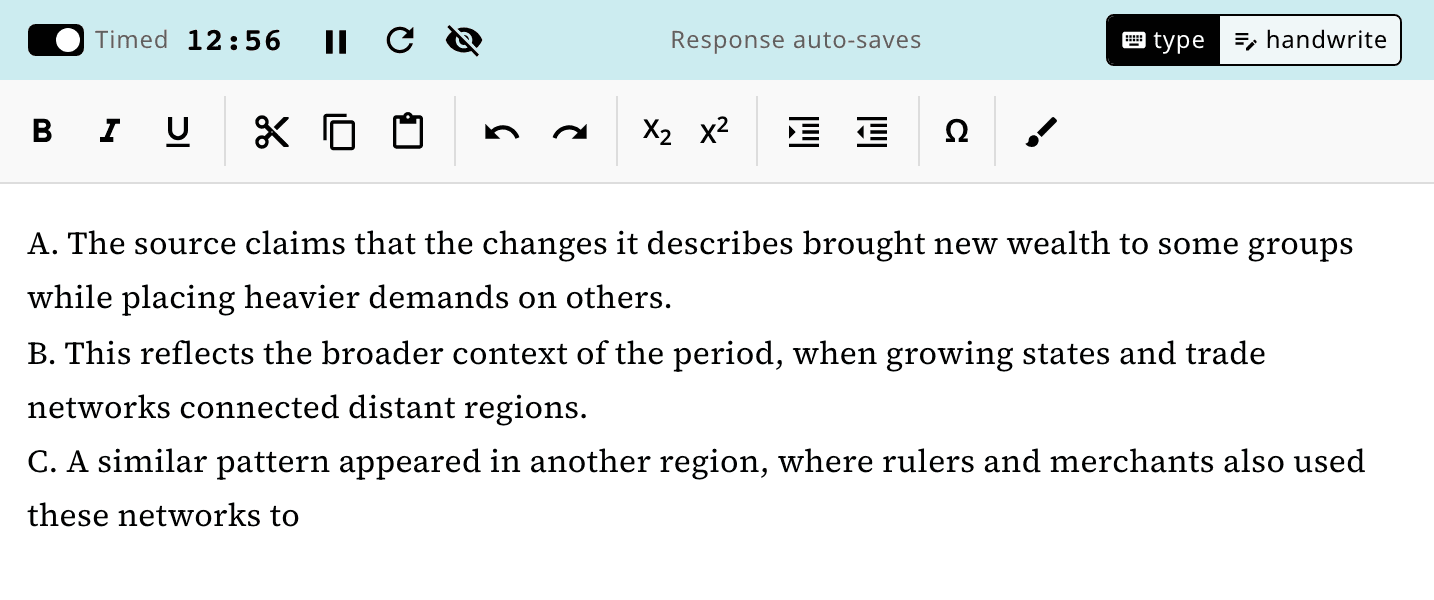
About the time each SAQ gets on exam day. Pause it or turn it off, and your response saves as you go.
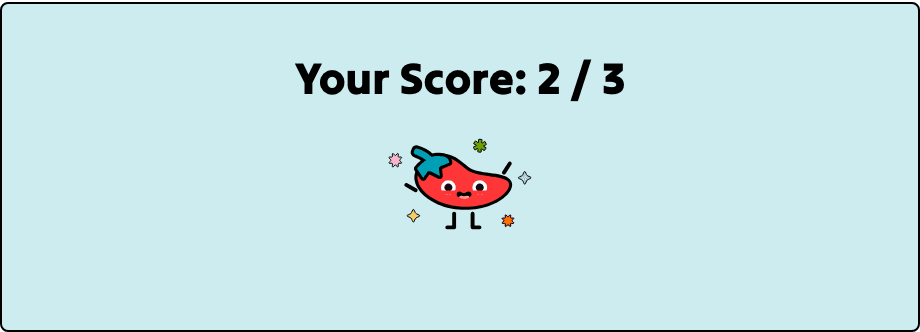
Submit for a score out of 3
Your response is scored against the scoring guidelines written for that question. Your first score is included.
Feedback on every part
A summary at the top tells you what to work on next. Below it, each part shows whether you earned the point and what the scoring guidelines were looking for.
Detailed Feedback
Part A: 1/1 point
Earned the point. You clearly explained how established colonial powers’ control of territory left late-developing nations at a disadvantage.
Part B: 1/1 point
Earned the point. You connected the mandate system’s transfer of German colonies to established empires with the grievance that the postwar order preserved their dominance.
Part C: 0/1 point
Did not earn the point. You named imperialism in the 1800s, but the response does not say what justification for expansion Konoe shared with European powers. To earn the point, you needed to name a reason, such as acquiring resources or markets, and explicitly connect it to a similar European justification.
Questions about the SAQ
How many responses can I get scored?
You can read every question without a plan. Your first scored response is included. A plan unlocks unlimited scoring.
Do I still choose between Questions 3 and 4?
No. Beginning with the May 2027 exam, all three SAQs are required and each one has a source. Question 1 uses one or two secondary texts, Question 2 a primary text, and Question 3 a non-text source. Every question here comes with a source.
How is the SAQ different from the DBQ?
The SAQ asks three short parts about a source, with about 13 minutes per question. The DBQ asks for a full essay built on seven documents, and the exam gives it 60 minutes.
How long should each answer be?
A few sentences per part. You don’t need a thesis, an introduction, or a conclusion.
Is each part scored on its own?
Yes. Each part is worth 1 point and is scored separately, so a strong answer to part A still counts if part C misses.
More AP World History: Modern practice
AP World History: Modern FRQs
Every FRQ type for AP World History: Modern, with practice for each.
See the SAQ rubric points students miss most, from responses scored on Fiveable.
Write your first SAQ
Pick one from the list, or let us choose for you.
Teaching AP World History: Modern? Assign these SAQs to your class