all units 295
unit 1 10
unit 2 7
unit 3 6
unit 4 10
unit 5 8
unit 6 9
unit 7 9
unit 8 7
unit 9 9
295 questions
sorted by unit
Islamic expansion's divergent political impacts: West Africa and South Asia
Global economic networks and social structure transformation, 1450-1900
Industrial Revolution's impact on global economic networks
Mongol and Aztec territorial administration methods, 1200–1550
British and French colonial control methods, 1750-1900
Soviet versus Chinese economic policy approaches, 1920–1990
Columbian Exchange: demographic and economic transformation, 1492–1750
Enlightenment ideas and Atlantic political revolutions, 1750–1850
Cold War impacts on developing nations' politics, economics, 1945–1991
Asian societies in global trade networks, 1200-1750
European and Asian economic relationship transformation, 1450-1900
Non-Western responses to Western imperialism, 1750-2001
Islamic expansion and cultural transformation in Afro-Eurasia, 1200–1450
European imperialism, raw materials, Africa and Asia, 1750–1900
Communication and transportation technologies, cultural globalization, 1900–2001
Mongol conquest political effects: Russia versus China, 1200–1450
French and Haitian Revolution causes compared, 1789–1804
Gandhi and Mandela's resistance methods compared
Urban trade and cultural centers in Afro-Eurasia, 1200–1750
Western European economic influence, 1450-1900
Aztec and Inca imperial consolidation methods, 1200–1550
Chattel slavery versus Russian serfdom systems, 1450–1900
Mongol conquests, economic and cultural transformation, 1200–1450
Industrialization and European imperial expansion, 1750-1900
European imperial collapse and world wars, 1914–2001
Social hierarchy systems in the Americas, 1200-1750
African societies in global economic networks, 1450-1900
Technological innovations and long-distance trade patterns, 1200-1750
Global economic integration and social hierarchy transformation, 1450-1900
Women's societal roles, 1750 to 2001
Environmental factors and Indian Ocean trade expansion, 1200–1450
Gunpowder weapons and land-based empire expansion, 1450–1750
Cold War ideological rivalries, regional conflicts, 1945–2001
Aztec and Inca political consolidation methods, 1400–1533
Indian and Vietnamese decolonization processes, 1945-1975
Nomadic peoples' political and economic influence, Eurasia 1200-1750
Agricultural production and land use transformation, 1450-1900
Women's political and social roles globally, 1750-2001
Technological and commercial innovations, Afro-Eurasian trade expansion, 1200–1450
Enlightenment philosophies and Atlantic political revolutions, 1750–1900
Medical and agricultural technologies, global demographic change, 1900–2001
Ottoman and Qing responses to Western industrialization, 1750–1900
Communist revolution causes: Russia versus China, 1900–2001
Cultural effects of Silk Roads and Indian Ocean trade, 1200–1450
Qing and Ottoman responses to Western pressure, 1750–1900
Nationalist independence methods in Ghana and Kenya, 1945–1970
Belief systems' influence on political authority, 1200-1750
Empire management of diverse populations, 1450-1900
Trans-Saharan and Indian Ocean trade cultural effects, 1200–1450
Spanish and British colonial administration methods, 1450–1750
Russian and Chinese Communist revolutionary political outcomes, 1900–2001
Long-distance trade cultural effects, Afro-Eurasia, 1200–1750
European imperial expansion motivations, 1450-1900
Political movements' methods challenging authority, 1750-2001
Ottoman and Mughal empire consolidation strategies, 1450–1750
State-sponsored industrialization in Russia and Japan, 1750–1900
Nationalist independence movements: India and Algeria methods, 1900–2001
Ruler consolidation methods, 1200-1750
Systems of coerced labor, 1450-1900
Imperial expansion and social hierarchy transformation, 1200-1750
Global trade and coerced labor expansion, 1450-1900
Anti-imperialist movements and decolonization reshaping global politics, 1750–2001
Exchange networks, cultural change, Afro-Eurasian demographics, 1200–1750
Americas integration, demographic shifts, environmental consequences, 1450–1900
Nationalist movements and imperial decline, 1750-2001
Cross-cultural interactions, technological and cultural change, Afro-Eurasia, 1200–1750
Global trade networks and social structural transformation, 1450-1900
Technological innovations and economic production transformation, 1750-2001
Land-based empires, religious and ethnic diversity accommodation, 1450–1750
Government responses to Great Depression across regions, 1929–1939
Government responses to Great Depression across states, 1929–1939
Chinese cultural influence on East Asian societies, 1200-1450
Cultural and racial ideologies, state power expansion, 1750–1900
Imperialism, resource competition, global conflict origins, 1900–1945
Economic imperialism and global economic development, 1750-1900
Religious transformation in land-based empires, 1450-1750
Industrialization's impact on European and North American social structures, 1750–1900
Indian Ocean and Silk Road commercial practices, 1200–1450
Government mobilization methods during World War era, 1914–1945
Chinese cultural traditions, East Asian governance structures, 1200–1450
Cultural and racial ideologies in imperial expansion, 1750–1900
Chinese cultural traditions and East Asian political systems
Economic imperialism and global economic development, 1750-1900
Cold War ideological competition in developing nations, 1945–1990
Cross-cultural interactions and exchange networks in Afro-Eurasia, 1200–1450
Industrialization's impact on European and American social hierarchies, 1750–1900
Government economic intervention during the Great Depression, 1929–1939
Chinese cultural traditions and East Asian state building, 1200–1450
European imperial expansion: economic versus other motives, 1750–1900
Imperialist expansion and global conflict origins, 1900-1945
Religious diffusion along Afro-Eurasian trade routes, 1200–1450
Industrialization's impact on social hierarchies, 1750-1900
Land-based empires, legitimization methods, 1450-1750
State responses to Great Depression economic crisis, 1929–1939
Belief systems in land-based empires, cross-cultural interactions, 1450–1750
Industrialization's impact on European and American social hierarchies, 1750–1900
European maritime empires' economic strategies, 1450-1750
Chinese cultural traditions and East Asian political systems, 1200–1450
Enlightenment ideals and Atlantic political revolutions, 1750–1900
Industrialization's transformation of global economic systems, 1750-1900
Indigenous resistance to state expansion, Africa and Asia, 1750–1900
European maritime exploration, Asian trade, 1450-1750
Portuguese and Spanish maritime economic strategies, 1450-1750
Columbian Exchange impacts on American social structures, 1450–1750
Maritime empire expansion and Atlantic labor systems transformation, 1450–1750
Gunpowder weapons and land-based empire expansion, 1450–1750
Religious ideas and monumental architecture legitimizing rule, 1450–1750
Indigenous resistance and state expansion in Africa/Asia, 1750–1900
Large-scale migration and social transformation, 1750-1900
Mongol Empire expansion and Afro-Eurasian trade networks, 1200–1450
Military technology and land-based imperial expansion, 1450-1750
Religious legitimization of land-based empire rulers, 1450–1750
Mongol Empire expansion and trans-Eurasian trade facilitation, 1200–1450
State involvement in industrialization across regions, 1750-1900
Government warfare methods in World War I and II, 1914–1945
Rights-based movements and social hierarchy transformation, 1900–present
Gunpowder weaponry and land-based empire expansion, 1450–1750
Religious legitimization of land-based empire rule, 1450–1750
State roles in Asian versus Western European industrialization, 1750–1900
Mongol Empire's impact on Eurasian political-economic development, 1200–1450
Global power distribution during Cold War era, 1945–1991
Government warfare methods in World Wars I and II
Land-based empire rulers' legitimization methods, 1450-1750
Gunpowder weapons and imperial expansion, 1450-1750
Land-based empires, legitimization methods, regional variations, 1450–1750
Technological innovations and land-based empire expansion, 1450–1750
European maritime exploration, state sponsorship, motivations, 1450–1750
Maritime empires and American social hierarchy transformation, 1450–1750
Government responses to Great Depression economic transformation, 1929–1939
Mongol Empire expansion and Afro-Eurasian exchange, 1200–1450
State roles in industrialization: Western versus non-Western nations, 1750–1900
Industrialization's impact on social structures, 1750-1900
Warfare evolution: total war and civilian targeting, 1914–1945
Rights-based discourses and social structure transformation, 1900–present
European versus non-European state expansion methods, 1750–1900
Mongol Empire's impact on Eurasian political, economic development, 1200–1450
Environmental factors shaping twentieth-century global developments
Gunpowder weapons and land-based empire expansion, 1450–1750
Religious legitimization of land-based empire rule, 1450–1750
Global power shifts through twentieth-century conflicts
Rights-based discourses challenging social hierarchies, 1900-present
Warfare transformation during World War periods, 1914–1945
Rights-based discourses and social hierarchy challenges, 1900–present
Mongol Empire expansion and Afro-Eurasian trade networks, 1200–1450
Government's role in industrialization across regions, 1750-1900
Maritime technology and European trading-post empires, 1450–1750
European maritime versus Asian land-based empire administration, 1450–1750
Government mobilization strategies in World Wars I and II
Indigenous resistance to state expansion, Africa and Asia, 1750–1900
Global migration patterns during industrialization, 1750-1900
Mongol Empire's impact on Eurasian political structures, 1200–1450
Transportation, commerce, and Afro-Eurasian trade expansion, 1200–1450
State economic development roles, 1750-1900
Industrial capitalism and social hierarchy transformation, 1750-1900
Empire expansion and interregional trade networks, 1200-1450
Industrial capitalism and social hierarchy transformation, 1750–1900
European maritime expansion, economic versus other motivations, 1450–1750
Columbian Exchange impacts on American social structures, 1450–1750
Transportation and commercial innovations, interregional trade growth, 1200–1450
Government mobilization methods in World Wars I and II
Rights-based movements and social hierarchy transformation, 1900–present
Migration patterns and social structure transformation, 1750-1900
Wartime population mobilization strategies, World War I and II, 1914–1945
State power and industrialization outside Western Europe, 1750–1900
European maritime empires and American social hierarchies, 1450–1750
Mercantilism and European maritime state consolidation, 1450–1750
State economic intervention in newly independent nations, 1945–2000
Government economic intervention during the Great Depression, 1929–1945
Rights-based movements and social-political change, 1900-present
World War I and World War II military strategies, 1914–1945
Government policies and industrialization, 1750-1900
Industrialization and social hierarchy transformation, 1750-1900
Global migration patterns, 1750-1900
Mongol Empire's impact on Eurasian trade networks, 1200–1450
European maritime technology and imperial expansion, 1450-1750
European maritime versus Asian land-based economic strategies, 1450–1750
Global balance of political power shifts, 1900-present
Exchange networks' impact on Afro-Eurasian societies, 1200-1450
Totalitarian state war mobilization methods, 1929-1945
Gunpowder weaponry and land-based empire expansion, 1450–1750
Land-based empires, power consolidation methods, 1450-1750
Land and resource redistribution movements, structural transformation, 1900–2000
European economic strategies for political consolidation, 1450-1750
Rights-based discourses and social hierarchy transformation, 1900–present
Ottoman and Mughal power consolidation methods, 1450–1750
Rights-based movements and social order transformation, 1900–present
Technological innovations and East Asian economic development, 1200–1450
European maritime technology and imperial expansion, 1450-1750
Columbian Exchange impacts on Eastern Hemisphere economies, populations, 1450–1750
World War I's impact on global political order, 1914–1939
Religious ideas in indigenous resistance movements, Africa/Asia, 1750–1900
Migration patterns and social structure transformation, 1750-1900
Gunpowder weapons and land-based empire expansion, 1450–1750
Religious ideas and monumental architecture legitimizing rulers, 1450–1750
Mongol Empire expansion and Afro-Eurasian cultural exchange, 1200–1450
Rights-based movements challenging social hierarchies, 1900-present
Warfare transformation: technology, tactics, scale 1900-1945
Mongol Empire, cultural and technological exchange, Eurasia, 1200–1450
Environmental factors and human population change, 1900-present
Gunpowder weapons and land-based empire expansion, 1450–1750
Belief systems and cultural transformation in land-based empires, 1450–1750
Global power shifts, 1900-1945
Technological innovations and commercial practices, East Asia 1200-1450
Newly independent states' economic policy shifts post-decolonization, 1950–2000
Global power distribution shifts, 1900-1950
Large-scale migration and social structural transformation, 1750-1900
European maritime expansion: economic motivations and causes, 1450–1750
Columbian Exchange impacts: Americas versus Afro-Eurasia, 1450–1750
Gunpowder weapons and land-based empire expansion, 1450–1750
Land-based empire legitimization methods, 1450-1750
Imperial expansion and interregional trade networks, 1200-1450
Transportation and commercial innovations in Afro-Eurasia, 1200–1450
European maritime expansion, technological innovation, causation, 1450–1750
European maritime empires' economic goals, 1450-1750
Gunpowder weapons and land-based empire expansion, 1450–1750
Religious legitimization of political authority, land-based empires, 1450–1750
Religious beliefs and political authority, 1200-1450
Commercial practices and innovation in East Asia, 1200–1450
Chinese economic transformation through innovation, 1200-1450
Song China economic innovations and societal transformation
State building processes in Americas and Africa
Unit 1
Belief systems and state building in South and Southeast Asia
Unit 1
Islamic intellectual innovations and cultural developments, 1200-1450
Unit 1
Chinese cultural traditions shaping East Asian societies
Unit 1
Islamic expansion and state building in Afro-Eurasia
Unit 1
Trade networks and state formation in Asia
Unit 1
Medieval agriculture, feudalism, social hierarchy
Unit 1
**Confucian bureaucracy in Song-Yuan East Asia**
**Religion's political role: Europe versus Islamic empires**
Unit 1
Religious movements transforming South and Southeast Asian societies
Agricultural labor systems in Eurasia, 1200-1450
Unit 1
Geographic factors shaping American state development
Unit 1
Mongol expansion and cross-Eurasian technological exchange
Unit 2
Environmental factors and Indian Ocean trade expansion
Unit 2
Trade networks and urban development, 1200-1450
Unit 2
Mongol expansion and Eurasian transformation, 1200-1450
Unit 2
Mongol Empire's impact on Afro-Eurasian economic integration
Unit 2
Trans-Saharan trade expansion, 1200-1450
Unit 2
Luxury goods demand and Asian economic transformation
Unit 2
Land-based empires, political legitimization methods, Eurasia
Unit 3
Bureaucratic systems and centralization in Eurasian empires
Unit 3
Land-based empires, rivalries, political and religious conflict
Unit 3
Land-based empires' cultural and religious influence, 1450-1750
Unit 3
Religious divisions and political conflict in Eurasia
Unit 3
Land-based empires' religious policies and political consolidation
Unit 3
Columbian Exchange and American societal transformation
Unit 4
European maritime exploration and technological innovation
Unit 4
European maritime expansion and African political transformation
Unit 4
Global silver circulation and economic transformation, 1450-1750
Unit 4
European maritime expansion and labor systems in Americas
Unit 4
Global silver flows and Asian economic transformation
Unit 4
European maritime expansion and Asian trade responses
Unit 4
Mercantilism, European expansion, state conflicts
Unit 4
Columbian Exchange demographic and social impacts
Unit 4
European colonial agricultural and environmental strategies, Americas
Unit 4
Enlightenment thought and Atlantic revolutions, 1750-1900
Industrialization's impact on social hierarchies and living standards
Unit 5
American Revolution versus Latin American independence causes
Industrial Revolution: natural resources and environmental factors
Unit 5
Nationalism's role in political transformation, 1750-1900
Industrial capitalism and global economic systems transformation
Unit 5
American and Haitian revolutionary causes, similarities and differences
Unit 5
French and Haitian Revolutions: political and social outcomes
Industrial Revolution: technological innovation and global economic change
Unit 5
Industrial capitalism, social change, political ideology development
Unit 5
Haitian Revolution versus Latin American independence movements
OR
Industrialization's impact on gender roles and families
Unit 5
Enlightenment reform movements: feminism and abolitionism
Unit 5
Industrial imperialism and indigenous resistance, 1750-1900
Unit 6
Ideologies and economic motives driving imperial expansion
Unit 6
Global migration, capitalism, transportation networks
Unit 6
Anti-imperial resistance and nationalism, 1750-1900
Unit 6
Imperial expansion: economic motivations and methods
Unit 6
Religious influence on anti-imperial resistance movements, 1750-1900
Unit 6
Export economies and environmental factors, 1750-1900
Unit 6
Global migration, gender roles, family structures
Unit 6
Indigenous resistance and imperial policy transformation, 1750-1900
Unit 6
Land-based empires collapse: internal factors evaluation
Unit 7
Imperialism, nationalism, and World War I origins
Unit 7
Extremist ideologies and mass atrocities, 1900-1950
Unit 7
Early twentieth-century revolutions: internal crises and imperial collapse
Unit 7
Great Depression's role in World War II origins
Revolutionary movements challenging global political and social orders
Unit 7
Ottoman and Russian Empire collapse consequences
Unit 7
Nationalism's role in World War One outbreak
Unit 7
Land-based empires collapse: internal versus external factors
Economic interventions: democratic and totalitarian states
Unit 7
Ottoman dissolution and mandate system implementation
Unit 7
Independence movements and decolonization strategies in Asia, Africa
Unit 8
Cold War influence on domestic policies, 1945-1990
Twentieth-century challenges to political and social orders
Unit 8
Soviet economic decline and Cold War conclusion
Newly independent states' economic development strategies
Unit 8
Cold War influence on postcolonial state conflicts
Economic redistribution movements in Asia and Latin America
Unit 8
Post-World War II decolonization and empire dissolution
Communist transformation of Chinese society and economy
Unit 8
Non-Aligned Movement, Cold War bipolarity, decolonization
Unit 8
Chinese internal instability and communist revolution, 1900-1949
Cold War superpower strategies and influence
Unit 8
New technologies and environmental change, 1900-present
Unit 9
State economic policy convergence in late twentieth century
Unit 9
Medical and agricultural innovations, rights-based movements, human populations
Unit 9
Energy technology development and global economic transformation
Unit 9
International organizations and global peace maintenance
Unit 9
Rights-based movements, educational access, political inclusion
Unit 9
Transportation, communication technologies, global interactions since 1900
Free-market policies, societal transformation late twentieth century
Unit 9
Global economic development and environmental change since 1900
Unit 9
Epidemic diseases and demographic change, 1900-present
Multinational corporations transforming global economic structures
Unit 9
In your response you should do the following:
Respond to the prompt with a historically defensible thesis or claim that establishes a line of reasoning.
Describe a broader historical context relevant to the prompt.
Support an argument in response to the prompt using at least two pieces of specific and relevant evidence.
Use historical reasoning (e.g., comparison, causation, continuity or change over time) to frame or structure an argument that addresses the prompt.
Demonstrate a complex understanding of a historical development related to the prompt through sophisticated argumentation and/or effective use of evidence.
1. Evaluate the most significant difference between the political impacts of the spread of Islam in West Africa and South Asia from 1200 to 1450.
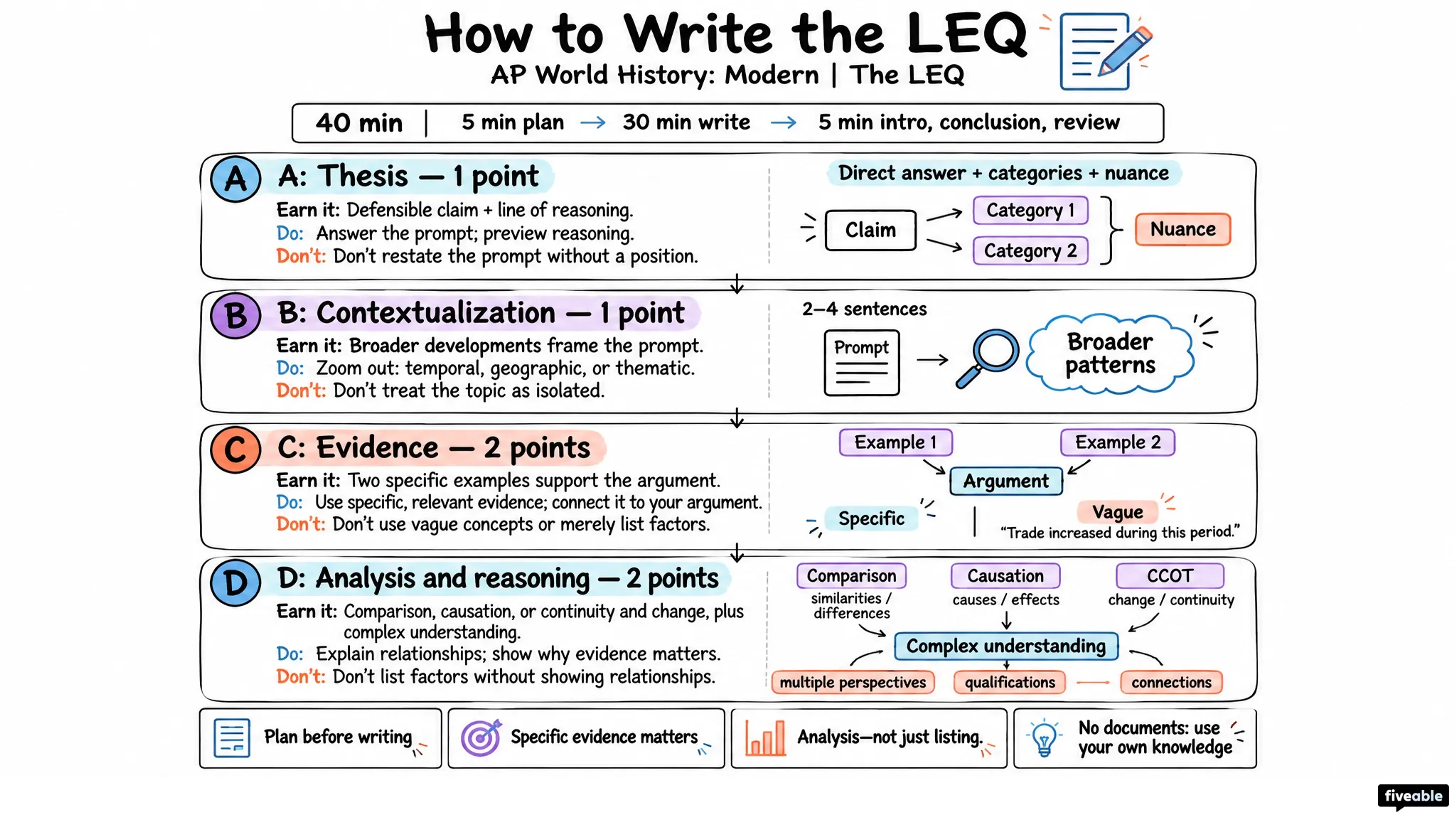
What the LEQ asks The Long Essay Question is the AP World History: Modern essay with no documents. You answer one broad prompt and build a historical argument with evidence from your own knowledge.
40 min to plan and write
6 points across rows A to D
15% of your exam score A
Part A: Thesis A defensible claim that sets up a line of reasoning
1 pt
B
Part B: Contextualization Broader developments that frame the prompt
1 pt
C
Part C: Evidence Two specific examples, used to support the argument
2 pts
D
Part D: Analysis and reasoning Comparison, causation, or continuity and change, plus a complex understanding
2 pts
How LEQ practice works Each question follows the exam’s format, from the full prompt to a score on every part.
1
Read the full prompt The prompt with its time period, laid out the way the exam shows it.
2
Write on a 40-minute timer The time to plan for on exam day. Pause it or turn it off, and your response saves as you go.
3
Submit for a score out of 6 Your response is scored against the scoring guidelines written for that question. Your first score is included.
Feedback on every part A summary at the top tells you what to work on next. Below it, each part shows whether you earned the point and what the scoring guidelines were looking for.
Earned the point. You established a clear, historically defensible claim that industrialization transformed social hierarchies by creating a new working class and taking power away from land-owning aristocracies.
Earned the point. You provided a strong description of the pre-industrial context, accurately explaining how land ownership and slave labor determined wealth and social status before the Industrial Revolution.
Did not earn the point. While you provided one relevant piece of evidence (the creation of the working class in factories), you needed at least two specific examples relevant to social hierarchies . Your other evidence (the horse manure crisis and poor sewer systems) was specific but related to urban public health and sanitation rather than social class structures.
Detailed feedback on a practice LEQ Questions about the LEQ How many responses can I get scored? You can read every question without a plan. Your first scored response is included. A plan unlocks unlimited scoring.
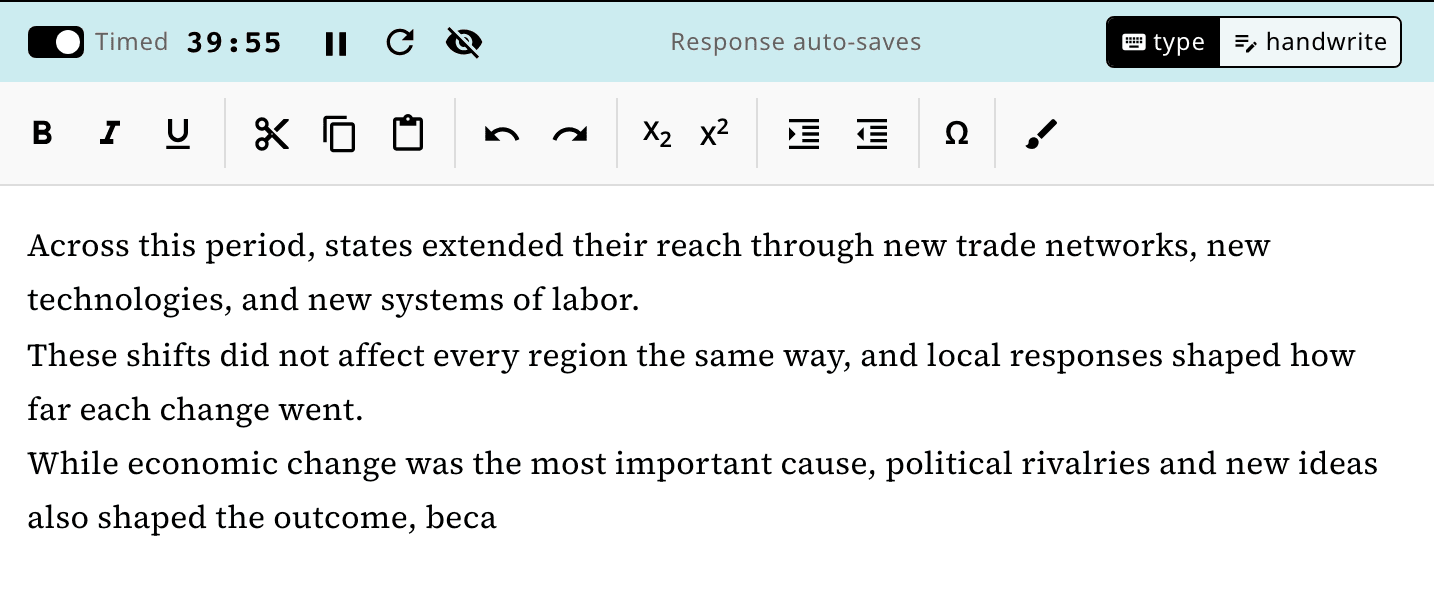
Do I still choose between three prompts? Not on the exam. Beginning with the May 2027 exam, the LEQ is one required broad prompt. Most questions here give you one prompt in that format, and some earlier ones still list three to choose from.
How is the LEQ different from the DBQ? The LEQ has no documents, so every piece of evidence comes from what you know. The DBQ gives you seven documents and 60 minutes, including a reading period.
What reasoning will the prompt ask for? Comparison, causation, or continuity and change over time. Row D checks that you use that reasoning to structure your argument.
Can I write my answer by hand? Yes. Switch the editor to handwrite, write on paper, and add a photo of your page.
More AP World History: Modern practice DBQ practice Document-Based Questions with the full prompt and all seven documents.
AP World History: Modern FRQs Every FRQ type for AP World History: Modern, with practice for each.
AP World History: Modern study guides Unit-by-unit review for the whole course.