AP exam review verified for 2027

AP Physics 1 Unit 7 Review: Oscillations

Review AP Physics 1 Unit 7 to build a complete picture of oscillating systems, from the restoring force that defines simple harmonic motion to the energy exchanges that keep a spring or pendulum moving. This unit connects force, kinematics, and energy conservation in one unified framework.

Use the topic guides, practice questions, and FRQ practice available for this unit to work through SHM problems from multiple angles.

What is AP Physics 1 unit 7?

Oscillations appear whenever a restoring force pulls an object back toward equilibrium. Unit 7 formalizes that idea into simple harmonic motion, a model that applies to springs, pendulums, and many real systems. The unit builds from defining SHM, to calculating how fast a system oscillates, to representing the motion graphically, to tracking energy throughout the cycle.

Simple harmonic motion occurs when a restoring force is proportional to displacement from equilibrium. The key equations are m*a = -k*delta_x for the force condition, T = 2*pi*sqrt(m/k) for a spring, T = 2*pi*sqrt(L/g) for a pendulum, and E_total = (1/2)*k*A^2 for total mechanical energy. Kinetic energy is maximum at equilibrium; potential energy is maximum at the turning points.

What makes motion simple harmonic

SHM requires a linear restoring force: the net force on the object must point back toward equilibrium and be proportional to displacement. The equation m*a_x = -k*delta_x captures this. A pendulum with small angular displacement qualifies because the restoring torque is proportional to the angular displacement.

Period depends on system properties, not amplitude

For a spring-mass system, T = 2*pi*sqrt(m/k). For a simple pendulum, T = 2*pi*sqrt(L/g). Neither formula includes amplitude, which means doubling the amplitude of oscillation does not change how long each cycle takes. This is a frequently tested and counterintuitive result.

Energy shifts between kinetic and potential

Total mechanical energy in SHM is constant and equals (1/2)*k*A^2 for a spring system. At the turning points (x = plus or minus A), all energy is potential and kinetic energy is zero. At equilibrium (x = 0), all energy is kinetic and speed is maximum. Increasing amplitude increases total energy by a factor of A squared.

One framework, two systems

The same SHM model describes both spring-mass oscillators and small-angle pendulums. In both cases a restoring force or torque is proportional to displacement, the period is amplitude-independent, and energy continuously converts between kinetic and potential forms while the total stays constant. Recognizing this shared structure lets you transfer reasoning from one system to the other on any problem.

AP Physics 1 unit 7 topics

7.1

Defining Simple Harmonic Motion

SHM is defined by a linear restoring force: m*a_x = -k*delta_x. The force and acceleration are always directed toward equilibrium and are proportional to displacement. Pendulums with small angular displacement qualify under the same logic.

open guide
7.2

Frequency and Period of SHM

T = 1/f. For a spring, T = 2*pi*sqrt(m/k). For a pendulum, T = 2*pi*sqrt(L/g). Amplitude does not appear in either formula, so changing amplitude does not change how long each oscillation takes.

open guide
7.3

Representing and Analyzing SHM

Displacement, velocity, and acceleration all vary sinusoidally with the same period but different phases. Velocity is zero at turning points and maximum at equilibrium. Acceleration is always opposite to displacement. Amplitude changes the vertical scale of graphs but not the period.

open guide
7.4

Energy of Simple Harmonic Oscillators

Total mechanical energy is constant at (1/2)*k*A^2. Energy shifts between kinetic and potential as the object oscillates. Kinetic energy peaks at equilibrium; potential energy peaks at the turning points. Total energy scales with the square of amplitude.

open guide
practice snapshot

Hardest AP Physics 1 unit 7 topics

This snapshot uses Fiveable practice activity to show where students tend to miss questions and which review moves are worth prioritizing first.

62%average MCQ accuracy

Across 3.4k multiple-choice practice attempts for this unit.

3.4kMCQ attempts

Practice activity included in this snapshot.

41%average FRQ score

Across 10 scored free-response attempts for this unit.

Hardest topics in unit 7

MCQ miss rate
7.1

Review Defining Simple Harmonic Motion with attention to how the concept appears in AP-style source and evidence questions.

44%903 tries
7.2

Review Frequency and Period of SHM with attention to how the concept appears in AP-style source and evidence questions.

35%758 tries
7.4

Review Energy of Simple Harmonic Oscillators with attention to how the concept appears in AP-style source and evidence questions.

31%912 tries

Unit 7 review notes

7.1

The restoring force condition for SHM

SHM is a special case of periodic motion defined by its force law. The net force on the object must be a restoring force: it points opposite to the displacement from equilibrium and its magnitude is proportional to that displacement. The governing equation is m*a_x = -k*delta_x, where k is the spring constant and delta_x is displacement from equilibrium. Because acceleration is proportional to displacement and oppositely directed, the object accelerates most strongly at the turning points and has zero acceleration at equilibrium. A simple pendulum with small angular displacement fits this model because the restoring torque is proportional to the angular displacement, making the angular acceleration proportional to the angle.

  • Restoring force: A force directed opposite to the object's displacement from equilibrium; its magnitude increases with displacement, pulling the object back.
  • Equilibrium position: The location where net force on the object is zero; the object passes through this point with maximum speed.
  • m*a_x = -k*delta_x: The defining SHM force equation; the negative sign confirms the force opposes displacement, and k sets how stiff the restoring force is.
  • Small-angle approximation: For a pendulum, sin(theta) is approximately equal to theta in radians when the angle is small, making the restoring torque proportional to angular displacement and allowing the SHM model to apply.
A block on a spring is pulled 0.10 m from equilibrium and released. At what position is the net force on the block greatest in magnitude, and at what position is it zero?
SystemRestoring quantityProportionality condition
Spring-massForce F = -k*delta_xForce proportional to linear displacement
Simple pendulum (small angle)Torque tau proportional to thetaTorque proportional to angular displacement
7.2

Calculating period and frequency for springs and pendulums

Period T and frequency f are inverses: T = 1/f. For a spring-mass system, T_s = 2*pi*sqrt(m/k). For a simple pendulum with small angular displacement, T_p = 2*pi*sqrt(L/g). Neither formula contains amplitude, confirming that amplitude does not affect how long each oscillation takes. To predict how a change in the system affects the period, isolate the variable that changed: doubling mass increases T_s by a factor of sqrt(2); quadrupling spring constant cuts T_s in half; doubling pendulum length increases T_p by sqrt(2); changing amplitude has no effect on either period.

  • T = 1/f: Period and frequency are reciprocals; if a spring completes 2 oscillations per second, its period is 0.5 s.
  • T_s = 2*pi*sqrt(m/k): Period of a spring-mass oscillator; increases with more mass and decreases with a stiffer spring.
  • T_p = 2*pi*sqrt(L/g): Period of a simple pendulum; depends only on length and gravitational acceleration, not on the mass of the bob.
  • Amplitude independence: For both the spring-mass system and the small-angle pendulum, the period is the same regardless of how large or small the oscillation is.
A pendulum has period T on Earth. If you take it to a planet where g is four times larger, what is the new period in terms of T?
SystemPeriod formulaVariables that change TVariables that do NOT change T
Spring-mass2*pi*sqrt(m/k)Mass m, spring constant kAmplitude A
Simple pendulum2*pi*sqrt(L/g)Length L, gravitational acceleration gBob mass, amplitude A
7.3

Displacement, velocity, and acceleration graphs in SHM

Displacement in SHM follows x = A*cos(2*pi*f*t) or x = A*sin(2*pi*f*t) depending on initial conditions. Velocity and acceleration are also sinusoidal but shifted in phase. Velocity is zero at the turning points (x = plus or minus A) and maximum at equilibrium (x = 0). Acceleration is maximum in magnitude at the turning points and zero at equilibrium, always pointing opposite to displacement. On a graph, the x-t, v-t, and a-t curves all have the same period but peak at different times. Changing amplitude stretches the curves vertically but does not change the period or the horizontal spacing of the peaks and zeros.

  • x = A*cos(2*pi*f*t): Displacement equation for an oscillator starting at maximum positive displacement; A is amplitude and f is frequency.
  • Turning points: Positions x = plus or minus A where velocity is zero and acceleration (and restoring force) is maximum in magnitude.
  • Equilibrium crossing: Position x = 0 where speed is maximum and acceleration is zero; the object passes through fastest here.
  • Phase relationship: Velocity peaks one quarter cycle after displacement crosses zero; acceleration is always opposite in sign to displacement.
  • Amplitude vs. period: Increasing amplitude raises the maximum values of displacement, velocity, and acceleration but leaves the period unchanged.
An object in SHM has displacement x = 0.05*cos(4*pi*t) meters. At t = 0, what are the displacement, velocity direction, and acceleration direction?
QuantityAt x = +A (turning point)At x = 0 (equilibrium)
DisplacementMaximum positiveZero
SpeedZeroMaximum
Acceleration magnitudeMaximumZero
Restoring force magnitudeMaximumZero
7.4

Energy conservation in oscillating systems

The total mechanical energy of an SHM system is constant: E_total = U + K. For a spring-mass system, E_total = (1/2)*k*A^2. At the turning points, all energy is stored as spring potential energy U = (1/2)*k*x^2 and kinetic energy is zero. At equilibrium, all energy is kinetic and speed is at its maximum, v_max = A*sqrt(k/m). Because E_total scales with A squared, doubling the amplitude quadruples the total energy. This energy framework lets you find the speed of the object at any position using (1/2)*k*A^2 = (1/2)*m*v^2 + (1/2)*k*x^2.

  • E_total = (1/2)*k*A^2: Total mechanical energy of a spring-mass oscillator; set by the amplitude and spring constant, not by position or time.
  • U = (1/2)*k*x^2: Elastic potential energy at displacement x; maximum at the turning points and zero at equilibrium.
  • K = (1/2)*m*v^2: Kinetic energy; maximum at equilibrium and zero at the turning points.
  • v_max = A*sqrt(k/m): Maximum speed, reached when the object passes through equilibrium; increases with amplitude and decreases with more mass.
  • Energy and amplitude: Total energy is proportional to A squared, so a larger amplitude means more total energy stored in the system.
A spring with k = 200 N/m oscillates with amplitude 0.04 m. What is the total mechanical energy, and what is the speed of the mass at x = 0.02 m if the mass is 0.5 kg?
PositionKinetic energyPotential energyTotal energy
x = A (turning point)ZeroMaximum = (1/2)*k*A^2(1/2)*k*A^2
x = 0 (equilibrium)Maximum = (1/2)*k*A^2Zero(1/2)*k*A^2
x between 0 and APartialPartial(1/2)*k*A^2

Practice AP Physics 1 unit 7 questions

Try stimulus-based AP practice questions and written prompts after you review the notes.

Example stimulus-based MCQs

open all practice
visual_answers

Stimulus-based practice question

A simple pendulum oscillates with a small amplitude. The graph shows the horizontal velocity vv of the pendulum bob as a function of time tt.

Question

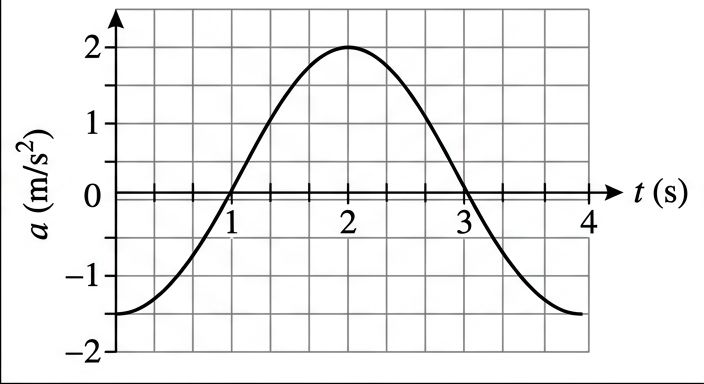
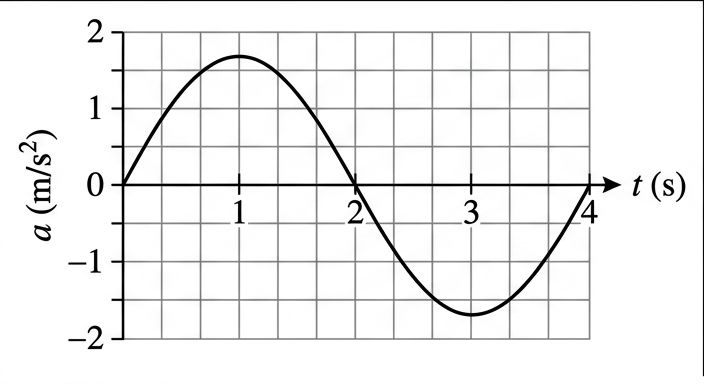
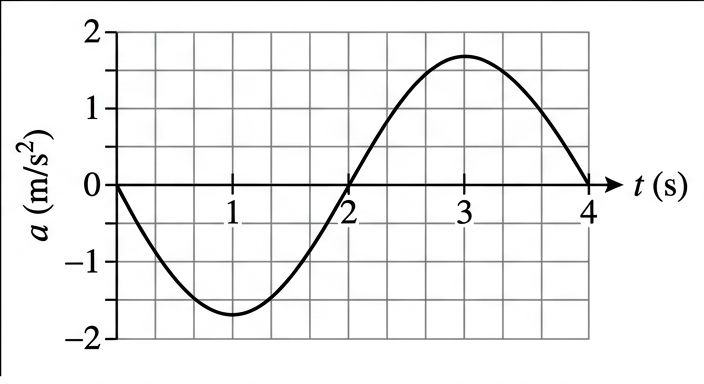
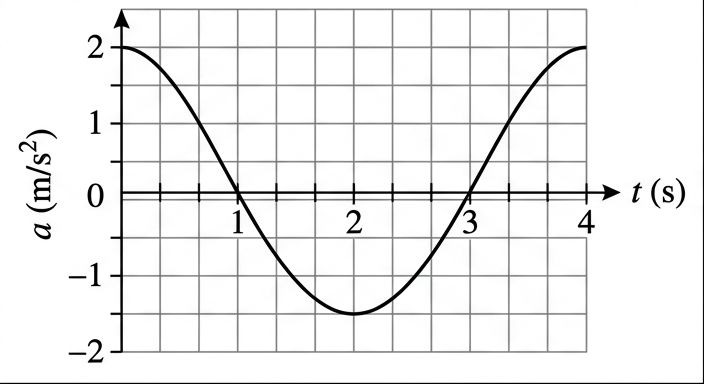
Which of the following graphs could represent the horizontal acceleration aa of the pendulum bob as a function of time tt?

Answer choice A
Answer choice B
Answer choice C
Answer choice D
visual_answers

Stimulus-based practice question

A block attached to a horizontal spring oscillates on a frictionless surface. The graph shows the block's position xx as a function of time tt.

Question

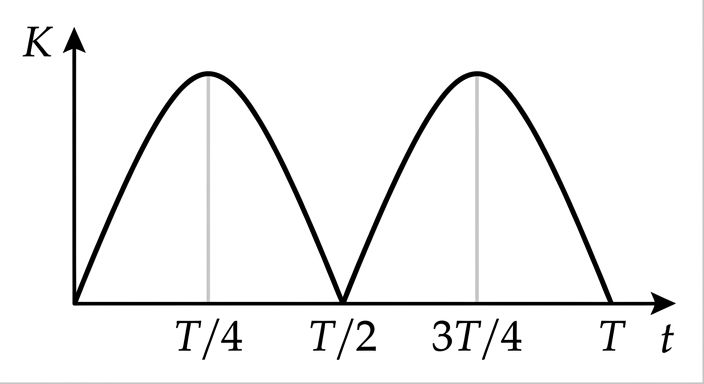
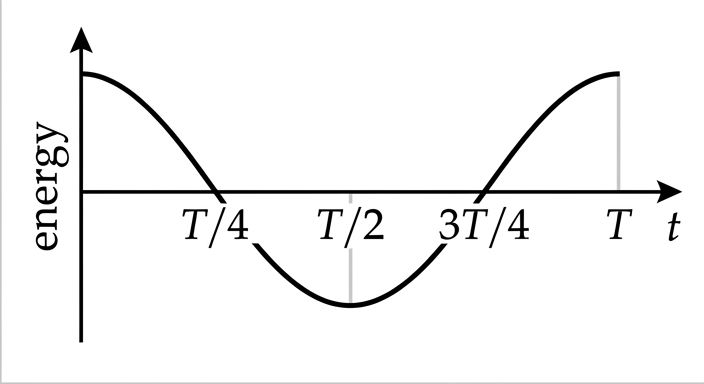
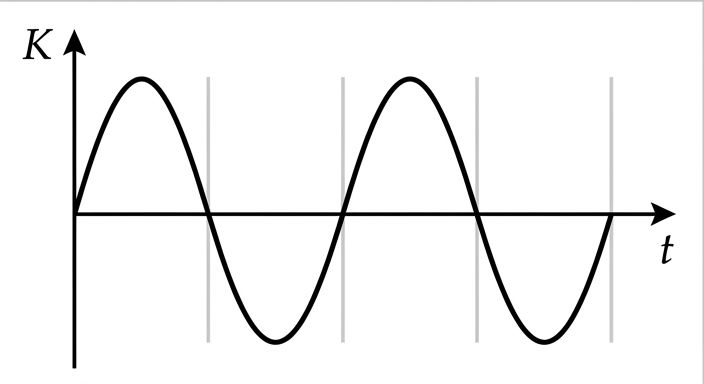
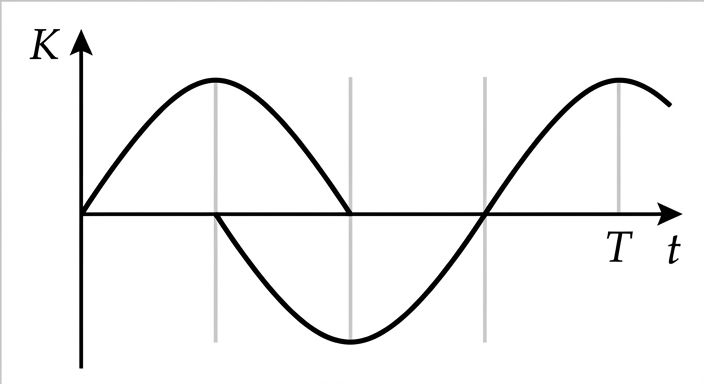
Which of the following graphs could represent the kinetic energy KK of the block as a function of time tt?

Answer choice A
Answer choice B
Answer choice C
Answer choice D

Example FRQs

open all FRQs
FRQ

Spring-mass oscillation energy conservation

2. A cart of mass 0.50 kg (see Figure 1) is attached to a spring and oscillates on a horizontal, frictionless track.

Figure 1. Cart–spring system at three specific positions: +0.20 m (released from rest), 0 m (equilibrium), and −0.20 m (turning point).

Figure 1

Figure 2. Energy bar chart at x = +0.20 m (released from rest).

Figure 2

Figure 3. Energy bar chart at x = 0 m (equilibrium).

Figure 3

Figure 4. Reference energy bar chart at x = −0.10 m (provides the energy scale).

Figure 4
A.

Draw shaded bars that represent K and UsU_s to complete the energy bar charts in Figure 2 and Figure 3 for when the cart is released from rest at x=+0.20 mx=+0.20\ \text{m} and for when the cart is at x=0 mx=0\ \text{m}, respectively. Figure 4 shows an energy bar chart that represents the kinetic energy K of the cart and the spring potential energy Us of the cart-spring system at the instant that the cart is at x=0.10 mx=-0.10\ \text{m}. The spring potential energy UsU_s is defined to be zero when the cart is at x=0 mx=0\ \text{m}.

• Shaded bars should start at the dashed line that represents zero energy.
• Represent any energy that is equal to zero with a distinct line on the zero-energy line.
• The relative heights of each shaded bar should reflect the magnitude of the respective energy consistent with the scale used in Figure 4.

Figure 5. Cart at x = +0.20 m released from rest, and at x = 0 m moving with maximum speed v_max.

Figure 5
B.

Starting with conservation of energy, derive an equation for the maximum speed vmaxv_{\max} of the cart. Express your answer in terms of kk, mm, and the amplitude A=0.20 mA=0.20\ \text{m}. Begin your derivation by writing a fundamental physics principle or an equation from the reference information. Figure 5 shows the cart at x=+0.20 mx=+0.20\ \text{m} when it is released from rest and the cart at x=0 mx=0\ \text{m} when its speed is vmaxv_{\max}. The mass of the cart is 0.50 kg, the spring constant is 80 N/m, and the release position is 0.20 m from equilibrium.

Figure 6. Energy vs. position for the cart–spring system from x = −0.20 m to x = +0.20 m, with Uₛ(x) given; students add E and K(x).

Figure 6
C.

Figure 6 shows a graph of the energy of the cart-spring system as a function of the position xx of the cart from x=0.20 mx=-0.20\ \text{m} to x=+0.20 mx=+0.20\ \text{m}. The spring potential energy Us(x)U_s(x) is shown on the graph.

i.

Sketch and label a line that represents the total mechanical energy EE for the cart-spring system as a function of the position xx from x=0.20 mx=-0.20\ \text{m} to x=+0.20 mx=+0.20\ \text{m}.

ii.

Sketch and label a curve that represents the kinetic energy K(x)K(x) for the cart-spring system as a function of the position xx from x=0.20 mx=-0.20\ \text{m} to x=+0.20 mx=+0.20\ \text{m}.

D.

Indicate whether the magnitude of the acceleration a0.10|a_{0.10}| of the cart at x=+0.10 mx=+0.10\ \text{m} is greater than, less than, or equal to the magnitude of the acceleration a0.20|a_{0.20}| at x=+0.20 mx=+0.20\ \text{m}.

a0.10>a0.20|a_{0.10}| > |a_{0.20}|
a0.10<a0.20|a_{0.10}| < |a_{0.20}|
a0.10=a0.20|a_{0.10}| = |a_{0.20}|
Justify how your response is consistent with the energy lines or curves you drew in Figure 6 in part C.

FRQ

Block acceleration in spring-mass systems

4. In Scenario 1, a block of mass m1=0.60 kgm_1 = 0.60\ \text{kg} is attached to a horizontal ideal spring with spring constant k=120 N/mk = 120\ \text{N/m} on a frictionless surface, as shown in Figure 1. The block is pulled to the right to a displacement x=+0.10 mx = +0.10\ \text{m} from equilibrium and released from rest. The block subsequently undergoes simple harmonic motion. All frictional forces are negligible.

In Scenario 2, the spring is attached to a different block of mass m2=0.90 kgm_2 = 0.90\ \text{kg} on the same frictionless surface, as shown in Figure 2. The block is again pulled to the right to the same displacement x=+0.10 mx = +0.10\ \text{m} from equilibrium and released from rest. The block subsequently undergoes simple harmonic motion. All frictional forces are negligible.

Figure 1. Scenario 1: Block–spring system on a frictionless horizontal surface, with the block pulled to x = +0.10 m and released.

Figure 1

Figure 2. Scenario 2: Same block–spring setup, but with mass m₂ = 0.90 kg; block pulled to the same displacement x = +0.10 m.

Figure 2
A.

Refer to Figure 2. Refer to Figure 1. Indicate whether the magnitude of the acceleration of the block at the instant it is released in Scenario 1, a1a_1, is greater than, less than, or equal to the magnitude of the acceleration at the instant it is released in Scenario 2, a2a_2, by writing one of the following in your answer booklet.

a1>a2a_1 > a_2
a1<a2a_1 < a_2
a1=a2a_1 = a_2

Justify your answer in terms of ALL forces exerted on the block at the instant it is released in each scenario. Use qualitative reasoning beyond referencing equations.

B.

Starting with Newton's second law, derive an expression for the instantaneous acceleration aa of the block at the instant it is released. Express your answer in terms of mm, kk, and xx. Begin your derivation by writing a fundamental physics principle or an equation from the reference information. Consider the general case of a block of mass mm attached to a horizontal ideal spring with spring constant kk on a frictionless surface. The block is released from rest from a displacement xx from equilibrium.

C.

Indicate whether the expression for the acceleration aa you derived in part B is or is not consistent with the claim made in part A. Briefly justify your answer by referencing your derivation in part B.

FRQ

Block-spring system oscillation period changes

1. A student investigates the horizontal motion of a block attached to a spring on a frictionless horizontal surface, as shown in Figure 1. The block is attached to the spring, which is fixed to a wall. The block is displaced from equilibrium and released, undergoing simple harmonic motion (SHM).

Figure 1. Block–spring system on a frictionless horizontal surface at the instant of release.

Figure 1

Figure 2. Axes for a position–time graph x versus t over one full period T.

Figure 2
A.
i.

On the axes shown in Figure 2, sketch a graph of the position x of the block as a function of time t for one full period from t = 0 to t = T. Be sure to indicate the values of x at t = 0, t = T/4, t = T/2, and t = T.

ii.

Derive an expression for the period T of the oscillations in terms of the mass m and the spring constant k. Begin your derivation by writing a fundamental physics principle or an equation from the reference information.

iii.

Derive an expression for the maximum speed v_max of the block in terms of the amplitude A, the mass m, and the spring constant k. Begin your derivation by writing a fundamental physics principle or an equation from the reference information.

B.

Indicate whether the period of the oscillations in the modified system increases, decreases, or remains the same compared to the original system. The block-spring system is modified by adding a second spring in parallel with the first spring, as shown in a new setup (not shown). The second spring has spring constant 40.0 N/m. The block is again displaced to x = +0.120 m and released from rest. Assume the springs remain within their elastic limits and the surface remains frictionless.

Increases
Decreases
Remains the same
Justify your response.
Key terms

TermDefinition
displacement from equilibriumThe distance and direction of an object's position relative to its equilibrium position; in SHM, the restoring force is proportional to this quantity.
resonanceThe condition in which a driven oscillator vibrates at maximum amplitude when the driving frequency matches a natural resonant frequency of the system.

Common unit 7 mistakes

Thinking amplitude affects period

Neither T_s = 2*pi*sqrt(m/k) nor T_p = 2*pi*sqrt(L/g) contains amplitude. A larger oscillation takes the same time per cycle as a smaller one. Amplitude does affect total energy and maximum speed, but not period or frequency.

Confusing where velocity and acceleration are maximum

Velocity is maximum at equilibrium (x = 0), not at the turning points. Acceleration is maximum at the turning points (x = plus or minus A), not at equilibrium. These are out of phase by a quarter cycle, and mixing them up leads to wrong answers on graph and scenario questions.

Applying the pendulum period formula outside the small-angle range

T_p = 2*pi*sqrt(L/g) is valid only for small angular displacements where sin(theta) is approximately equal to theta. For large angles, the motion is no longer simple harmonic and this formula does not apply.

Forgetting that pendulum period is independent of bob mass

The formula T_p = 2*pi*sqrt(L/g) contains no mass term. Changing the mass of the pendulum bob does not change the period. Students often assume heavier bobs swing more slowly.

Using total energy as (1/2)*k*x^2 at an arbitrary position

The total energy is (1/2)*k*A^2, where A is the amplitude, not the current displacement x. At an arbitrary position x, the potential energy is (1/2)*k*x^2 and the kinetic energy makes up the rest. Setting total energy equal to (1/2)*k*x^2 at a non-turning-point position is a common algebra error.

How this unit shows up on the AP exam

Predicting the effect of changing system parameters

A common task presents a spring-mass or pendulum system and asks how the period, frequency, or total energy changes when one variable is altered. You need to apply T_s = 2*pi*sqrt(m/k) or T_p = 2*pi*sqrt(L/g) algebraically, explain why amplitude does not appear, and use E_total = (1/2)*k*A^2 to reason about energy changes. Justifying your answer with the relevant equation is expected.

Translating between representations

Multi-part problems often give one representation of SHM, such as an x-t graph or a position equation, and ask you to derive or sketch the corresponding v-t and a-t graphs, identify specific values at labeled points, or describe the motion in words. Knowing the phase relationships between displacement, velocity, and acceleration and being able to identify turning points and equilibrium crossings from any representation is a core skill.

Applying energy conservation to find speed or position

Problems frequently ask for the speed of an oscillating object at a position other than equilibrium or a turning point. The approach is to set (1/2)*k*A^2 equal to (1/2)*m*v^2 + (1/2)*k*x^2 and solve. Variations include changing the amplitude and asking for the new maximum speed, or describing energy bar charts at different points in the cycle and asking for qualitative comparisons.

Final unit 7 review checklist

  • Final Unit 7 review checklistUse this list to confirm you can handle every major skill in the Oscillations unit before exam day.
  • Identify SHM from a force descriptionGiven a force equation or scenario, confirm whether the restoring force is proportional to displacement from equilibrium and directed opposite to it, satisfying m*a_x = -k*delta_x.
  • Calculate period and frequency for both systemsApply T_s = 2*pi*sqrt(m/k) for a spring-mass oscillator and T_p = 2*pi*sqrt(L/g) for a simple pendulum. Predict how changing m, k, L, or g affects the period, and confirm that amplitude changes have no effect.
  • Read and connect SHM graphsGiven an x-t graph, identify where velocity and acceleration are zero, maximum, or minimum. Sketch corresponding v-t and a-t graphs with correct phase relationships and the same period.
  • Apply energy conservation in SHMUse E_total = (1/2)*k*A^2 = (1/2)*m*v^2 + (1/2)*k*x^2 to find speed at any position. Identify where kinetic and potential energies are maximum or zero, and explain how changing amplitude changes total energy.
  • Explain amplitude independence of periodArticulate in words and with equations why the period of a spring-mass system or small-angle pendulum does not depend on amplitude, and why total energy does depend on amplitude.

How to study unit 7

Step 1: Lock in the SHM force conditionStart with Topic 7.1. Read the topic guide and practice identifying whether a described force qualifies as a restoring force. Write out m*a_x = -k*delta_x and explain in your own words why acceleration is largest at the turning points and zero at equilibrium. Apply the same logic to the pendulum case.
Step 2: Practice period and frequency calculationsWork through Topic 7.2 by solving problems that ask you to calculate T or f for spring-mass and pendulum systems, then predict how the period changes when one variable is doubled or halved. Confirm for yourself that amplitude never appears in either period formula.
Step 3: Interpret and sketch SHM graphsFor Topic 7.3, practice sketching x-t, v-t, and a-t graphs for the same oscillator and labeling the turning points, equilibrium crossings, and phase relationships. Given one graph, derive the other two. Use the equations x = A*cos(2*pi*f*t) to check your sketches numerically.
Step 4: Solve energy problems in SHMWork through Topic 7.4 by applying E_total = (1/2)*k*A^2 = (1/2)*m*v^2 + (1/2)*k*x^2 to find speed at intermediate positions. Practice problems where amplitude changes and you must find the new total energy. Connect energy graphs to position graphs by identifying where KE and PE peak.
Step 5: Review with practice questions and FRQ practiceUse the 25+ practice questions and FRQ practice available for this unit to work through multi-part problems that combine force, period, graphs, and energy in a single scenario. Use the AP score calculator to estimate your estimated score range and identify which topic areas need more attention.

More ways to review

Topic study guides

Open the individual guides for Unit 7 when you want a closer review of one topic.

browse guides

FRQ practice

Practice free-response reasoning and compare your answer with scoring guidance.

practice FRQs

Cram archive videos

Watch past review streams filtered to Unit 7 when you want a video walkthrough.

open videos

Cheatsheets

Use unit cheatsheets for a quick visual review after you work through the notes.

open cheatsheets

Score calculator

Estimate your broader AP score goal after you review the course and exam format.

open calculator

Frequently Asked Questions

What topics are covered in AP Physics 1 Unit 7?

AP Physics 1 Unit 7 covers four topics focused on oscillations and simple harmonic motion: 7.1 Defining Simple Harmonic Motion, 7.2 Frequency and Period of SHM, 7.3 Representing and Analyzing SHM, and 7.4 Energy of Simple Harmonic Oscillators. You'll apply these ideas to spring-object systems and pendulums. The unit connects force, energy, and periodic motion in a way that shows up across many real-world applications. Head to Unit 7 for topic-by-topic practice.

How much of the AP Physics 1 exam is Unit 7?

Unit 7 makes up 5-8% of the AP Physics 1 exam. That weight covers oscillations and simple harmonic motion, including how energy transforms in spring-object systems and pendulums, how to calculate frequency and period, and how to represent SHM graphically and mathematically. It's a smaller unit by topic count (4 topics), but the energy and SHM concepts it introduces connect directly to other units, so a solid understanding pays off on exam day.

What's on the AP Physics 1 Unit 7 progress check (MCQ and FRQ)?

The AP Physics 1 Unit 7 progress check includes both MCQ and FRQ parts drawn from all four unit topics: defining simple harmonic motion, frequency and period, representing and analyzing SHM, and the energy of simple harmonic oscillators. MCQ questions typically ask you to interpret graphs, compare systems, or calculate period and frequency. FRQ questions often ask you to explain energy transformations or justify the motion of a spring or pendulum using SHM principles. Working through the progress check is one of the best ways to spot gaps before the real exam. Find matched practice at Unit 7.

How do I practice AP Physics 1 Unit 7 FRQs?

AP Physics 1 Unit 7 FRQs most often focus on energy in simple harmonic oscillators and representing or analyzing SHM, so those are the two areas to prioritize. Typical question types ask you to sketch or interpret position-time and energy graphs, explain why a restoring force produces SHM, or compare how changing mass or spring constant affects period. To practice effectively, write out full justifications, not just numerical answers. College Board rewards clear reasoning. You can find FRQ-style practice questions at Unit 7.

Where can I find AP Physics 1 Unit 7 practice questions?

The best place to find AP Physics 1 Unit 7 practice questions, including multiple-choice and practice test style problems, is Unit 7. That page organizes MCQ and FRQ practice around all four topics: defining SHM, frequency and period, representing and analyzing SHM, and energy of simple harmonic oscillators. For a practice test experience, work through questions from each topic in one sitting and time yourself. Mixing MCQ and FRQ in the same session mirrors what the real exam feels like.

How should I study AP Physics 1 Unit 7?

Start with the concept of energy in simple harmonic motion, since it ties together nearly every other idea in the unit. Once you understand how kinetic and potential energy trade off in a spring-object oscillator or pendulum, the rest of the unit, including frequency, period, and SHM graphs, clicks into place much faster. Here's a practical study sequence: 1. **Define SHM** (Topic 7.1): Make sure you can explain what a restoring force is and why it produces oscillations. 2. **Frequency and period** (Topic 7.2): Practice deriving and applying the period formulas for springs and pendulums. 3. **Graphs and representations** (Topic 7.3): Sketch position, velocity, and acceleration vs. time graphs from scratch until it feels automatic. 4. **Energy** (Topic 7.4): Work problems where you track energy at different points in the oscillation cycle. After each topic, do a short set of MCQ to check your understanding before moving on. Find topic-aligned practice at Unit 7.

Ready to review Unit 7?Start with the notes, check the topic cards, and use the practice or resource links when they are available for this course.