AP English Literature Prose Analysis Essay Practice
47 prose fiction analysis prompts written in the AP format. Pick one, read the full passage, and write your analysis. Fiveable scores each Prose Analysis Essay response part by part on the AP rubric.
Your first scored response is included. A plan unlocks unlimited scoring.
47 questions
sorted by unit
Literary devices depicting internal psychological conflict
Unit 1: Intro to Short Fiction
In this excerpt from Rebecca Harding Davis's novella Life in the Iron-Mills; Or, The Korl Woman, published in 1861, a woman brings supper to Hugh Wolfe at his workplace. Read the passage carefully. Then, in a well-written essay, analyze how Davis uses literary elements and techniques to convey the complexity of the woman's internal experience.
Respond to the prompt with a thesis that presents a defensible interpretation.
Select and use evidence to support your line of reasoning.
Explain how the evidence supports your line of reasoning.
Use appropriate grammar and punctuation in communicating your argument.
She shook her head. Wolfe had forgotten her. He turned, hearing the man, and came closer.
“I did no' think; gi' me my supper, woman.”
She watched him eat with a painful eagerness. With a woman's quick instinct, she saw that he was not hungry,--was eating to please her. Her pale, watery eyes began to gather a strange light.
“Is't good, Hugh? T' ale was a bit sour, I feared.”
“No, good enough.” He hesitated a moment. “Ye're tired, poor lass! Bide here till I go. Lay down there on that heap of ash, and go to sleep.”
He threw her an old coat for a pillow, and turned to his work. The heap was the refuse of the burnt iron, and was not a hard bed; the half-smothered warmth, too, penetrated her limbs, dulling their pain and cold shiver.
Miserable enough she looked, lying there on the ashes like a limp, dirty rag,--yet not an unfitting figure to crown the scene of hopeless discomfort and veiled crime: more fitting, if one looked deeper into the heart of things, at her thwarted woman's form, her colorless life, her waking stupor that smothered pain and hunger,--even more fit to be a type of her class. Deeper yet if one could look, was there nothing worth reading in this wet, faded thing, halfcovered with ashes? no story of a soul filled with groping passionate love, heroic unselfishness, fierce jealousy? of years of weary trying to please the one human being whom she loved, to gain one look of real heart-kindness from him? If anything like this were hidden beneath the pale, bleared eyes, and dull, washed-out-looking face, no one had ever taken the trouble to read its faint signs: not the half-clothed furnace-tender, Wolfe, certainly. Yet he was kind to her: it was his nature to be kind, even to the very rats that swarmed in the cellar: kind to her in just the same way. She knew that. And it might be that very knowledge had given to her face its apathy and vacancy more than her low, torpid life. One sees that dead, vacant look steal sometimes over the rarest, finest of women's faces,--in the very midst, it may be, of their warmest summer's day; and then one can guess at the secret of intolerable solitude that lies hid beneath the delicate laces and brilliant smile. There was no warmth, no brilliancy, no summer for this woman; so the stupor and vacancy had time to gnaw into her face perpetually. She was young, too, though no one guessed it; so the gnawing was the fiercer.
She lay quiet in the dark corner, listening, through the monotonous din and uncertain glare of the works, to the dull plash of the rain in the far distance, shrinking back whenever the man Wolfe happened to look towards her. She knew, in spite of all his kindness, that there was that in her face and form which made him loathe the sight of her. She felt by instinct, although she could not comprehend it, the finer nature of the man, which made him among his fellow-workmen something unique, set apart. She knew, that, down under all the vileness and coarseness of his life, there was a groping passion for whatever was beautiful and pure, that his soul sickened with disgust at her deformity, even when his words were kindest. Through this dull consciousness, which never left her, came, like a sting, the recollection of the dark blue eyes and lithe figure of the little Irish girl she had left in the cellar. The recollection struck through even her stupid intellect with a vivid glow of beauty and of grace. Little Janey, timid, helpless, clinging to Hugh as her only friend: that was the sharp thought, the bitter thought, that drove into the glazed eyes a fierce light of pain. You laugh at it? Are pain and jealousy less savage realities down here in this place I am taking you to than in your own house or your own heart,--your heart, which they clutch at sometimes? The note is the same, I fancy, be the octave high or low.
Source: Rebecca Harding Davis, Life in the Iron-Mills; Or, The Korl Woman, 1861
What the Prose Analysis Essay asks
The prose fiction analysis essay is FRQ 2 on the AP English Literature exam. You read a passage of prose fiction and write an essay analyzing how the author uses literary elements and techniques to develop a complex effect.
- 40 min
- suggested time
- 6 points
- across rows A to C
- 55%
- of your score, across all three essays
Part A: Thesis
A defensible interpretation of the passage that answers the prompt
1 pt
Part B: Evidence and commentary
Quotes from the passage, with commentary on how several techniques work together
4 pts
Part C: Sophistication
A complex reading, sustained across the essay
1 pt
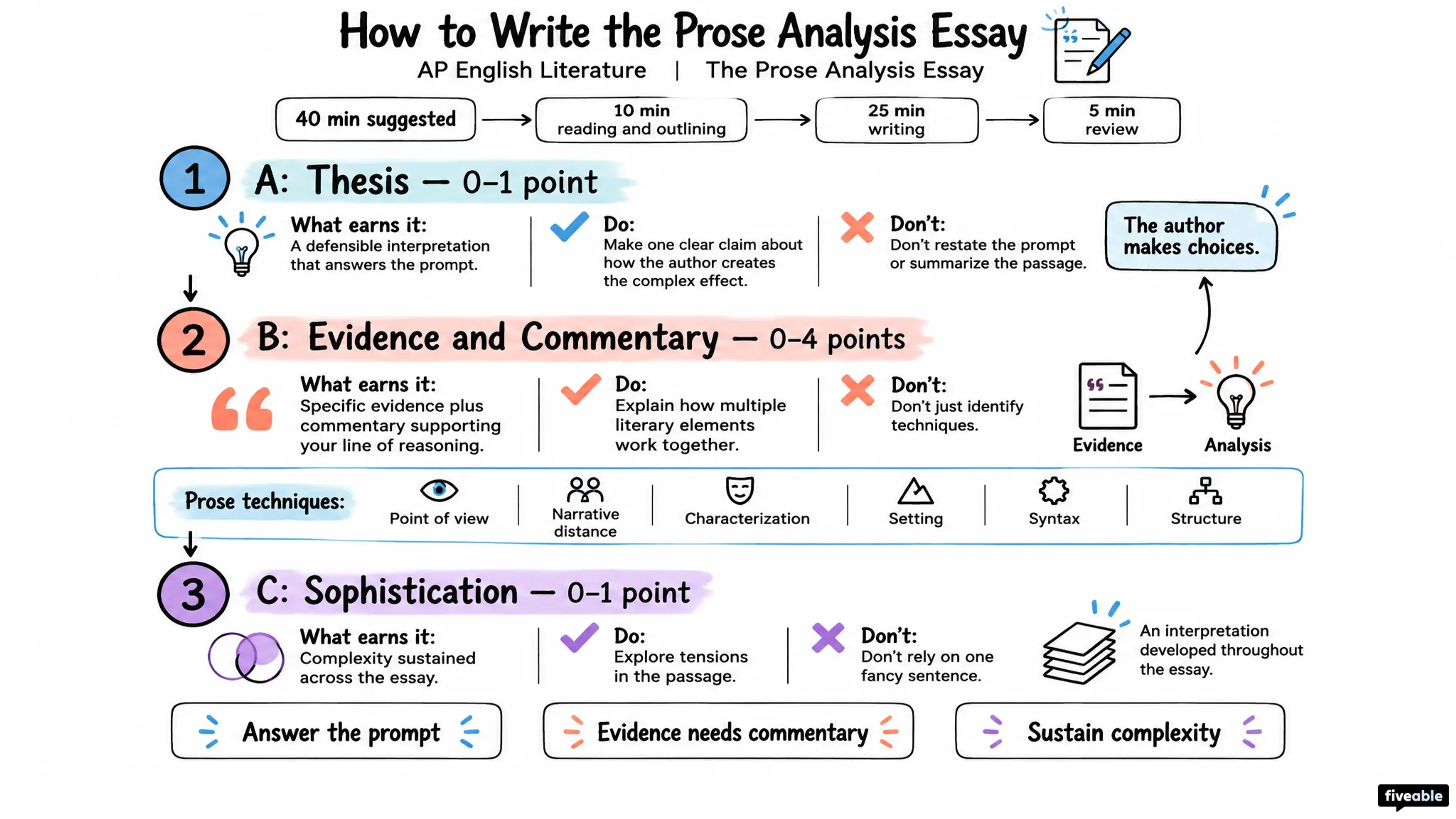
Prose Analysis Essay skill sheet
Every rubric point on one page: what earns it, what to do and what to avoid. Tap the sheet to see it full size.
How Prose Analysis Essay practice works
Each question follows the exam’s format, from the full prompt to a score on every part.
Read the full passage
The prompt and the full prose passage, laid out the way the exam shows them.
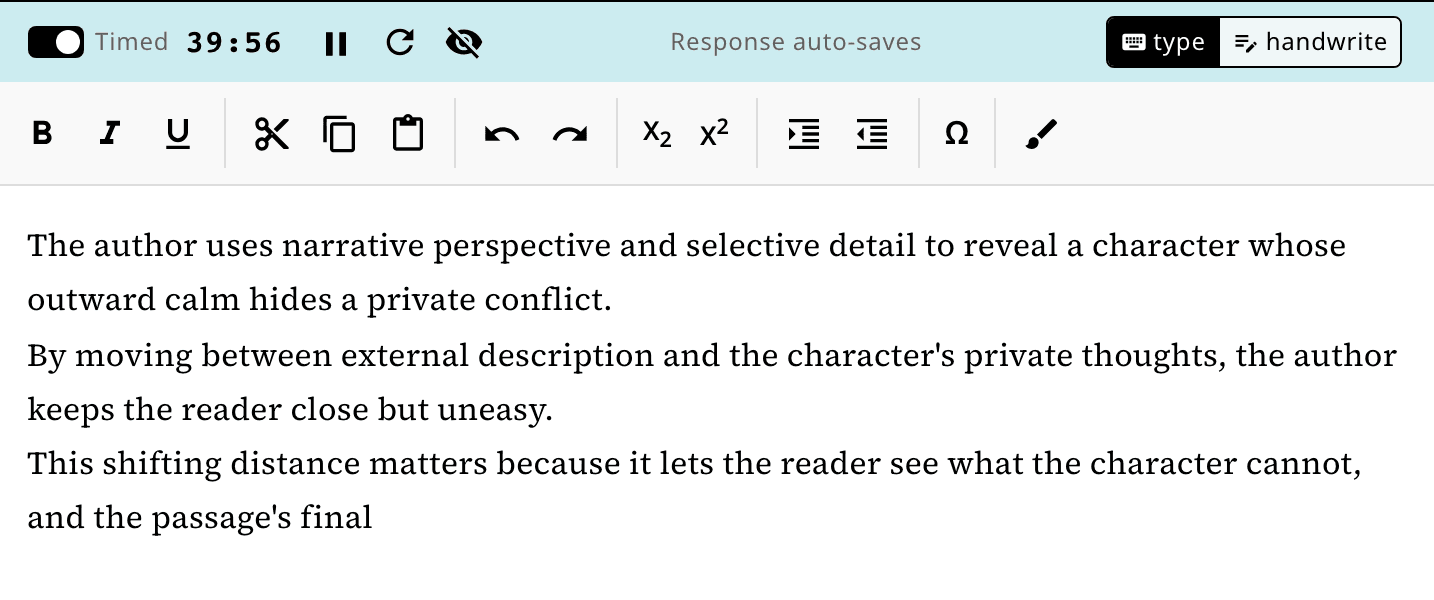
Write on a 40-minute timer
The time to plan for on exam day. Pause it or turn it off, and your response saves as you go.
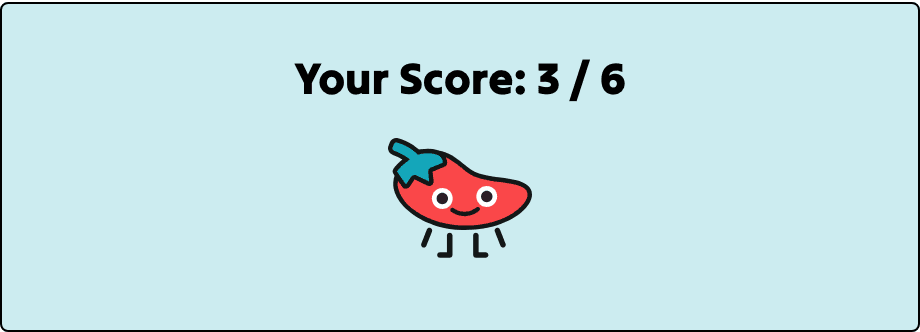
Submit for a score out of 6
Your response is scored against the scoring guidelines written for that question. Your first score is included.
Feedback on every part
A summary at the top tells you what to work on next. Below it, each part shows whether you earned the point and what the scoring guidelines were looking for.
Detailed Feedback
Part A: 1/1 point
Earned the point. You provided a defensible thesis that responds to the prompt by claiming Ishmael's motivation is influenced by the sea being a place of competition and conflict rather than just a physical space.
Part C: 0/1 point
Did not earn the point. To earn the sophistication point, the essay needs to demonstrate a complex understanding of the text, such as exploring tensions within Ishmael's motivations or situating the analysis in a broader context, and this complexity must be consistently maintained throughout the argument.
Questions about the Prose Analysis Essay
How many responses can I get scored?
You can read every question without a plan. Your first scored response is included. A plan unlocks unlimited scoring.
What should I analyze in a prose passage?
Point of view, narrative distance, characterization, syntax, and structure come up most. Tie each choice to the effect the prompt names.
How is the prose essay different from poetry analysis?
Both use the same 6-point rubric. The prose passage is longer, so the work is covering more of the text while keeping your commentary specific.
Are these real College Board questions?
No. We wrote them in the AP format, with the same 6-point rubric, and wrote scoring guidelines for each one.
Can I write my answer by hand?
Yes. Switch the editor to handwrite, write on paper, and add a photo of your page.
More AP English Literature practice
Poetry Analysis Essay practice
Poetry analysis prompts with the full poem and its context.
Literary Argument Essay practice
Literary argument prompts with the full list of suggested works.
AP English Literature FRQs
Every FRQ type for AP English Literature, with practice for each.
Write your first Prose Analysis Essay
Pick one from the list, or let us choose for you.
Teaching AP English Literature? Assign these Prose Analysis Essays to your class