AP exam review verified for 2027

AP Comparative Government Unit 4 Review: Party Systems & Electoral Participation

Review AP Comparative Government Unit 4 to understand how electoral systems, party structures, and citizen organizations shape political participation across China, Iran, Mexico, Nigeria, Russia, and the UK. This unit connects regime type to real mechanisms of access and representation, making it essential for comparison tasks on the exam.

Use the topic guides, practice questions, FRQ practice, and AP score calculator available for this unit to focus your review.

What is AP Comparative Government unit 4?

Unit 4 asks you to explain how formal rules and informal practices determine who participates in politics and how much influence they have. Electoral systems set the rules for translating votes into seats. Party systems determine how many real competitors exist and how tightly the state controls them. Social movements and interest groups represent alternative channels when parties fail to represent citizens adequately.

Unit 4 is about the rules and organizations that connect citizens to power: electoral systems, party structures, social movements, interest groups, and whether those groups operate freely or under state control.

Electoral systems vary by design and purpose

Single-member district plurality systems like the UK's first-past-the-post favor two large parties and strong geographic accountability. Proportional representation increases the number of parties and improves minority and women's representation. Many countries use mixed systems, and some, like China, use indirect elections entirely.

Party systems reflect regime type

China's Communist Party monopolizes power while permitting eight minor parties. Russia uses registration barriers, media restrictions, and threshold rules to keep United Russia dominant. Mexico transitioned from PRI one-party dominance to a competitive multiparty system through electoral reforms. Nigeria and the UK run genuinely competitive multiparty systems.

Civil society channels matter when parties are weak

Social movements like Iran's Green Movement, Mexico's Zapatistas, and Nigeria's MEND and MOSOP push for change outside formal party structures. Interest groups are more narrowly organized. Whether groups operate freely or through state-approved channels depends on whether the system is pluralist or corporatist.

Rules determine access

Every topic in Unit 4 returns to the same question: who gets access to political power, and what rules create or block that access? Electoral rules, party registration laws, candidate vetting, gender quotas, reserved seats, and interest group structures all function as gatekeeping mechanisms. Comparing how each course country designs those gates is the core analytical skill of this unit.

AP Comparative Government unit 4 topics

4.1

Electoral Systems and Rules

Describes how each course country selects representatives, covering China's indirect NPC elections, Iran's Guardian Council vetting and reserved seats, Mexico's mixed Chamber of Deputies system, the UK's first-past-the-post House of Commons, Russia's mixed State Duma elections, and Nigeria's direct elections.

open guide
4.2

Objectives of Election Rules

Explains how PR increases party diversity and minority representation, how FPTP produces two-party systems and geographic accountability, and how different presidential election rules such as Mexico's plurality, Nigeria's 25% threshold, and Iran and Russia's runoff requirements serve distinct regime objectives.

open guide
4.3

Political Party Systems

Describes party system types across course countries, from China's one-party state and Russia's dominant-party system to Mexico's post-reform multiparty competition and Nigeria's competitive multiparty system, with attention to the specific rules that maintain or challenge party dominance.

open guide
4.4

Role of Political Party Systems

Explains how party systems link citizens to policy making, comparing the CPC's total control in China, Iran's factional alliances operating under Guardian Council constraints, Mexico's coalition-based multiparty competition, Nigeria's ethnically shaped party representation, and Russia's structurally limited opposition.

open guide
4.5

Impact of Social Movements and Interest Groups

Distinguishes social movements from interest groups and explains how each affects political change, using examples including Iran's Green Movement, Mexico's Zapatistas, Nigeria's MEND and MOSOP, and Russia's anti-LGBT protests.

open guide
4.6

Pluralist and Corporatist Interests

Describes pluralist and corporatist interest group systems, contrasting autonomous group competition with state-controlled single peak associations, and uses Mexico's transition from PRI-era corporatism to a more pluralist system as the central course example.

open guide
practice snapshot

Hardest AP Comparative Government unit 4 topics

This snapshot uses Fiveable practice activity to show where students tend to miss questions and which review moves are worth prioritizing first.

72%average MCQ accuracy

Across 12k multiple-choice practice attempts for this unit.

12kMCQ attempts

Practice activity included in this snapshot.

73%average FRQ score

Across 93 scored free-response attempts for this unit.

Hardest topics in unit 4

MCQ miss rate
4.3

Review Political Party Systems with attention to how the concept appears in AP-style source and evidence questions.

30%2,202 tries
4.2

Review Objectives of Election Rules with attention to how the concept appears in AP-style source and evidence questions.

29%2,274 tries
4.1

Review Electoral Systems and Rules with attention to how the concept appears in AP-style source and evidence questions.

28%2,716 tries
4.5
Impact of Social Movements and Interest Groups

Review Impact of Social Movements and Interest Groups with attention to how the concept appears in AP-style source and evidence questions.

25%1,729 tries

Unit 4 review notes

4.1

Electoral Systems and Rules

Each course country uses a distinct set of rules to select representatives. The key distinctions are between direct and indirect elections, single-member and multimember districts, and plurality versus majority requirements. China's National People's Congress is selected indirectly through a series of local and regional people's congresses, with the Communist Party controlling candidate selection at each level. Iran's Majles has 290 seats filled by direct elections in single-member and multimember districts, with a two-round runoff if no candidate wins a majority; the Guardian Council vets all candidates before the election, and a small number of seats are reserved for non-Muslim minorities. Mexico's Congress of the Union uses a mixed system: the Chamber of Deputies has 300 single-member district seats elected by plurality and 200 seats allocated by proportional representation from party lists, while the Senate uses a combination of three-seat constituencies and 32 proportional representation seats.

  • Indirect election (China): NPC members are chosen through a chain of local and regional congresses, not by direct national popular vote, keeping the CCP in control of outcomes.
  • Guardian Council vetting (Iran): All Majles candidates must be approved by the Guardian Council before the election, effectively limiting who voters can choose from.
  • Reserved seats (Iran): A small number of Majles seats are set aside for Christians, Jews, and Zoroastrians, guaranteeing minimal minority representation.
  • Mixed electoral system (Mexico): Mexico's Chamber of Deputies combines 300 SMD plurality seats with 200 PR party-list seats, balancing geographic accountability with broader party representation.
  • Two-round system: Used in Iran and Russia for executive elections; if no candidate wins an absolute majority in round one, the top two face a runoff.
Can you describe how each of the six course countries selects its national legislature, and identify which use direct elections, indirect elections, or mixed systems?
CountryLegislative bodyElection methodKey rule or constraint
ChinaNational People's CongressIndirect via local/regional congressesCCP controls candidate selection
IranMajles (290 seats)Direct, SMD and multimember districtsGuardian Council vets all candidates
MexicoChamber of DeputiesMixed: 300 SMD + 200 PRGender quotas apply to party lists
UKHouse of CommonsDirect, single-member districtsFirst-past-the-post plurality
RussiaState DumaMixed: SMD + party list PRHigh registration barriers for parties
4.2

Objectives of Election Rules

Electoral rules are not neutral; they are designed to produce specific political outcomes. Proportional representation tends to increase the number of parties in the legislature and improves the election of women and minority candidates, especially when combined with gender quotas or reserved seats. Single-member district plurality systems, sometimes called first-past-the-post, tend to produce two-party systems because voters engage in strategic voting to avoid wasting their ballot on smaller parties; they also create strong geographic accountability since each district has one identifiable representative. Presidential election rules vary: Mexico's president is elected by a simple plurality of the national popular vote, while Nigeria requires a presidential candidate to win a plurality and receive at least 25 percent of the vote in two-thirds of the states, creating a national mandate requirement. Iran and Russia require an absolute majority, triggering a runoff if no candidate clears 50 percent in the first round. Independent electoral commissions in Mexico and Nigeria are designed to reduce fraud and increase electoral competition.

  • Proportional representation: Seats are allocated based on each party's share of the vote, increasing the number of parties and improving minority and women's representation.
  • First-past-the-post (FPTP): The candidate with the most votes in a single-member district wins, regardless of whether they have a majority; tends to produce two-party systems.
  • Runoff election: A second round of voting between the top two candidates when no one wins an absolute majority in the first round, used in Iran and Russia.
  • Nigeria's 25% rule: Presidential candidates must win a plurality and receive at least 25 percent of the vote in two-thirds of Nigeria's states, ensuring a national geographic base of support.
  • Independent election commission: A non-partisan body overseeing elections; Mexico's INE and Nigeria's INEC are designed to reduce fraud and increase competitive fairness.
Can you explain why PR tends to produce more parties while FPTP tends to produce two-party systems, and link each presidential election rule to its course country?
RuleEffect on partiesEffect on representationCourse country example
Proportional representationIncreases number of partiesMore minority and women candidatesMexico (200 PR seats), Russia (Duma PR tier)
Single-member district pluralityFavors two large partiesStrong geographic accountabilityUK House of Commons, Mexico SMD tier
Absolute majority / runoffReduces first-round winnersEnsures majority legitimacyIran, Russia (presidential)
25% in two-thirds of statesRequires broad national coalitionPrevents regional-only candidatesNigeria (presidential)
Gender quotasNo direct party effectIncreases women's representationMexico party lists
4.3

Political Party Systems

Party systems describe how many parties compete and how much real competition exists. China operates as a one-party state: the Communist Party of China has held governing power since 1949, and while eight other parties are permitted, they exist only for consultation and hold no real power. Russia uses a set of legal and administrative tools to maintain United Russia's dominance without formally banning opposition: increasing party registration requirements, allowing only registered parties to run, using selective court decisions to disqualify candidates, restricting opposition media access, raising electoral threshold rules, and eliminating direct gubernatorial elections. Mexico transitioned away from PRI one-party dominance through a series of reforms including eliminating el dedazo, reducing patronage through privatization, decentralizing subnational power, and strengthening the National Electoral Institute. Nigeria operates a genuine multiparty system where the People's Democratic Party and the All Progressives Congress compete for power, though ethnic and regional affiliations heavily shape party support.

  • Communist Party of China (CPC): The only party allowed to hold governing power in China; eight minor parties exist for consultation but have no independent political authority.
  • United Russia: Russia's dominant party, which maintains power through legal barriers to competition rather than outright banning of other parties.
  • El dedazo: The informal Mexican practice in which the sitting president chose the next PRI presidential candidate; its elimination was a key step in Mexico's democratic transition.
  • National Electoral Institute (INE): Mexico's independent electoral body, strengthened through reform to oversee elections and reduce PRI manipulation of the electoral process.
  • Multiparty system (Nigeria): Nigeria has multiple competing parties, with the PDP and APC as the two strongest, though ethnic quotas and regional loyalties shape competition.
Can you distinguish between China's one-party state, Russia's dominant-party system, Mexico's transition to multiparty competition, and Nigeria's competitive multiparty system?
CountryParty system typeKey mechanism of control or competition
ChinaOne-party stateCPC monopoly; eight minor parties for consultation only
RussiaDominant partyRegistration barriers, media limits, threshold rules favor United Russia
MexicoMultiparty (post-transition)INE reforms, end of el dedazo, PAN/PRI/PRD competition
NigeriaMultipartyPDP and APC compete; ethnic quotas shape representation
UKTwo-party dominantFPTP favors Conservative and Labour; SNP holds regional seats
4.4

Role of Political Party Systems

Party systems link citizens to policy making, but the strength of that link varies enormously. In China, the CPC has controlled the government and military since 1949; minor parties fill limited offices but have no independent policy role. In Iran, formal political parties do not exist; instead, loosely organized factions such as reformists and principlists form electoral alliances, but the Guardian Council's vetting power means these alliances have weak and uncertain connections to constituents. In Mexico, PAN, PRI, and PRD are allowed to form coalitions to nominate candidates, and the INE provides a framework for competitive elections. In Nigeria, multiple parties compete, and ethnic quotas and the federal character principle shape how representation is distributed across the country's diverse regions. In Russia, United Russia dominates the State Duma, and opposition parties face structural barriers that limit their ability to translate voter support into policy influence.

  • Reformists and principlists (Iran): The two main factional groupings in Iranian politics that operate as loose alliances rather than formal parties, competing within the limits set by the Guardian Council.
  • Federal character principle (Nigeria): A constitutional requirement that government appointments and representation reflect Nigeria's ethnic and regional diversity.
  • Coalition candidacies (Mexico): Mexican parties are permitted to jointly nominate candidates, allowing PAN, PRI, and PRD to coordinate electoral strategy.
  • Party-state dual governance (China): The CPC governs through both party structures and state institutions simultaneously, making the party inseparable from the government.
  • Linkage institutions: Parties, interest groups, and media that connect citizen preferences to government policy; the strength of this linkage varies by regime type.
Can you explain how each course country's party system either strengthens or weakens the link between citizen participation and policy making?
4.5

Social Movements and Interest Groups

Social movements are large, loosely organized collective efforts pushing for broad political or social change. Interest groups are formally organized to advocate for a specific policy or constituency. The distinction matters because social movements often emerge when formal channels like parties or elections are blocked or ineffective. Iran's Green Movement in 2009 used social media to mobilize protests against alleged fraud in the presidential election, challenging the regime's legitimacy. Mexico's Zapatista uprising in Chiapas in 1994 combined indigenous rights demands with opposition to NAFTA, using armed protest and autonomous municipalities to pressure the state. In Nigeria, MEND used armed tactics in the Niger Delta to demand redistribution of oil revenues, while MOSOP and Ken Saro-Wiwa pursued nonviolent advocacy for Ogoni environmental and political rights. In Russia, anti-LGBT protests emerged in response to the 2013 propaganda law, illustrating how social movements can form around civil rights issues even in restrictive regimes.

  • Social movement: A large, loosely organized group pushing collectively for significant political or social change, often operating outside formal party or electoral channels.
  • Interest group: A formally organized body advocating for a specific policy issue or constituency, distinct from social movements in its narrow focus and organizational structure.
  • Green Movement (Iran, 2009): A protest movement that challenged the results of the presidential election, using social media for mobilization and demanding electoral transparency.
  • Zapatistas (Mexico): An indigenous-led movement in Chiapas that launched an armed uprising in 1994 against NAFTA and socioeconomic inequality, demanding indigenous autonomy.
  • MEND and MOSOP (Nigeria): Two movements in the Niger Delta: MEND used armed tactics to demand oil revenue redistribution, while MOSOP pursued nonviolent advocacy for Ogoni rights and environmental protection.
Can you distinguish social movements from interest groups and give a specific example of each from at least two course countries?
MovementCountryMain demandTactic
Green MovementIranElectoral transparency and anti-corruptionSocial media mobilization, street protests
Zapatistas (EZLN)MexicoIndigenous rights, opposition to NAFTAArmed uprising, autonomous municipalities
MENDNigeriaOil revenue redistributionArmed sabotage of oil infrastructure
MOSOPNigeriaOgoni environmental and political rightsNonviolent advocacy; Ken Saro-Wiwa led
Anti-LGBT protestsRussiaCivil rights for LGBT citizensPublic protest against 2013 propaganda law
4.6

Pluralist and Corporatist Interests

Pluralism and corporatism describe two different ways interest groups gain access to policy making. In a pluralist system, autonomous groups compete freely to influence government without state direction; no single group has a monopoly on representing a sector, and lobbying is the primary tool. In a corporatist system, the government controls access to policy making by designating state-sanctioned groups or single peak associations (SPAs) to represent labor, business, and agricultural sectors; these groups negotiate directly with the state in a structured, often tripartite arrangement. The state retains significantly more control over citizen input in a corporatist system. Mexico under the PRI was a classic example of state corporatism: the CTM represented labor, the CNC represented peasants, and the CNOP represented popular organizations, all formally linked to the PRI. As Mexico democratized, it shifted away from this model toward a more pluralist system in which autonomous groups compete independently for policy influence.

  • Pluralism: An interest group system in which autonomous groups compete freely to influence policy without state direction or a monopoly on representation.
  • Corporatism: An interest group system in which the state controls policy access by designating approved single peak associations to represent labor, business, and agriculture.
  • Single peak association (SPA): A state-sanctioned organization that holds a monopoly on representing a particular sector, such as labor or agriculture, in a corporatist system.
  • PRI-era Mexico corporatism: Under the PRI, the CTM (labor), CNC (peasants), and CNOP (popular organizations) were formally incorporated into the party structure, giving the state control over group demands.
  • Transition from corporatism to pluralism (Mexico): As the PRI lost dominance through electoral reforms and privatization, Mexico's interest group system shifted toward autonomous group competition characteristic of pluralism.
Can you explain the difference between pluralist and corporatist systems and describe how Mexico's interest group system changed over time?
FeaturePluralismCorporatism
Group autonomyGroups operate independently of the stateGroups are state-sanctioned or state-created
Access to policy makingOpen competition among many groupsControlled through designated SPAs
State control over inputLow; state does not direct group activityHigh; state mediates and limits group demands
Number of groups per sectorMultiple competing groupsOne peak association per sector
Mexico examplePost-PRI autonomous NGOs and unionsPRI-era CTM, CNC, and CNOP

Practice AP Comparative Government unit 4 questions

Try AP-style multiple-choice questions and written prompts after you review the notes.

Example AP-style MCQs

open all practice
MCQ

AP-style practice question

Question

Which factor most limits what data on China’s eight minor parties reveal about the party system?

State control prevents the eight minor parties from acting as independent political actors

These parties lack electoral competition so election results do not show real pluralism

Language and translation limits hinder outsiders from fully interpreting party platforms

State secrecy limits public information but stems from Communist Party control

MCQ

AP-style practice question

Question

Compared to Iran's Green Movement, which focused on election integrity, the Zapatista uprising in Mexico differed primarily in that it

targeted systemic economic inequality rather than a single electoral event

employed only nonviolent protest methods while Iran used military force

sought to establish a new form of government rather than reform existing institutions

succeeded in achieving all stated goals while Iran's movement faced complete suppression

Example FRQs

open all FRQs
FRQ

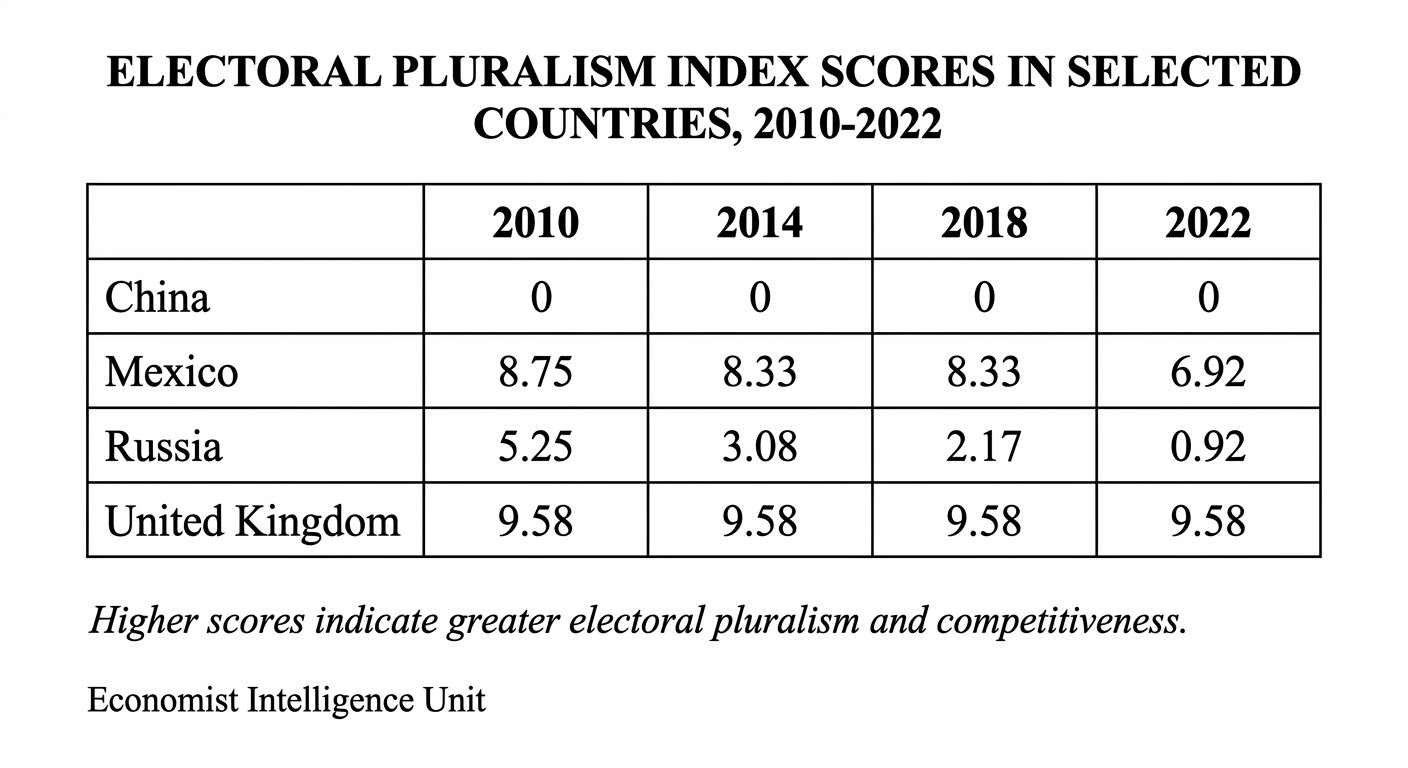
FRQ 2 – Quantitative Analysis

ELECTORAL PLURALISM INDEX SCORES IN SELECTED COUNTRIES, 2010-2022

2. Respond to parts A, B, C, D, and E.

A.

Using the data in the table, identify the country with the highest Electoral Pluralism Index score in 2022.

B.

Using the data in the table, describe a trend in Mexico's Electoral Pluralism Index score between 2010 and 2022.

C.

Describe political pluralism.

D.

Using the data in the table, draw a conclusion that explains China's Electoral Pluralism Index scores between 2010 and 2022.

E.

Explain how the trend in Russia's Electoral Pluralism Index score between 2010 and 2022 relates to changes in its regime type.

FRQ

Electoral systems and legislative representation outcomes

3. Compare the impact of electoral systems on legislative representation in two different AP Comparative Government and Politics course countries.

A.

Describe a proportional representation electoral system.

B.

Describe the electoral system used to elect the national legislature in two different AP Comparative Government and Politics course countries.

C.

Explain how the electoral system affects the representation of smaller political parties in the legislature in each of the two AP Comparative Government and Politics course countries described in (B).

FRQ

Single-member district electoral systems and two-party outcomes

1. Respond to parts A, B, C, and D.

A.

Describe a single-member district (SMD) electoral system.

B.

Describe the party system that typically emerges in countries with single-member district electoral systems.

C.

Explain how single-member district systems limit the legislative representation of minor parties.

D.

Explain why a country might maintain a single-member district system despite the potential for disproportionate representation.

Key terms

TermDefinition
Proportional RepresentationAn electoral system in which legislative seats are allocated based on each party's share of the vote, tending to increase the number of parties and improve minority and women's representation.
First-past-the-post (FPTP)A single-member district electoral system in which the candidate with the most votes wins regardless of whether they have a majority; tends to produce two-party systems and strong geographic accountability.
Guardian CouncilIran's powerful body that vets all candidates for the Majles and the presidency, effectively limiting electoral competition by disqualifying candidates before voting begins.
indirect electionAn electoral process in which representatives are chosen through intermediate bodies rather than direct popular vote; used in China's selection of the National People's Congress.
runoff electionA second round of voting held when no candidate wins an absolute majority in the first round; used in Iran and Russia for presidential elections.
Communist Party of ChinaThe only party permitted to hold governing power in China; maintains centralism and order while allowing eight minor parties to exist for consultation only.
United RussiaRussia's dominant political party, which maintains power through legal barriers including registration requirements, media restrictions, and electoral threshold rules rather than outright banning of opposition.
El DedazoThe informal Mexican practice in which the sitting president chose the next PRI presidential candidate; its elimination was a key step in Mexico's democratic transition.
Social MovementsLarge, loosely organized groups pushing collectively for broad political or social change, such as Iran's Green Movement, Mexico's Zapatistas, and Nigeria's MEND and MOSOP.
PluralismAn interest group system in which autonomous groups compete freely to influence policy without state direction or a monopoly on representing any sector.
reserved seatsLegislative seats designated for specific groups to ensure their representation; used in Iran's Majles for non-Muslim minorities including Christians, Jews, and Zoroastrians.
Gender QuotasRules requiring a minimum percentage of candidates or seats to be filled by women; applied to Mexico's party lists to increase women's representation in the Chamber of Deputies.

Common unit 4 mistakes

Confusing China's one-party state with Russia's dominant-party system

China formally prohibits any party from holding governing power except the CPC. Russia technically allows multiple parties to register and compete, but uses legal and administrative tools to ensure United Russia dominates. These are structurally different systems, and the exam expects you to explain the specific mechanisms in each case.

Saying Iran has no elections

Iran holds direct elections for the Majles and the presidency. The key constraint is not the absence of elections but the Guardian Council's candidate vetting, which limits who voters can actually choose from. Always pair the fact of elections with the vetting mechanism.

Mixing up PR effects and FPTP effects

Proportional representation increases the number of parties and improves minority and women's representation. First-past-the-post reduces the number of viable parties and strengthens geographic accountability. Students often reverse these or apply them to the wrong country.

Treating social movements and interest groups as interchangeable

Interest groups are formally organized around a specific policy issue. Social movements are large, loosely organized, and push for broad social or political change. The Green Movement and the Zapatistas are social movements; a labor union or business association is an interest group. The distinction affects how you explain their political impact.

Forgetting that Mexico is the primary example for both party system transition and corporatism to pluralism

Mexico appears in Topics 4.3, 4.4, and 4.6 as a case study. Its transition from PRI dominance to multiparty competition and from corporatist to pluralist interest group structures are two separate but related changes. Do not conflate them or apply the corporatism argument to other course countries without evidence.

How this unit shows up on the AP exam

Country comparison tasks

Unit 4 is heavily tested through comparison questions that ask you to identify a similarity or difference between two course countries and explain its political significance. Common pairings include China and Russia on party control mechanisms, Mexico and Nigeria on multiparty competition, and Iran and China on candidate selection constraints. Practice stating the comparison precisely and then explaining the cause or consequence, not just restating the description.

Concept application across countries

The exam frequently asks you to apply a concept such as proportional representation, corporatism, or social movements to a specific course country and explain how it works there. For Unit 4, be ready to explain how the same concept, like electoral rules or interest group access, produces different outcomes depending on regime type. Linking the mechanism to the political effect is the core skill.

Argument and evidence tasks

FRQ tasks in AP Comparative Government often ask you to support a claim about political change or citizen participation with specific evidence from course countries. Unit 4 provides strong evidence for arguments about democratization (Mexico's transition), authoritarian resilience (Russia's party barriers, China's one-party state), and civil society pressure (Green Movement, Zapatistas, MEND). Practice selecting the most precise evidence for a given claim rather than listing everything you know.

Final unit 4 review checklist

  • Final Unit 4 review checklistUse this checklist to confirm you can handle every major skill and concept in Unit 4 before the exam.
  • Describe each country's electoral systemFor all six course countries, identify whether elections are direct or indirect, which chamber or body is elected, and what rules govern candidate access and vote counting.
  • Explain the effects of PR vs. FPTPState how proportional representation increases party diversity and minority representation, and how single-member district plurality tends to produce two-party systems and geographic accountability.
  • Compare party system types across course countriesDistinguish China's one-party state, Russia's dominant-party system, Mexico's multiparty transition, Nigeria's competitive multiparty system, and the UK's two-party dominant system using specific rules and mechanisms.
  • Explain how party systems link citizens to policy makingFor each course country, describe whether parties provide a strong or weak channel between citizen preferences and government decisions, and identify the structural reason why.
  • Distinguish social movements from interest groups with examplesDefine each concept and give at least one specific example from two different course countries, including the movement's main demand and primary tactic.
  • Contrast pluralist and corporatist interest group systemsExplain the difference in state control, group autonomy, and access to policy making between the two systems, and describe how Mexico's system changed from corporatist to pluralist.
  • Practice country-specific comparisonSelect two course countries with similar or contrasting features in any Unit 4 topic and write a comparison that identifies a similarity or difference and explains its political significance.

How to study unit 4

Step 1: Map electoral systems for all six countriesRead the Topic 4.1 guide and build a table listing each country's legislative body, election method, and one key rule or constraint. Pay special attention to China's indirect elections, Iran's Guardian Council vetting, and Mexico's mixed system. This table will anchor your comparison work throughout the unit.
Step 2: Connect electoral rules to their political effectsWork through the Topic 4.2 guide and practice explaining why PR produces more parties while FPTP produces two-party systems. For each presidential election rule, identify the country and the specific threshold or requirement. Use the comparison table in this review to check your understanding.
Step 3: Categorize party systems and their control mechanismsReview Topics 4.3 and 4.4 together. For each course country, identify the party system type and the specific rules or practices that maintain or challenge party dominance. Practice explaining how each party system either strengthens or weakens the link between citizens and policy making.
Step 4: Learn the social movement examples and the interest group distinctionReview the Topic 4.5 guide and memorize the five key social movement examples with their country, main demand, and tactic. Then practice distinguishing social movements from interest groups in writing. Use the comparison table in this review to check that you have the details right.
Step 5: Understand pluralism vs. corporatism using MexicoReview the Topic 4.6 guide and practice explaining the difference between pluralist and corporatist systems using the feature comparison table. Focus on Mexico's PRI-era CTM, CNC, and CNOP as the corporatist example, and be ready to explain what changed and why as Mexico democratized.

More ways to review

Topic study guides

Open the individual guides for Unit 4 when you want a closer review of one topic.

browse guides

Practice questions

Use AP-style practice after you review the notes so you can check what you understand.

start practice

FRQ practice

Practice free-response reasoning and compare your answer with scoring guidance.

practice FRQs

Cheatsheets

Use unit cheatsheets for a quick visual review after you work through the notes.

open cheatsheets

Score calculator

Estimate your broader AP score goal after you review the course and exam format.

open calculator

Frequently Asked Questions

What topics are covered in AP Comp Gov Unit 4?

AP Comp Gov Unit 4 covers 6 topics: Electoral Systems and Rules (4.1), Objectives of Election Rules (4.2), Political Party Systems (4.3), Role of Political Party Systems (4.4), Impact of Social Movements and Interest Groups (4.5), and Pluralist and Corporatist Interests (4.6). Together they explain how electoral rules, party competition, and citizen organizations shape political power across the six AP countries. See the full topic list at /ap-comp-gov/unit-4.

How much of the AP Comp Gov exam is Unit 4?

Unit 4 makes up 13-18% of the AP Comp Gov exam, making it one of the more heavily weighted units. It covers party and electoral systems, election rules, social movements, interest groups, and pluralist vs. corporatist models of interest representation. Expect several multiple-choice questions and possible FRQ prompts drawing from these topics.

What's on the AP Comp Gov Unit 4 progress check (MCQ and FRQ)?

The AP Comp Gov Unit 4 progress check includes both MCQ and FRQ parts that test all six unit topics. The MCQ section asks you to compare electoral systems and rules, identify party system types, and analyze the role of social movements and interest groups across countries. The FRQ part typically asks you to explain or compare how electoral rules or party systems affect political participation in specific countries. For matched practice questions aligned to these progress check topics, visit /ap-comp-gov/unit-4.

How do I practice AP Comp Gov Unit 4 FRQs?

AP Comp Gov Unit 4 FRQs most often draw from Electoral Systems and Rules (4.1-4.2), Political Party Systems (4.3-4.4), and the role of social movements and interest groups (4.5-4.6). Question types include concept application prompts asking you to explain how a rule or party system affects participation, and comparative prompts asking you to contrast two of the six AP countries. To practice, write out short responses that name a specific country, identify the relevant system or rule, and explain the political effect. Then check your answer against the scoring guidelines. Find FRQ practice resources at /ap-comp-gov/unit-4.

Where can I find AP Comp Gov Unit 4 practice questions?

The best place to find AP Comp Gov Unit 4 practice questions, including multiple-choice and practice test sets, is /ap-comp-gov/unit-4. There you'll find MCQ questions covering electoral systems, party system types, interest groups, and pluralist vs. corporatist models, all matched to the 13-18% exam weight this unit carries. Practicing with unit-specific MCQs first helps you spot patterns before moving to full practice tests.

How should I study AP Comp Gov Unit 4?

Start by learning the two main electoral system types (proportional representation vs. single-member district plurality) and how each affects party competition, then connect that to the party system categories in topics 4.3-4.4. Use a comparison chart to track how each of the six AP countries fits these models. From there, move to social movements and interest groups (4.5) and the pluralist vs. corporatist distinction (4.6), noting concrete country examples for each. Finish each study session by writing one short FRQ response that names a country, identifies the system, and explains the political outcome. Get topic guides and practice sets at /ap-comp-gov/unit-4.

Ready to review Unit 4?Start with the notes, check the topic cards, and use the practice or resource links when they are available for this course.