AP Chemistry FRQ 6 Short Answer Practice
115 FRQ 6 short-answer questions written in the AP format. Pick one, read the full question, and write your response.
Your first scored response is included. A plan unlocks unlimited scoring.
115 questions
sorted by unit
Element identification and atomic mass calculations
Unit 1: Atomic Structure and Properties
A scientist is investigating the properties of a pure sample of Element X. The scientist obtains the photoelectron spectrum of Element X shown in Figure 1.
Figure 1. Photoelectron spectrum of Element X
Identify Element X and write the complete ground-state electron configuration for an atom of Element X.
Table 1. Isotopic Composition of Element X
Isotope | Isotopic Mass (amu) | Percent Abundance (%) |
|---|---|---|
X-24 | 23.985 | 78.99 |
X-25 | 24.986 | 10.00 |
X-26 | 25.983 | 11.01 |
Calculate the average atomic mass of Element X. The scientist determines the isotopic composition of Element X, which is summarized in Table 1.
Which sample contains a greater number of atoms: a 10.0 g sample of Element X or a 10.0 g sample of Ca? Justify your answer with a calculation. The scientist also has a pure sample of Calcium (Ca).
A student claims that the first ionization energy of Element X should be lower than that of Aluminum because Aluminum has a higher nuclear charge. Do you agree or disagree with the student's claim? Justify your answer using principles of atomic structure. The scientist compares the first ionization energy of Element X to that of Aluminum (Al).
What the FRQ 6 Short Answer asks
FRQ 6 is the third of four short-answer questions on the AP Chemistry exam, worth 4 points and focused on one topic. In this set, you write an equation or identify a result, then work calculations and justify a prediction.
- 4 points
- across parts A to D
- 105 min
- for all seven FRQs
- 50%
- of your exam score comes from FRQs
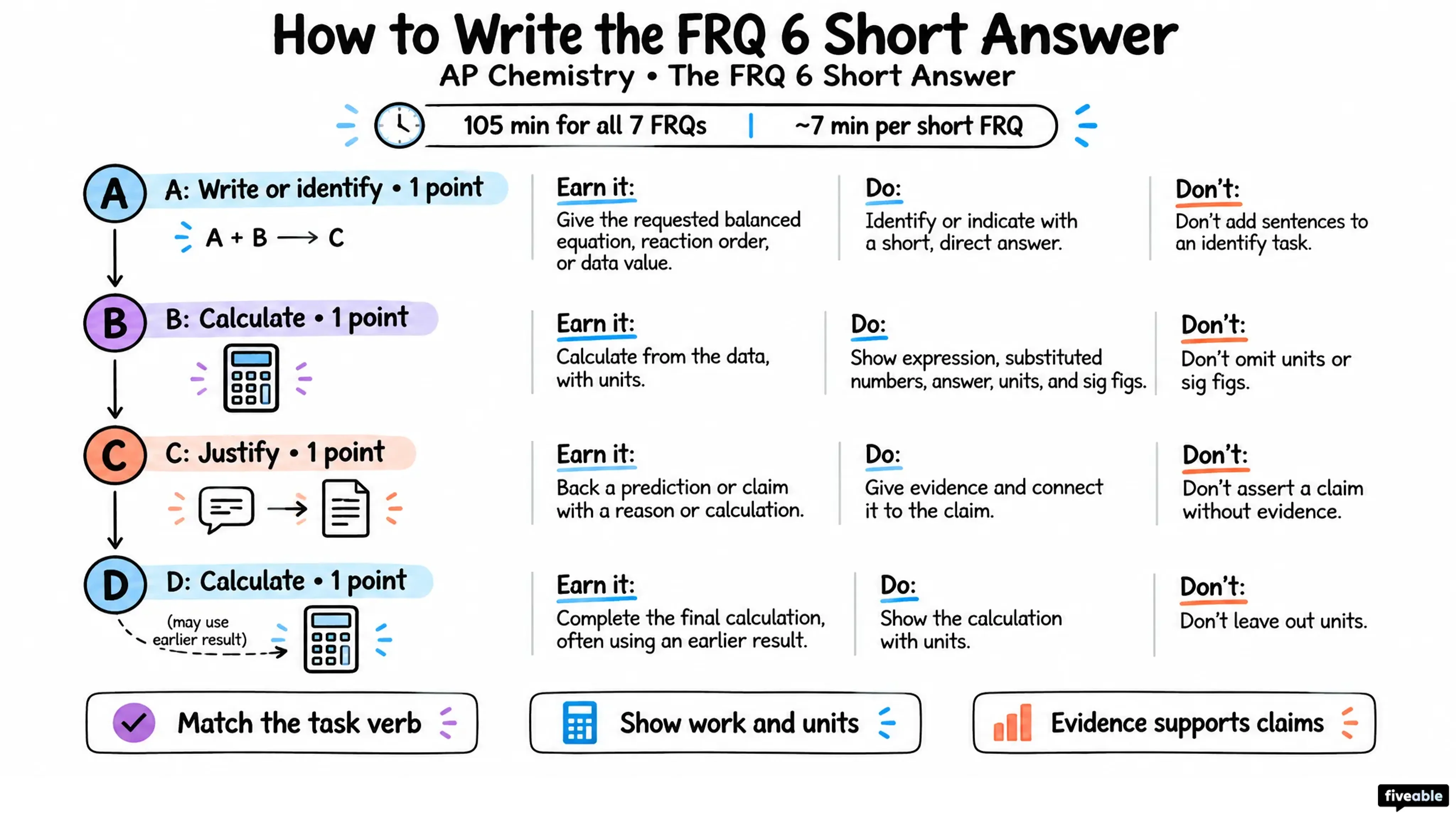
Part A: Write or identify
A balanced equation, a reaction order, or a value from the data
1 pt
Part B: Calculate
A calculation from the data, with units
1 pt
Part C: Justify
A prediction or claim, backed by a reason or a calculation
1 pt
Part D: Calculate
A final calculation, often using an earlier result
1 pt
FRQ 6 Short Answer skill sheet
Every rubric point on one page: what earns it, what to do and what to avoid. Tap the sheet to see it full size.
How FRQ 6 Short Answer practice works
Each question follows the exam’s format, from the full prompt to a score on every part.
Read the full question
The setup, the figure or data table, and every part, laid out the way the exam shows them.
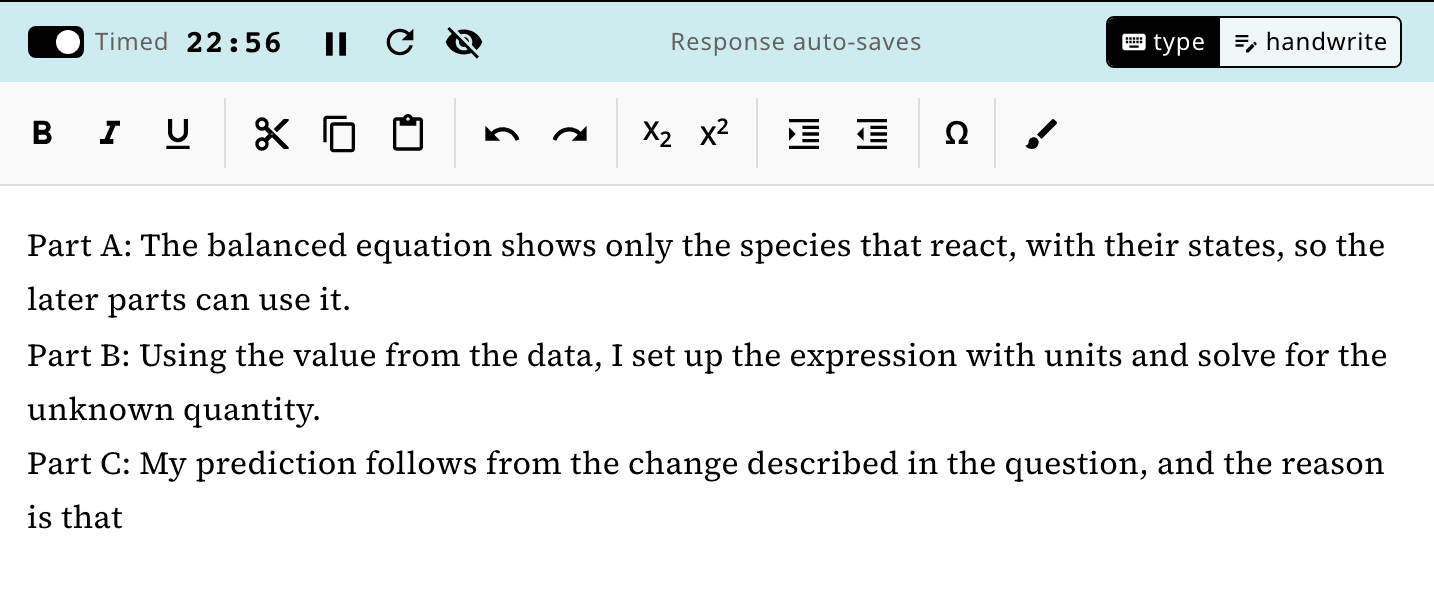
Write on a 9-minute timer
A pace that fits all seven questions into the 105-minute section. Pause it or turn it off, and your response saves as you go.
Submit for a score out of 4
Your response is scored against the scoring guidelines written for that question. Your first score is included.
Feedback on every part
A summary at the top tells you what to work on next. Below it, each part shows whether you earned the point and what the scoring guidelines were looking for.
Detailed Feedback
Part A: 1/1 point
Earned the point. You correctly identified the hybridization of the oxygen atom in ethanol as sp³.
Part B: 1/1 point
Earned the point. You correctly set up the ideal gas law equation (PV=nRT) and calculated the correct number of moles of ethanol vapor (0.016 mol).
Part C: 0/1 point
Did not earn the point. You were on the right track by calculating the moles of each gas and noting that ethanol has more moles, which would lead to a greater pressure. However, to earn the point, you needed to state that you DISAGREE with the student's claim based on that calculation. Instead, you concluded that you agree with the claim based on boiling points and intermolecular forces, which is incorrect since both substances are already gases at 400 K and pressure depends on the number of moles.
Questions about the FRQ 6 Short Answer
How many responses can I get scored?
You can read every question without a plan. Your first scored response is included. A plan unlocks unlimited scoring.
How do I type formulas, charges, and drawings?
Use the subscript and superscript buttons for formulas and ion charges. For a drawing, like a Lewis diagram or a mark on a figure, use the drawing tool, or switch the editor to handwrite, draw on paper, and add a photo of your page.
How much should I write for each part?
Match the task verb. Identify can take a word or phrase. Explain and justify need the chemical reason, stated in a sentence or two.
How are short-answer questions different from FRQs 1 to 3?
Short answers are 4 points and stay on one topic, usually with one point per scored step. FRQs 1 to 3 are 10-point problems with about six parts.
Can I use a calculator and the equations sheet?
Yes. The practice screen has a calculator and the AP Chemistry equations sheet with the periodic table, which you also get on exam day.
More AP Chemistry practice
FRQ 1 Long Answer practice
FRQ 1 long-answer questions with every part, figure, and data table.
FRQ 2 Long Answer practice
FRQ 2 long-answer questions, 10 points each, from every unit.
FRQ 3 Long Answer practice
FRQ 3 long-answer questions with the full setup and every part.
FRQ 4 Short Answer practice
FRQ 4 short-answer questions with the figure to draw on and both steps of part C.
FRQ 5 Short Answer practice
FRQ 5 short-answer questions with a student’s claim to evaluate.
FRQ 7 Short Answer practice
FRQ 7 short-answer questions with a diagram and two linked calculations.
Write your first FRQ 6 Short Answer
Pick one from the list, or let us choose for you.
Teaching AP Chemistry? Assign these FRQ 6 Short Answers to your class