AP Chemistry FRQ 7 Short Answer Practice
119 FRQ 7 short-answer questions written in the AP format. Pick one, read the full question, and write your response. Fiveable scores each FRQ 7 Short Answer response part by part on the AP rubric.
Your first scored response is included. A plan unlocks unlimited scoring.
119 questions
sorted by unit
Photoelectron spectroscopy and atomic structure analysis
Unit 1: Atomic Structure and Properties
A scientist is analyzing a pure sample of Element Z to determine its atomic structure and properties. The scientist obtains the photoelectron spectrum (PES) shown in Figure 1 and the isotopic data shown in Table 1.
Table 1. Isotopic data for Element Z
Isotope | Isotopic Mass (amu) | Relative Abundance (%) |
|---|---|---|
Z-24 | 23.99 | 79.00 |
Z-25 | 24.99 | 10.00 |
Z-26 | 25.98 | 11.00 |
Figure 1. Photoelectron spectrum (PES) of Element Z
On the PES diagram in Figure 1, circle the peak corresponding to the valence electrons of Element Z.
Calculate the average atomic mass of Element Z using the data in Table 1.
Using your answer to part B(i), calculate the number of atoms in a 3.50 g sample of Element Z.
Explain why the first ionization energy of Element Z is greater than the first ionization energy of Sodium (Na), which is the element directly to the left of Element Z in the periodic table. Element Z is located in the third period of the periodic table.
What the FRQ 7 Short Answer asks
FRQ 7 is the last of four short-answer questions on the AP Chemistry exam, worth 4 points and focused on one topic. In this set, you circle a feature on a diagram, work two linked calculations, then explain a result.
- 4 points
- across parts A to C
- 105 min
- for all seven FRQs
- 50%
- of your exam score comes from FRQs
Part A: Circle
Usually, mark a feature on a figure, like an atom or an electrode
1 pt
Part B: Two calculations
A calculation, then a second one that uses its answer
2 pts
Part C: Explain
A prediction or comparison, with the chemical reason
1 pt
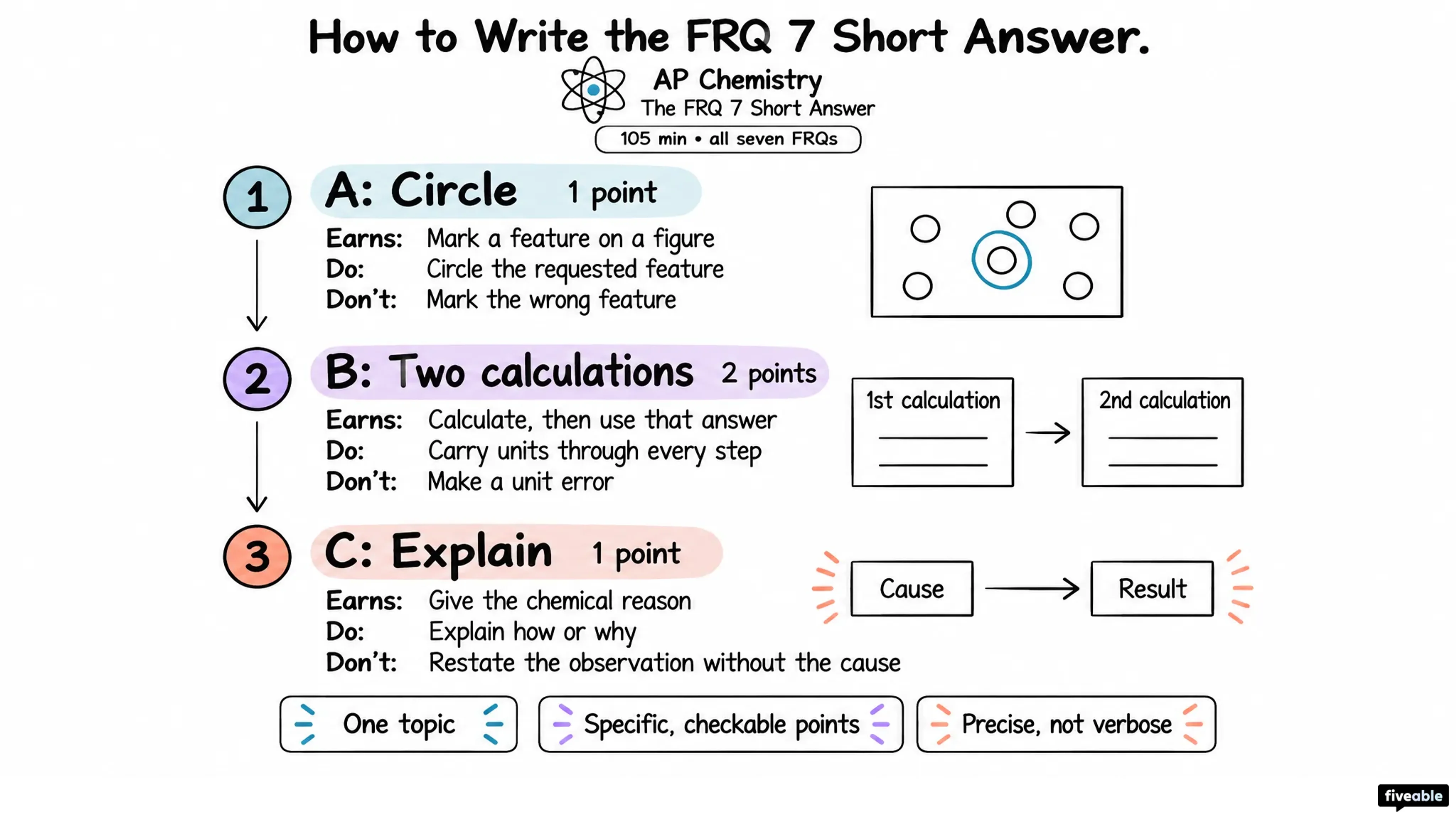
FRQ 7 Short Answer skill sheet
Every rubric point on one page: what earns it, what to do and what to avoid. Tap the sheet to see it full size.
How FRQ 7 Short Answer practice works
Each question follows the exam’s format, from the full prompt to a score on every part.
Read the full question
The setup, the figure or data table, and every part, laid out the way the exam shows them.
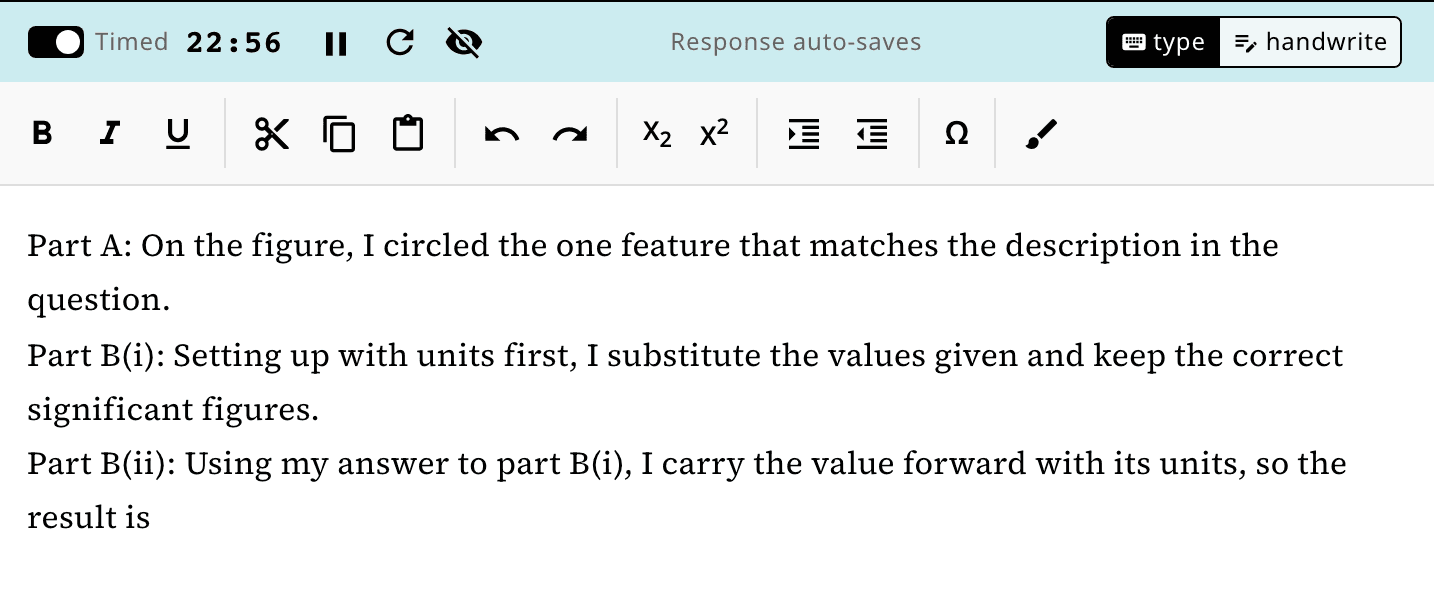
Write on a 9-minute timer
A pace that fits all seven questions into the 105-minute section. Pause it or turn it off, and your response saves as you go.
Submit for a score out of 4
Your response is scored against the scoring guidelines written for that question. Your first score is included.
Feedback on every part
A summary at the top tells you what to work on next. Below it, each part shows whether you earned the point and what the scoring guidelines were looking for.
Detailed Feedback
Part A: 0/1 point
You identified the double-bonded top oxygen, which has a formal charge of 0. Either single-bonded oxygen has a formal charge of −1.
Part B(i): 1/1 point
You correctly calculated 0.0375 mol of Na₂CO₃.
Part B(ii): 1/1 point
You correctly calculated a mass of 3.97 g of Na₂CO₃.
Questions about the FRQ 7 Short Answer
How many responses can I get scored?
You can read every question without a plan. Your first scored response is included. A plan unlocks unlimited scoring.
What if I can’t finish the first calculation in part B?
Use a reasonable value, say where it came from, and work the second calculation. Each of the two steps has its own point.
How do I type formulas, charges, and drawings?
Use the subscript and superscript buttons for formulas and ion charges. For a drawing, like a Lewis diagram or a mark on a figure, use the drawing tool, or switch the editor to handwrite, draw on paper, and add a photo of your page.
How are short-answer questions different from FRQs 1 to 3?
Short answers are 4 points and stay on one topic, usually with one point per scored step. FRQs 1 to 3 are 10-point problems with about six parts.
Can I use a calculator and the equations sheet?
Yes. The practice screen has a calculator and the AP Chemistry equations sheet with the periodic table, which you also get on exam day.
More AP Chemistry practice
FRQ 1 Long Answer practice
FRQ 1 long-answer questions with every part, figure, and data table.
FRQ 2 Long Answer practice
FRQ 2 long-answer questions, 10 points each, from every unit.
FRQ 3 Long Answer practice
FRQ 3 long-answer questions with the full setup and every part.
FRQ 4 Short Answer practice
FRQ 4 short-answer questions with the figure to draw on and both steps of part C.
FRQ 5 Short Answer practice
FRQ 5 short-answer questions with a student’s claim to evaluate.
Write your first FRQ 7 Short Answer
Pick one from the list, or let us choose for you.
Teaching AP Chemistry? Assign these FRQ 7 Short Answers to your class