AP Chemistry FRQ 4 Short Answer Practice
149 FRQ 4 short-answer questions written in the AP format. Pick one, read the full question, and write your response. Fiveable scores each FRQ 4 Short Answer response part by part on the AP rubric.
Your first scored response is included. A plan unlocks unlimited scoring.
149 questions
sorted by unit
Isotopic composition and mass spectrum analysis
Unit 1: Atomic Structure and Properties
A scientist is investigating the properties of a pure sample of Element X. The scientist generates the following diagrams to analyze the element's isotopic composition and particle structure.
Figure 1. Mass spectrum of Element X
Identify Element X based on the mass spectrum in Figure 1.
Figure 2. Particle representation of Element X
Figure 2 represents a sample of 10 atoms of Element X. Based on the relative abundances shown in Figure 1, shade the circles in Figure 2 to represent the isotopic composition of the sample.
Table 1. Experimental Data for Reaction of X with Sulfur
Measurement | Mass (g) |
|---|---|
Mass of empty crucible | 24.00 |
Mass of crucible + Element X | 25.27 |
Mass of crucible + Compound | 25.59 |
The scientist heats the sample of Element X with excess sulfur to form a sulfide compound. The data from the experiment are summarized in Table 1.
Propose the empirical formula of the sulfide compound formed based on the data in Table 1.
Calculate the mass percent of Element X in the sulfide compound.
What the FRQ 4 Short Answer asks
FRQ 4 is the first of four short-answer questions on the AP Chemistry exam, worth 4 points and focused on one topic. In this set, you identify something from the data, draw on a figure, then work a two-step part C.
- 4 points
- across parts A to C
- 105 min
- for all seven FRQs
- 50%
- of your exam score comes from FRQs
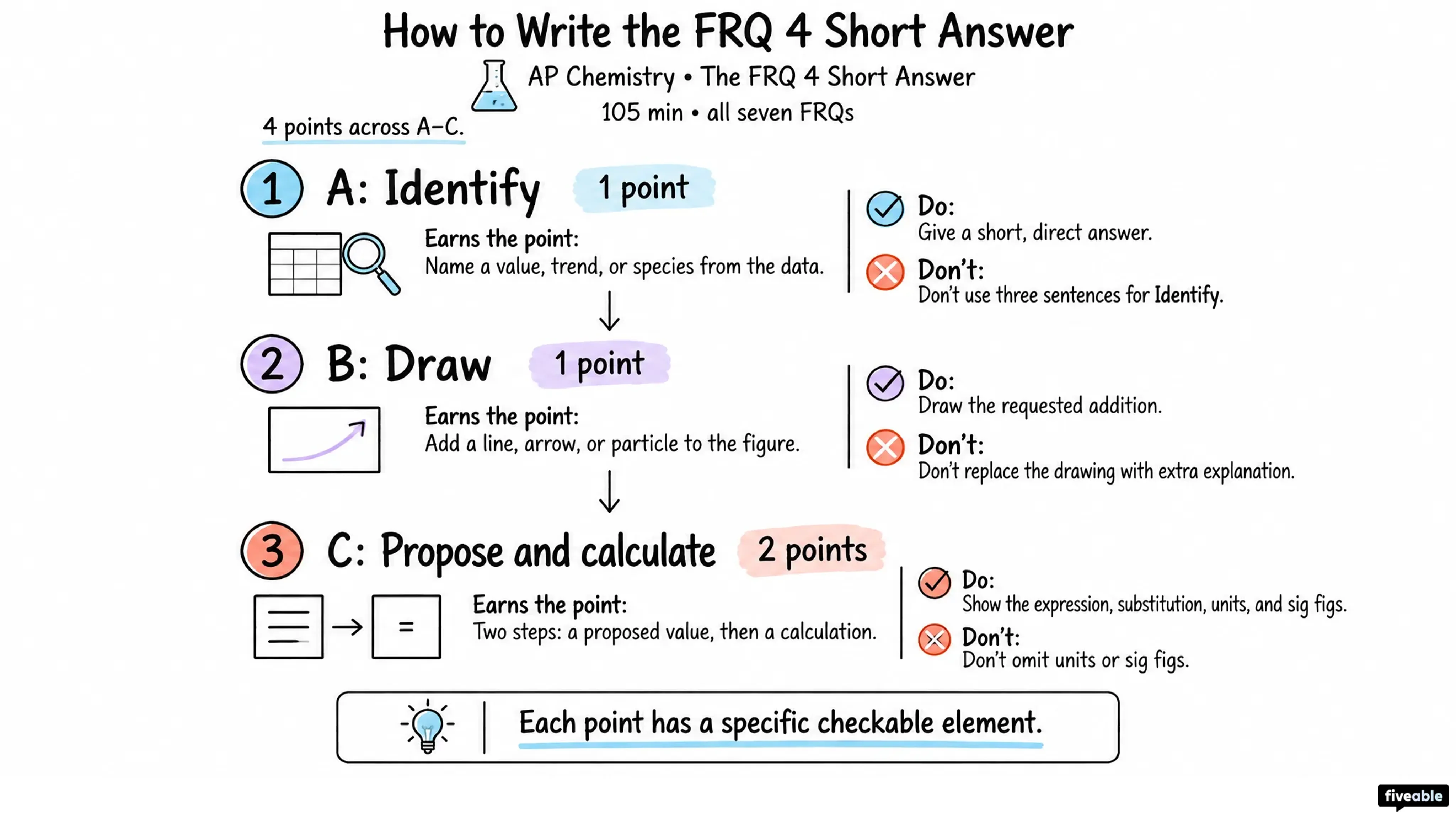
Part A: Identify
Name a value, trend, or species from the data, sometimes with a reason
1 pt
Part B: Draw
Add a line, arrow, or particle to the figure
1 pt
Part C: Propose and calculate
Two steps, often a proposed value and then a calculation
2 pts
FRQ 4 Short Answer skill sheet
Every rubric point on one page: what earns it, what to do and what to avoid. Tap the sheet to see it full size.
How FRQ 4 Short Answer practice works
Each question follows the exam’s format, from the full prompt to a score on every part.
Read the full question
The setup, the figure or data table, and every part, laid out the way the exam shows them.
Write on a 9-minute timer
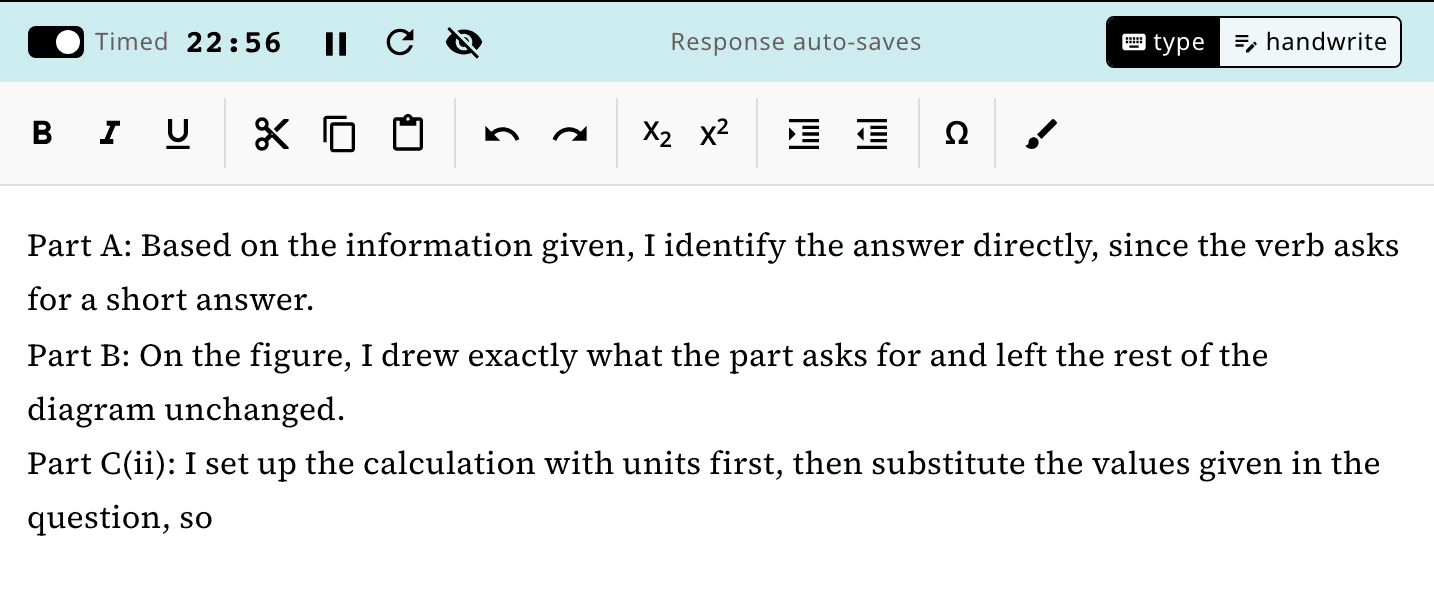
A pace that fits all seven questions into the 105-minute section. Pause it or turn it off, and your response saves as you go.
Submit for a score out of 4
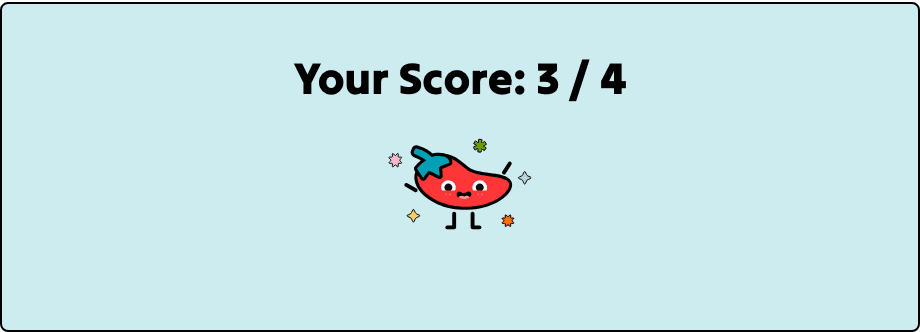
Your response is scored against the scoring guidelines written for that question. Your first score is included.
Feedback on every part
A summary at the top tells you what to work on next. Below it, each part shows whether you earned the point and what the scoring guidelines were looking for.
Detailed Feedback
Part A: 1/1 point
Earned the point. You correctly identified the reaction as exothermic and justified it by explaining that the equilibrium constant decreases as temperature increases, meaning less product is formed.
Part B: 0/1 point
Did not earn the point. Your proposed mixture of 2 Br₂, 4 NO, and 1 NOBr₂ does not conserve the total number of atoms from Figure 1. Figure 1 has 6 N, 6 O, and 6 Br atoms, but your mixture has 5 N, 5 O, and 6 Br atoms. Additionally, NOBr₂ is not a valid molecule for this reaction; the product is NOBr. A correct response would be 2 NOBr, 4 NO, and 2 Br₂.
Part C(i): 1/1 point
Earned the point. You correctly proposed a temperature lower than 350 K (200 K) and justified it by stating that lowering the temperature of an exothermic reaction shifts the equilibrium to produce more product.
Questions about the FRQ 4 Short Answer
How many responses can I get scored?
You can read every question without a plan. Your first scored response is included. A plan unlocks unlimited scoring.
How do I type formulas, charges, and drawings?
Use the subscript and superscript buttons for formulas and ion charges. For a drawing, like a Lewis diagram or a mark on a figure, use the drawing tool, or switch the editor to handwrite, draw on paper, and add a photo of your page.
How much should I write for each part?
Match the task verb. Identify can take a word or phrase. Explain and justify need the chemical reason, stated in a sentence or two.
How are short-answer questions different from FRQs 1 to 3?
Short answers are 4 points and stay on one topic, usually with one point per scored step. FRQs 1 to 3 are 10-point problems with about six parts.
Can I use a calculator and the equations sheet?
Yes. The practice screen has a calculator and the AP Chemistry equations sheet with the periodic table, which you also get on exam day.
More AP Chemistry practice
FRQ 1 Long Answer practice
FRQ 1 long-answer questions with every part, figure, and data table.
FRQ 2 Long Answer practice
FRQ 2 long-answer questions, 10 points each, from every unit.
FRQ 3 Long Answer practice
FRQ 3 long-answer questions with the full setup and every part.
FRQ 5 Short Answer practice
FRQ 5 short-answer questions with a student’s claim to evaluate.
FRQ 7 Short Answer practice
FRQ 7 short-answer questions with a diagram and two linked calculations.
Write your first FRQ 4 Short Answer
Pick one from the list, or let us choose for you.
Teaching AP Chemistry? Assign these FRQ 4 Short Answers to your class