AP Chemistry FRQ 1 Long Answer Practice
87 FRQ 1 long-answer questions written in the AP format. Pick one, read the full question, and write your response. Fiveable scores each FRQ 1 Long Answer response part by part on the AP rubric.
Your first scored response is included. A plan unlocks unlimited scoring.
87 questions
sorted by unit
Gallium oxide empirical formula determination
Unit 1: Atomic Structure and Properties
Answer the following questions about the element gallium, Ga.
The mass spectrum for a sample of gallium is shown in Figure 1. The sample contains two stable isotopes, gallium-69 and gallium-71.
Figure 1. Mass spectrum of gallium isotopes
Using the data in Figure 1, calculate the average atomic mass of gallium.
Determine the number of neutrons in the most abundant isotope shown in Figure 1.
A student investigates the reaction of gallium with oxygen to determine the empirical formula of a gallium oxide compound. The student heats a sample of gallium in a crucible, allowing it to react with atmospheric oxygen. The data collected is shown in Table 2.
Using the data in Table 2, calculate the number of moles of gallium that reacted. (The molar mass of gallium is 69.72 g/mol).
Calculate the number of moles of oxygen that reacted.
Using your answers from part B, determine the empirical formula of the gallium oxide.
The properties of gallium are determined by its atomic structure.
Explain why the atomic radius of a gallium atom (135 pm) is smaller than the atomic radius of a calcium atom (197 pm). Justify your answer using Coulomb's law and the principles of atomic structure.
The photoelectron spectrum for the valence shell of gallium is shown in Figure 3.
Table 2. Mass data for gallium oxide formation
Figure 3. Photoelectron spectrum of gallium valence region
Identify the subshell corresponding to the peak at 0.59 MJ/mol in Figure 3.
A peak for the 3d subshell of zinc (Zn, Z=30) would appear at a different binding energy than the 3d peak for gallium shown in Figure 3. Predict whether the binding energy for the Zn 3d peak would be greater than, less than, or equal to the binding energy of the Ga 3d peak. Explain.
In the experiment described in part B, the student did not heat the crucible long enough to completely drive off all atmospheric moisture before weighing the final product. Would the calculated mass percent of oxygen in the gallium oxide be greater than, less than, or equal to the actual mass percent of oxygen? Justify your answer.
What the FRQ 1 Long Answer asks
FRQ 1 is the first of three long-answer questions on the AP Chemistry exam: a 10-point problem in about six parts that mixes calculations, written explanations, and drawings. Each question splits its 10 points its own way, so the table shows one common split.
- 10 points
- usually across parts A to F
- 105 min
- for all seven FRQs
- 50%
- of your exam score comes from FRQs
Part A: Setup
Identify a species, write an equation, or start a calculation
2 pts
Part B: Calculation
A calculation from the data, with units
2 pts
Part C: Short calculation
A quick calculation or an explanation of a result
1 pt
Part D: Linked calculation
A calculation that often builds on an earlier part
2 pts
Part E: Justification
A calculation or a claim justified with evidence
2 pts
Part F: Prediction
How a change to the system affects the result, with a reason
1 pt
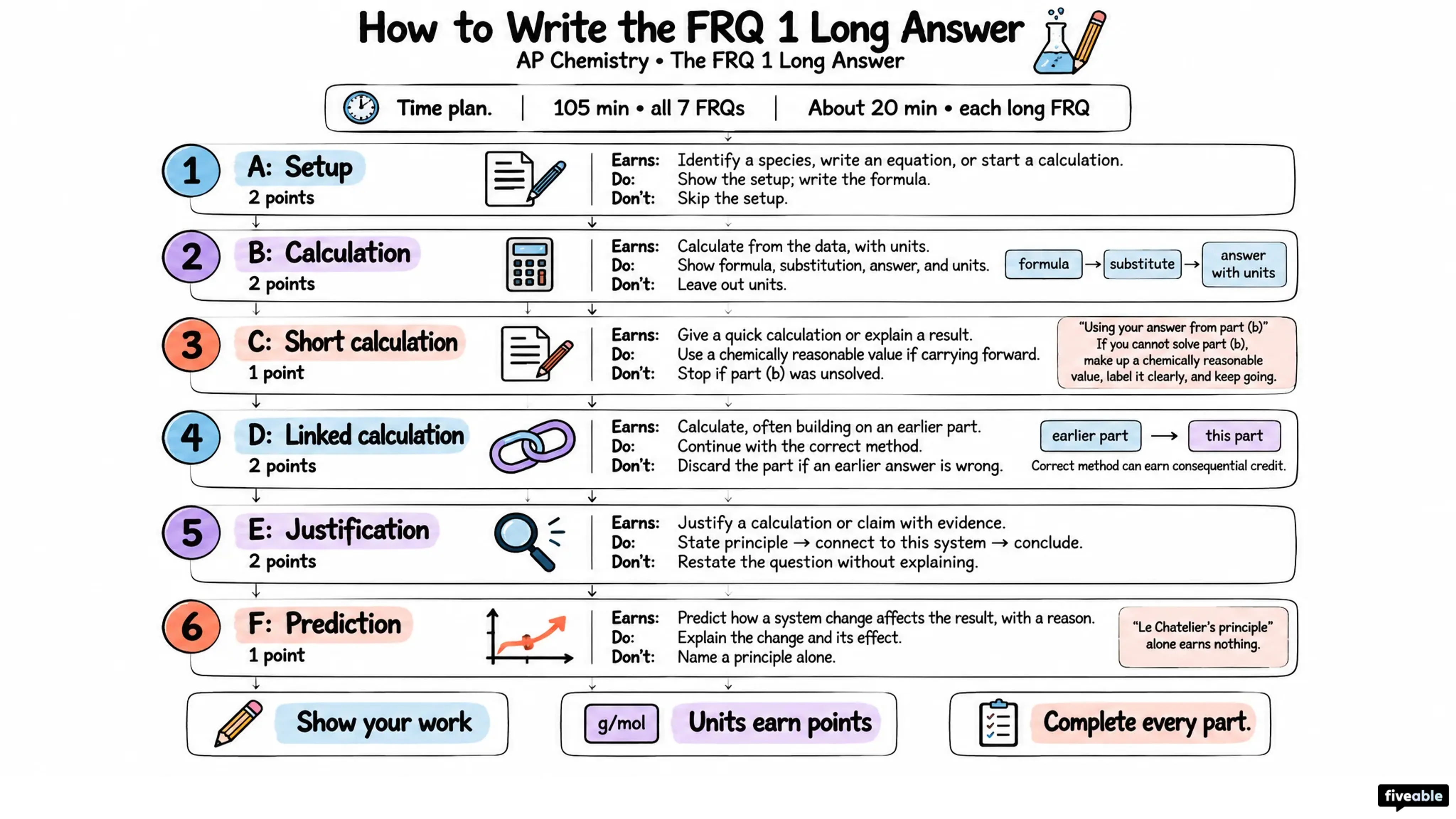
FRQ 1 Long Answer skill sheet
Every rubric point on one page: what earns it, what to do and what to avoid. Tap the sheet to see it full size.
How FRQ 1 Long Answer practice works
Each question follows the exam’s format, from the full prompt to a score on every part.
Read the full question
The setup, figures, data tables, and every part, laid out the way the exam shows them.
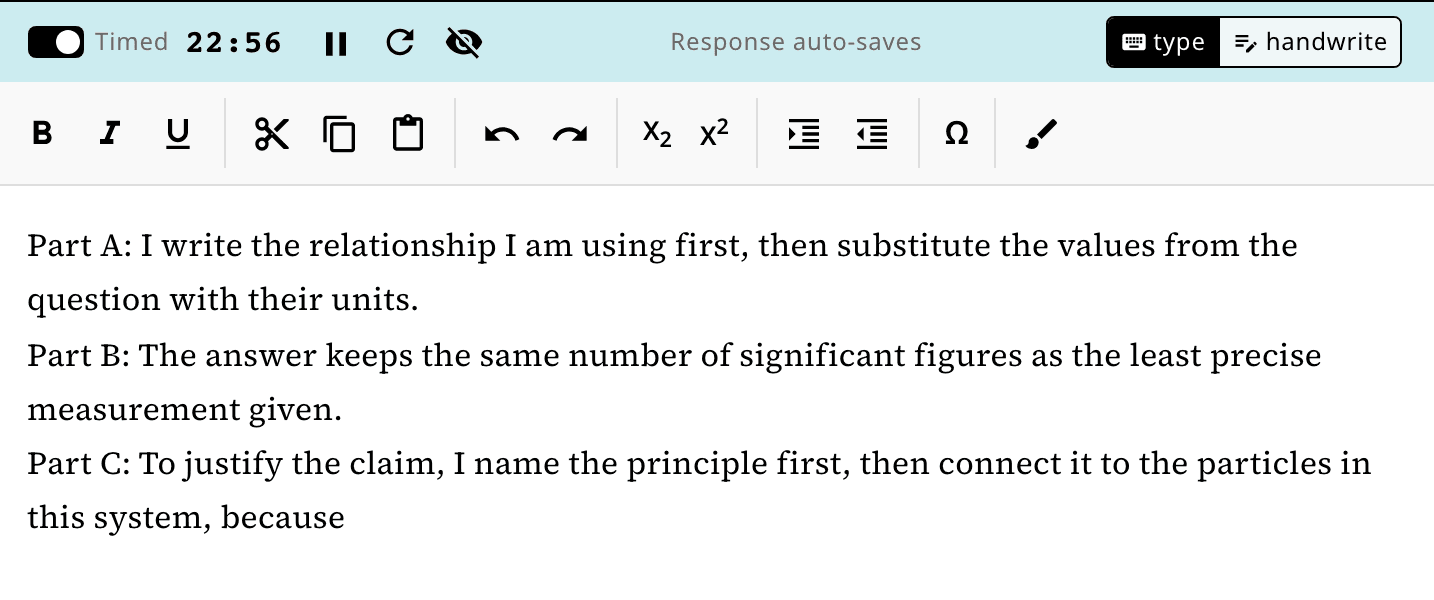
Write on a 23-minute timer
A pace that fits all seven questions into the 105-minute section. Pause it or turn it off, and your response saves as you go.
Submit for a score out of 10
Your response is scored against the scoring guidelines written for that question. Your first score is included.
Feedback on every part
A summary at the top tells you what to work on next. Below it, each part shows whether you earned the point and what the scoring guidelines were looking for.
Detailed Feedback
Part A(i): 1/1 point
You used the isotope abundances correctly and calculated 35.48 amu.
Part A(ii): 1/1 point
You correctly identified the two-neutron difference.
Part B: 0/1 point
You described the O–H bond as stronger and holding H more tightly, which does not explain greater ionization. You did not connect Cl’s greater electronegativity to easier H⁺ release.
What 236 scored FRQ 1 Long Answers show
Patterns from the practice FRQ 1 Long Answers students have turned in on Fiveable. Students lose the most points on Part F: prediction.
A: Setup
71%
B: Calculation
62%
C: Short calculation
59%
E: Justification
55%
D: Linked calculation
51%
F: Prediction
44%
8%
of responses earned all 10 points
5.8 of 10
average score
+2.1 points
average gain when students rewrote the same FRQ 1 Long Answer after feedback
236 practice responses from 151 students, scored on Fiveable through October 25, 2026.
Questions about the FRQ 1 Long Answer
How many responses can I get scored?
You can read every question without a plan. Your first scored response is included. A plan unlocks unlimited scoring.
Is FRQ 1 different from FRQ 2 and FRQ 3?
They share one format: 10 points, usually six parts, and a topic from any unit. Practice all three to prepare for the full long-answer set.
How are long-answer questions different from FRQs 4 to 7?
FRQs 1 to 3 are 10-point problems with about six parts that mix calculations, explanations, and drawings. FRQs 4 to 7 are 4-point questions that stay on one topic.
How do I type formulas, charges, and drawings?
Use the subscript and superscript buttons for formulas and ion charges. For a drawing, like a Lewis diagram or a mark on a figure, use the drawing tool, or switch the editor to handwrite, draw on paper, and add a photo of your page.
Can I use a calculator and the equations sheet?
Yes. The practice screen has a calculator and the AP Chemistry equations sheet with the periodic table, which you also get on exam day.
More AP Chemistry practice
FRQ 2 Long Answer practice
FRQ 2 long-answer questions, 10 points each, from every unit.
FRQ 3 Long Answer practice
FRQ 3 long-answer questions with the full setup and every part.
FRQ 4 Short Answer practice
FRQ 4 short-answer questions with the figure to draw on and both steps of part C.
FRQ 5 Short Answer practice
FRQ 5 short-answer questions with a student’s claim to evaluate.
FRQ 7 Short Answer practice
FRQ 7 short-answer questions with a diagram and two linked calculations.
See the FRQ 1 Long Answer rubric points students miss most, from responses scored on Fiveable.
Write your first FRQ 1 Long Answer
Pick one from the list, or let us choose for you.
Teaching AP Chemistry? Assign these FRQ 1 Long Answers to your class