AP Chemistry Unit 6 Cheatsheet: Thermochemistry

AP Chemistry Unit 6 Cheatsheet: Thermochemistry

Start with the first 3 sections of the Unit 6 one-page cheatsheet below. The full sheet is a PDF you can print.

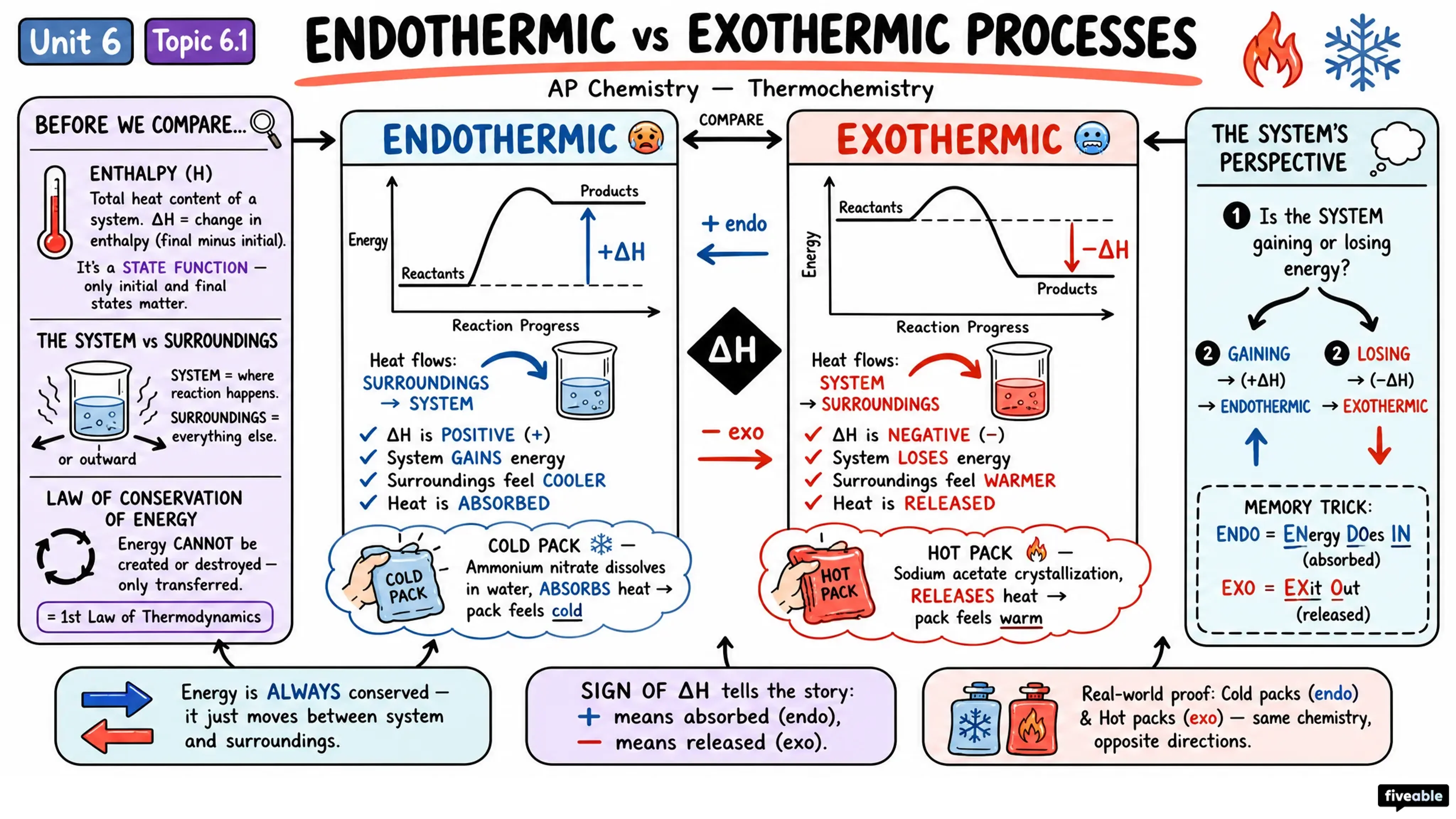
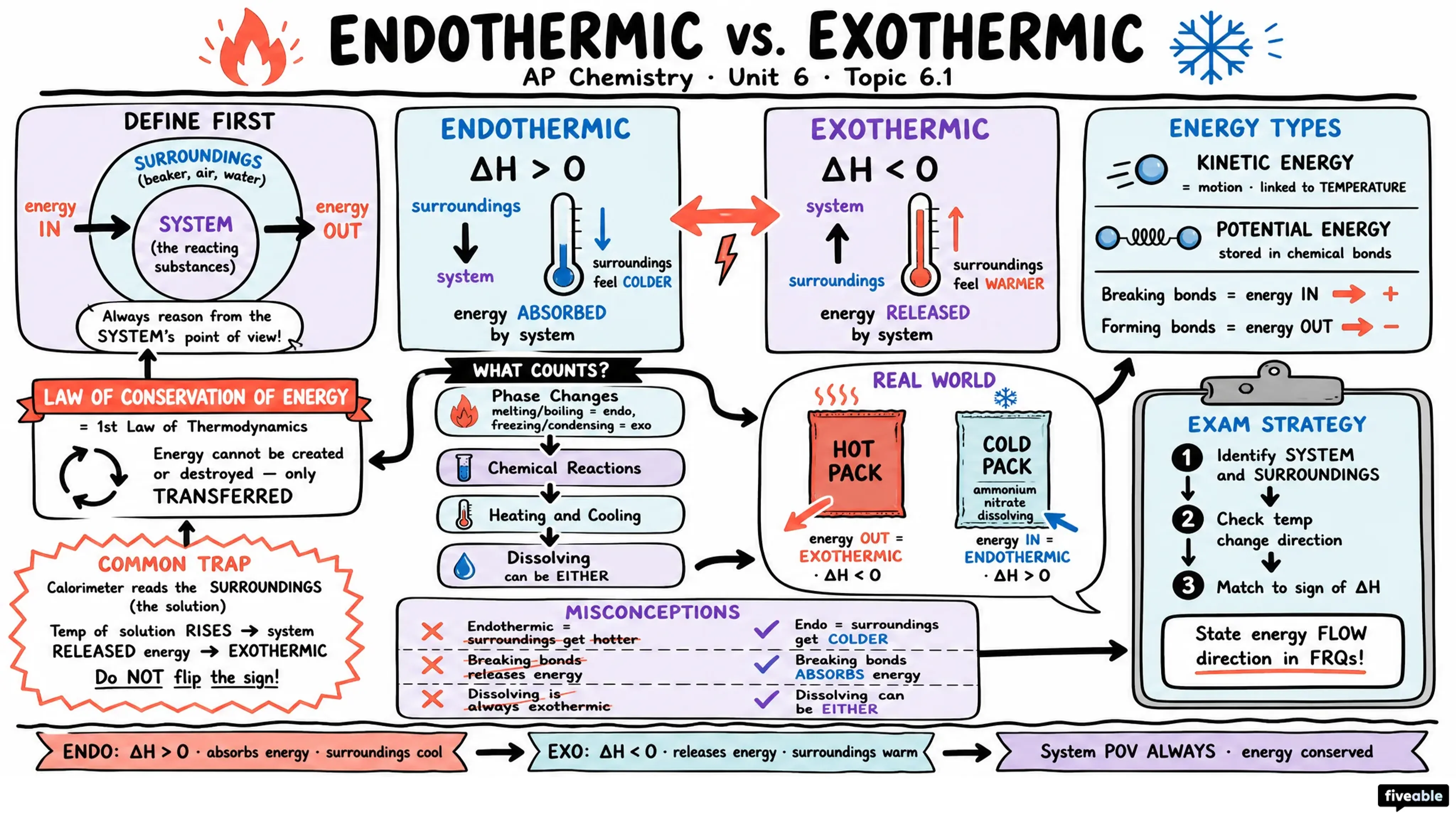
Endothermic vs. Exothermic

Exothermic: System loses energy → surroundings gain heat. ΔH < 0. Temperature of surroundings increases.

Endothermic: System gains energy → surroundings lose heat. ΔH > 0. Temperature of surroundings decreases.

Key observation: In a calorimeter, warming of the surroundings means the system released heat, while cooling means the system absorbed heat.

  • Dissolution can be either (depends on relative strength of intermolecular forces before/after)
  • Phase changes: melting/boiling absorb energy (endothermic); freezing/condensing release energy (exothermic)
Heat Capacity & q = mcΔT

Formula: q = mcΔT

  • q = heat absorbed or released (J)
  • m = mass (g)
  • c = specific heat capacity (J/g·°C)
  • ΔT = temperature change (°C or K)

Specific heat capacity: Energy needed to raise 1 g of substance by 1 °C.

Molar heat capacity: Energy needed to raise 1 mole by 1 °C.

Key principle: Same thermal energy produces different ΔT in substances with different c values.

Calorimetry & Energy Conservation

First Law of Thermodynamics: Energy is conserved in all processes.

In calorimetry: Heat lost by system = Heat gained by surroundings (or vice versa).

Dissolution calorimetry:

  • Temperature increases → Exothermic dissolution (ΔH < 0)
  • Temperature decreases → Endothermic dissolution (ΔH > 0)

Three main energy processes in chemical systems:

  1. Heating/cooling (q = mcΔT)
  2. Phase transitions (q = n × ΔHphase)
  3. Chemical reactions (q = n × ΔHrxn)

The rest of the Unit 6 sheet

6 more sections are on the one-page PDF:

  • Heat Transfer & Thermal Equilibrium

  • Phase Changes & Molar Enthalpy

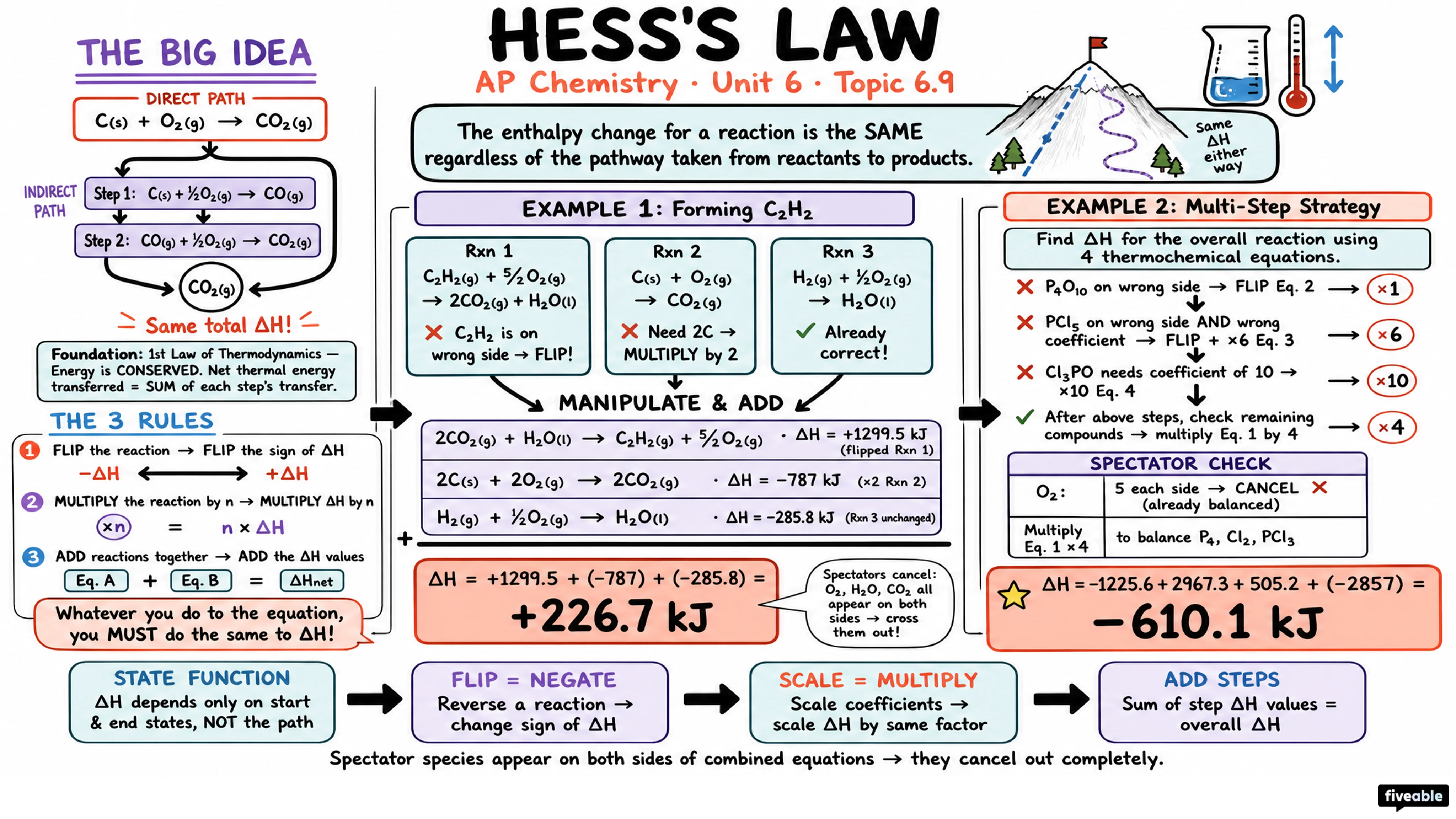
  • Hess's Law & Reaction Sequences

  • Enthalpy of Reaction (ΔHrxn)

  • Bond Enthalpies

  • Enthalpy of Formation (ΔH°f)

Made by you

Visual Cheatsheets

Pick a Unit 6 topic and a format: flowchart, comparison chart, vocab sheet, Cornell notes and more. Ready in about a minute.

Printable PDF · from the Fiveable shop

AP Chemistry Unit 6 Cheatsheet

1 page · Thermochemistry · PDF

Visual Cheatsheets

One topic, the format you pick, ready in about a minute

Format

Topic

Takes 30–60 seconds

Preview: Standard

Unit 6: Thermochemistry, topic by topic

Each topic has a full study guide. See the whole unit.