AP Biology Experimental Results FRQ Practice
128 Interpreting and Evaluating Experimental Results questions written in the AP format. Pick one, read the full question, and write your response.
Your first scored response is included. A plan unlocks unlimited scoring.

128 questions
sorted by unit
Hot-spring and E. coli DHFR enzymes after heat exposure
Unit 1: Chemistry of Life
Proteins are essential macromolecules that perform a diverse range of functions in living organisms, including catalyzing metabolic reactions. The function of a protein is directly determined by its specific three-dimensional shape, which is established by interactions between its constituent amino acids.
Researchers are investigating the enzyme dihydrofolate reductase (DHFR) in a species of bacteria, Thermophilus aquaticus, which lives in hot springs, and a related species, Escherichia coli, which lives in the mammalian gut. DHFR is an enzyme critical for DNA synthesis. The researchers purified DHFR from both species to study their thermal stability.
They incubated the purified enzymes from both species at temperatures ranging from 30°C to 90°C for 10 minutes. After incubation, they cooled the samples to 37°C and measured the remaining enzyme activity by adding substrate and monitoring product formation. The activity was calculated as a percentage relative to the activity of the enzyme kept at 37°C (Figure 1).
To understand the molecular basis for the difference in thermal stability, the researchers analyzed the protein structures. They focused on a specific region of the protein surface where the amino acid sequence differed between the two species. Figure 2 shows a simplified model of the interactions between amino acid side chains in this region for both the E. coli and T. aquaticus enzymes.
Describe how the R-groups of amino acids contribute to the tertiary structure of a protein.
Figure 1. Effect of 10-minute incubation temperature on DHFR activity. Relative enzyme activity is measured at 37°C after cooling and is expressed as a percent of the 37°C control for each species. Error bars show ±SE.
Identify the independent variable in the experiment shown in Figure 1.
Justify the researchers' decision to cool the enzyme samples to 37°C before measuring their activity, rather than measuring activity at the incubation temperatures.
Based on Figure 1, describe the effect of increasing temperature from 40°C to 60°C on the activity of the E. coli enzyme.
Figure 2. Amino acid side-chain interactions in a structural domain of DHFR from E. coli versus T. aquaticus. Panel A shows nonionic hydrophobic side chains without an inter-side-chain bond; Panel B shows an ionic interaction (salt bridge) between oppositely charged side chains.
Based on Figure 2, identify the specific type of chemical interaction present in the T. aquaticus enzyme that is absent in the E. coli enzyme.
Identify the level of protein structure (primary, secondary, tertiary, or quaternary) that is stabilized by the interaction between the side chains of Glutamic Acid and Lysine shown in Figure 2.
The molecular mass of the amino acid Glutamic Acid is 147 Daltons, and the molecular mass of Valine is 117 Daltons. Calculate the difference in mass (in Daltons) of the protein if a single Glutamic Acid residue is substituted with a Valine residue.
Researchers claim that the T. aquaticus enzyme is evolutionarily adapted to function in high-temperature environments. Using data from Figure 1, support the researchers' claim.
Researchers claim that replacing the Glutamic Acid in the T. aquaticus enzyme with Valine would decrease the thermal stability of the enzyme. Justify the researchers' claim based on the information in Figure 2 and your understanding of protein structure.
What the Experimental Results FRQ asks
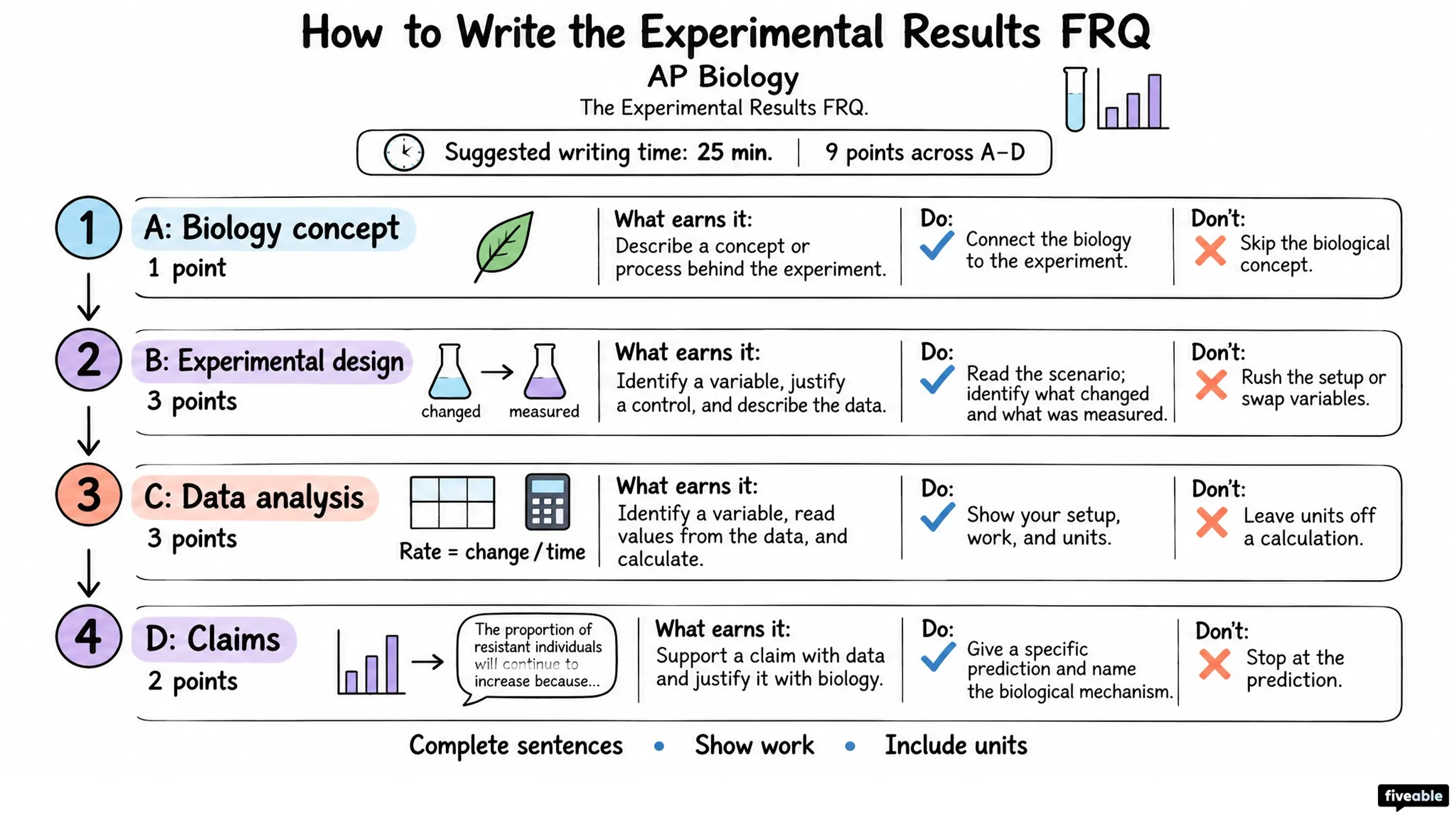
This is FRQ 1 on the AP Biology exam, one of the two long FRQs. You get a research scenario with figures and answer four parts about the biology, the experiment’s design, the data, and the researchers’ claims.
- 25 min
- suggested writing time
- 9 points
- across parts A to D
- 50%
- of your score, for all six FRQs
Part A: Biology concept
Describe a concept or process behind the experiment
1 pt
Part B: Experimental design
Identify a variable, justify a control, and describe the data
3 pts
Part C: Data analysis
Identify a variable, read values from the data, and calculate
3 pts
Part D: Claims
Support a claim with data and justify it with biology
2 pts
Experimental Results FRQ skill sheet
Every rubric point on one page: what earns it, what to do and what to avoid. Tap the sheet to see it full size.
How Experimental Results FRQ practice works
Each question follows the exam’s format, from the full prompt to a score on every part.
Read the full question
The research scenario, the figures, and all four parts, A through D, laid out the way the exam shows them.
Write on a 25-minute timer
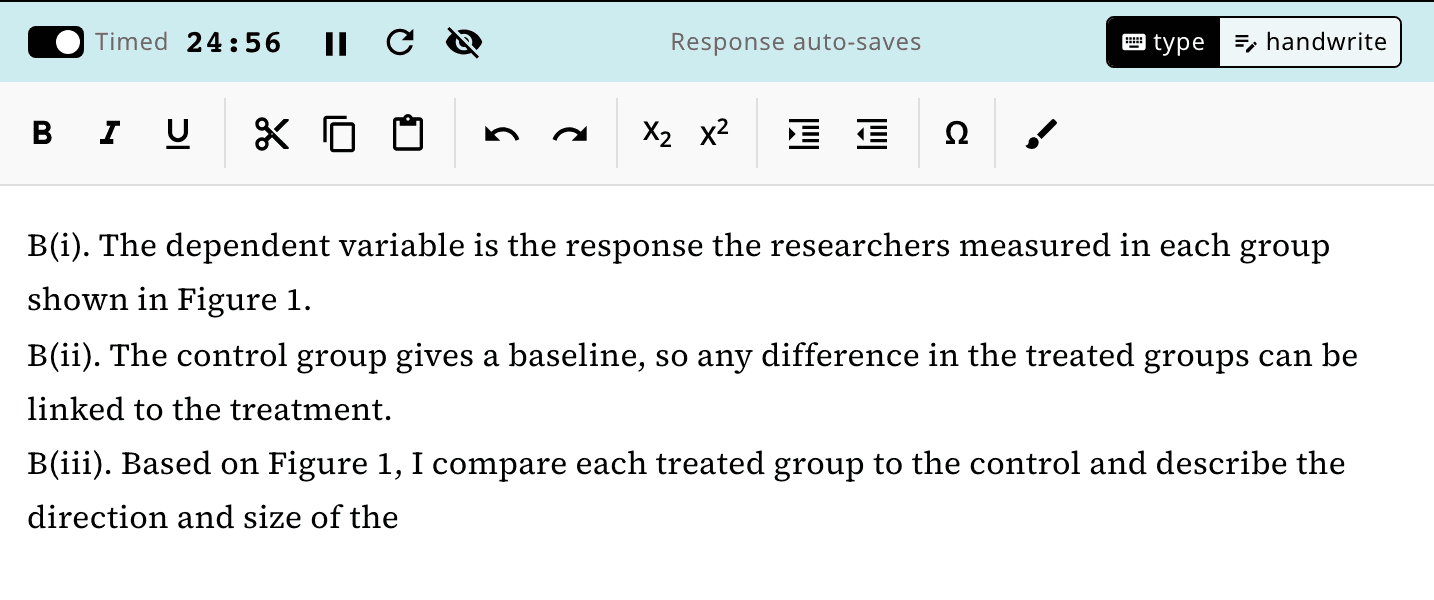
The time to plan for on exam day. Pause it or turn it off, and your response saves as you go.
Submit for a score out of 9
Your response is scored against the scoring guidelines written for that question. Your first score is included.
Feedback on every part
A summary at the top tells you what to work on next. Below it, each part shows whether you earned the point and what the scoring guidelines were looking for.
Detailed Feedback
Part A: 1/1 point
Earned the point. You correctly described that the active site has a specific three-dimensional shape that is complementary to the substrate's shape, allowing only specific substrates to bind.
Part B: 1/1 point
Earned the point. You correctly identified the dependent variable as PPO activity (or relative PPO activity).
Part B: 0/1 point
Did not earn the point. While you mentioned that PPO activity decreases, you did not provide sufficient detail from Figure 1. To earn this point, you needed to describe the trend with reference to the data shown in the graph (e.g., activity decreases from 100% at 0 mM to approximately 40% at 5 mM and 10% at 10 mM).
What 1,297 scored Experimental Results FRQs show
Patterns from the practice Experimental Results FRQs students have turned in on Fiveable. Students lose the most points on Part D: claims.
B: Experimental design
83%
C: Data analysis
76%
A: Biology concept
70%
D: Claims
51%
11%
of responses earned all 9 points
6.5 of 9
average score
+1.2 points
average gain when students rewrote the same Experimental Results FRQ after feedback
1,297 practice responses from 624 students, scored on Fiveable through October 9, 2026.
Questions about the Experimental Results FRQ
How many responses can I get scored?
You can read every question without a plan. Your first scored response is included. A plan unlocks unlimited scoring.
How is FRQ 1 different from FRQ 2?
Both give you an experiment with data and the same four parts. FRQ 1 gives you figures to read. FRQ 2 asks you to build a graph from a data table.
How do I show a calculation?
Type your setup, the numbers, and the answer with its units. You can also switch the editor to handwrite, write on paper, and add a photo of your page.
Do I have to write in complete sentences?
Yes. On the exam, outlines and bulleted lists alone aren’t scored, so write each part in full sentences.
Are these real College Board questions?
No. We wrote them in the AP format, with the same four parts, and wrote scoring guidelines for each one.
More AP Biology practice
Scientific Investigation FRQ practice
Short FRQs on experimental design, with the scenario and all four parts.
Conceptual Analysis FRQ practice
Short FRQs on a process and a disruption, with all four parts.
Data Analysis FRQ practice
Short FRQs with a graph or table of results and all four parts.
Write your first Experimental Results FRQ
Pick one from the list, or let us choose for you.
Teaching AP Biology? Assign these Experimental Results FRQs to your class