AP Biology Scientific Investigation FRQ Practice
145 Scientific Investigation questions written in the AP format. Pick one, read the full question, and write your response. Fiveable scores each Scientific Investigation FRQ response part by part on the AP rubric.
Your first scored response is included. A plan unlocks unlimited scoring.
New to the Scientific Investigation FRQ? Read the exam guide

145 questions
sorted by unit
DNA thermal stability across bacterial species
Unit 1: Chemistry of Life
Certain bacteria, such as Thermus aquaticus, thrive in high-temperature environments like hot springs, while others, such as Escherichia coli, inhabit moderate environments like the mammalian gut. The stability of biological macromolecules, including DNA, is critical for survival in these diverse habitats.
Scientists conducted an experiment to investigate the thermal stability of DNA from these two species. They extracted purified DNA from T. aquaticus and E. coli and suspended samples of each in a buffer solution. The scientists slowly heated the DNA samples from 25°C to 95°C while monitoring the absorbance of UV light. As the two strands of the DNA double helix separate (denature), UV absorbance increases. The temperature at which 50% of the DNA strands have separated is defined as the melting temperature (). The scientists observed that the genomic DNA of T. aquaticus has a significantly higher than the genomic DNA of E. coli.
Describe the specific chemical interaction that connects the nitrogenous bases of complementary DNA strands and holds the double helix together.
Identify one variable, other than the rate of heating, that the scientists must keep constant between the two DNA samples to ensure the validity of the results.
State the null hypothesis for the experiment comparing the melting temperatures () of the DNA from the two bacterial species.
The scientists claim that the DNA of T. aquaticus contains a higher percentage of guanine-cytosine (G-C) base pairs than the DNA of E. coli. Based on the chemical structure of DNA, justify the scientists' claim.
What the Scientific Investigation FRQ asks
This is FRQ 3 on the AP Biology exam. You get a research scenario and answer four parts about the experiment: the biology behind it, its procedures, a null hypothesis or prediction, and the reasoning for that prediction.
- 10 min
- suggested writing time
- 4 points
- 1 point for each part
- 50%
- of your score, for all six FRQs
Part A: Biology concept
Describe the biology behind the investigation
1 pt
Part B: Procedure
Identify or justify a part of the experimental design
1 pt
Part C: Hypothesis
State a null hypothesis or predict a result
1 pt
Part D: Justification
Justify the prediction with biological reasoning
1 pt
Scientific Investigation FRQ skill sheet
Every rubric point on one page: what earns it, what to do and what to avoid. Tap the sheet to see it full size.

How Scientific Investigation FRQ practice works
Each question follows the exam’s format, from the full prompt to a score on every part.
Read the full question
The scenario and all four parts, A through D, laid out the way the exam shows them.
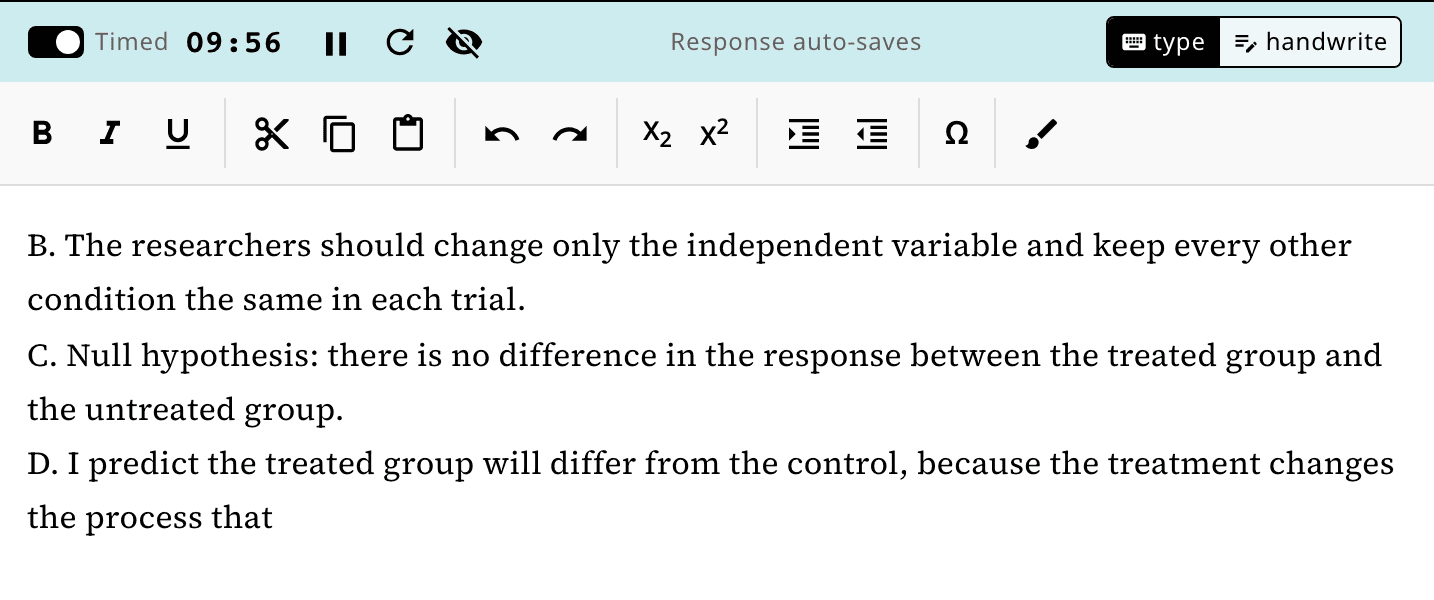
Write on a 10-minute timer
The time to plan for on exam day. Pause it or turn it off, and your response saves as you go.
Submit for a score out of 4
Your response is scored against the scoring guidelines written for that question. Your first score is included.
Feedback on every part
A summary at the top tells you what to work on next. Below it, each part shows whether you earned the point and what the scoring guidelines were looking for.
Detailed Feedback
Part A: 1/1 point
Earned the point. You described the key mechanism of natural selection: mice with dark fur (those with the Mc1r gene) were better suited to survive in the dark lava environment, survived better, and passed on their genes through reproduction. This shows you understand that differential survival and reproduction led to the trait becoming more common. To make this even stronger, you could explicitly mention that the frequency of the dark-fur allele increased in the population over generations.
Part B: 0/1 point
Did not earn the point. You identified the predatory barn owl as the dependent variable, but the owl is actually part of the experimental setup (the predator that creates the selection pressure). The dependent variable is what the scientists measured as an outcome — in this case, the number or proportion of surviving mice of each fur color in each enclosure. The dependent variable is what you observe or count at the end of the experiment to see the effect of the independent variable (fur color and substrate color).
Part C: 1/1 point
Earned the point. You correctly stated that the null hypothesis is that light and dark mice would have the same survival rate. This shows you understand that a null hypothesis predicts no difference between the groups being compared.
What 554 scored Scientific Investigation FRQs show
Patterns from the practice Scientific Investigation FRQs students have turned in on Fiveable. Students lose the most points on Part D: justification.
C: Hypothesis
83%
A: Biology concept
78%
B: Procedure
78%
D: Justification
67%
40%
of responses earned all 4 points
3.1 of 4
average score
+1.3 points
average gain when students rewrote the same Scientific Investigation FRQ after feedback
554 practice responses from 236 students, scored on Fiveable through October 26, 2026.
Questions about the Scientific Investigation FRQ
How many responses can I get scored?
You can read every question without a plan. Your first scored response is included. A plan unlocks unlimited scoring.
How is a null hypothesis different from a prediction?
A null hypothesis says there’s no difference or relationship between the variables. A prediction states the result you expect and its direction.
How long should each part be?
Two to four focused sentences usually does it. Each part is worth 1 point, so answer every part.
How is this different from the Data Analysis FRQ?
This question asks how an experiment is designed: its variables, controls, and predictions. The Data Analysis FRQ asks you to describe data and use it to evaluate a hypothesis.
More AP Biology practice
Experimental Results FRQ practice
Long FRQs with a research scenario, its figures, and all four parts.
Conceptual Analysis FRQ practice
Short FRQs on a process and a disruption, with all four parts.
Data Analysis FRQ practice
Short FRQs with a graph or table of results and all four parts.
See the Scientific Investigation FRQ rubric points students miss most, from responses scored on Fiveable.
Write your first Scientific Investigation FRQ
Pick one from the list, or let us choose for you.
Teaching AP Biology? Assign these Scientific Investigation FRQs to your class