AP Biology Model Analysis FRQ Practice
146 Analyze Model or Visual Representation questions written in the AP format. Pick one, read the full question, and write your response. Fiveable scores each Model Analysis FRQ response part by part on the AP rubric.
Your first scored response is included. A plan unlocks unlimited scoring.
146 questions
sorted by unit
Hydrophobic amino acid clustering in protein folding
Unit 1: Chemistry of Life
Figure 1 models the folding of Protein X, a cytosolic protein found in animal cells.
Describe the chemical property of the amino acids in Region A that results in their location within the folded protein.
Figure 1. Structural features of Protein X
Based on Figure 1, explain why the amino acids in Region A cluster together in the center of the protein rather than interacting with the surrounding cytosol.
Using the information in Figure 1, identify the level of protein structure represented by Interaction B: secondary structure, tertiary structure, or quaternary structure.
Based on Figure 1, explain how a significant decrease in pH would affect Interaction B in such a way that Protein X loses its function.
What the Model Analysis FRQ asks
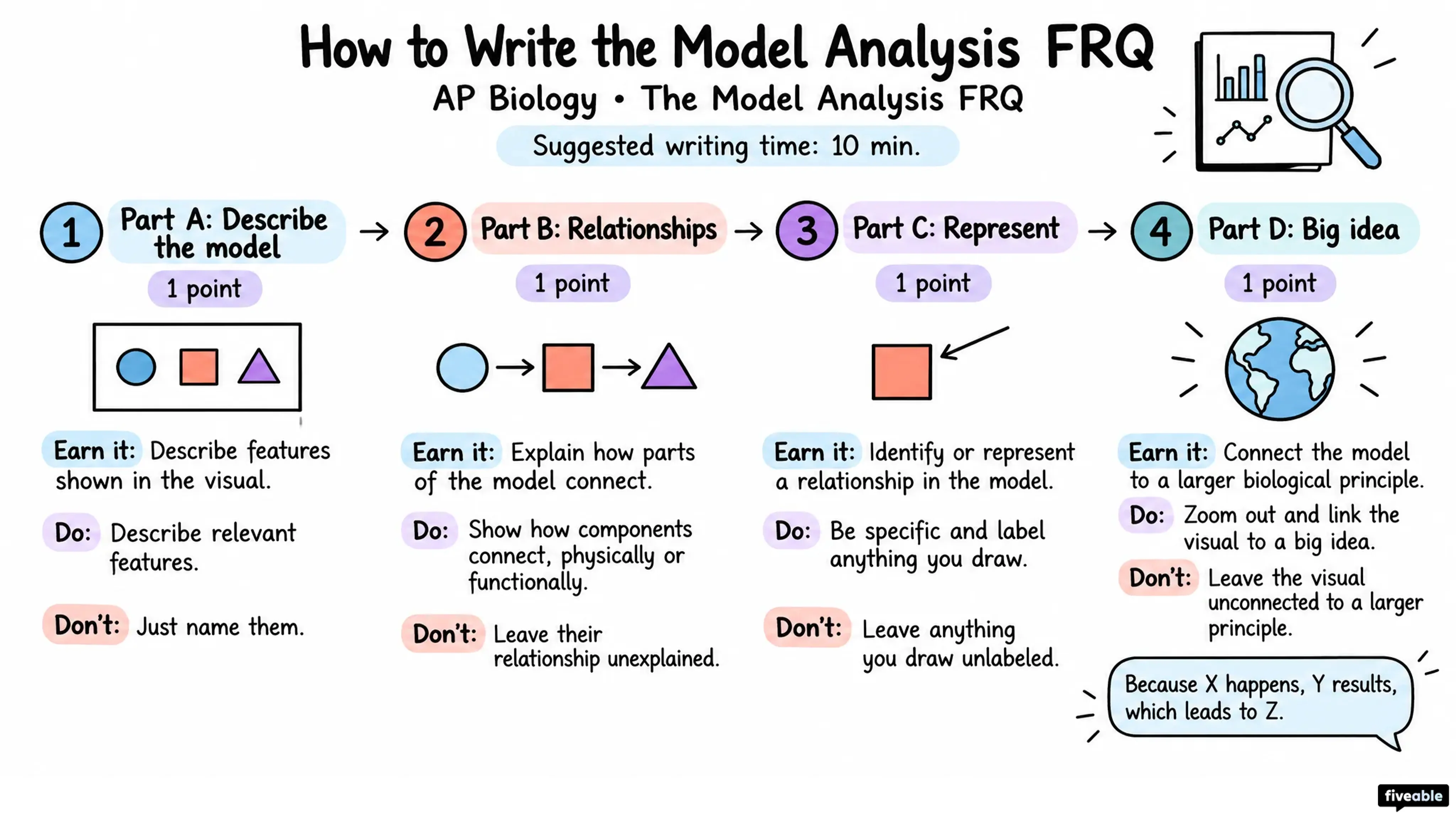
This is FRQ 5 on the AP Biology exam. You get a diagram, model, or other visual and answer four parts that describe it, explain how its pieces relate, and connect it to a larger biological principle.
- 10 min
- suggested writing time
- 4 points
- 1 point for each part
- 50%
- of your score, for all six FRQs
Part A: Describe the model
Describe features shown in the visual
1 pt
Part B: Relationships
Explain how parts of the model connect
1 pt
Part C: Represent
Identify or represent a relationship in the model
1 pt
Part D: Big idea
Connect the model to a larger biological principle
1 pt
Model Analysis FRQ skill sheet
Every rubric point on one page: what earns it, what to do and what to avoid. Tap the sheet to see it full size.
How Model Analysis FRQ practice works
Each question follows the exam’s format, from the full prompt to a score on every part.
Read the full question
The visual and all four parts, A through D, laid out the way the exam shows them.
Write on a 10-minute timer
The time to plan for on exam day. Pause it or turn it off, and your response saves as you go.
Submit for a score out of 4
Your response is scored against the scoring guidelines written for that question. Your first score is included.
Feedback on every part
A summary at the top tells you what to work on next. Below it, each part shows whether you earned the point and what the scoring guidelines were looking for.
Detailed Feedback
Part A: 0/1 point
Did not earn the point. You were on the right track by mentioning that nitrogen-fixing bacteria convert atmospheric nitrogen into a usable form, but you confused the process. Nitrogen-fixing bacteria convert atmospheric nitrogen (N₂) into ammonia (NH₃), not nitrates. Nitrification is a separate process performed by different bacteria. To earn this point, you needed to describe that nitrogen-fixing bacteria specifically convert N₂ to ammonia.
Part B: 1/1 point
Earned the point. You correctly explained that denitrification converts nitrates (the usable form) into nitrogen gas (N₂), which is not usable by plants, thereby regulating the amount of nitrogen available for plant growth. Your explanation clearly shows the causal relationship between denitrification and reduced nitrogen availability.
Part C: 1/1 point
Earned the point. You correctly identified nitrates as the product of nitrification.
What 420 scored Model Analysis FRQs show
Patterns from the practice Model Analysis FRQs students have turned in on Fiveable. Students lose the most points on Part D: big idea.
C: Represent
90%
A: Describe the model
82%
B: Relationships
72%
D: Big idea
65%
38%
of responses earned all 4 points
3.1 of 4
average score
+1.1 points
average gain when students rewrote the same Model Analysis FRQ after feedback
420 practice responses from 152 students, scored on Fiveable through October 26, 2026.
Questions about the Model Analysis FRQ
How many responses can I get scored?
You can read every question without a plan. Your first scored response is included. A plan unlocks unlimited scoring.
What kinds of visuals show up?
Diagrams of cell structures, metabolic pathways, phylogenetic trees, and other models of biological systems.
How is this different from the Data Analysis FRQ?
This question asks you to read a model or diagram. The Data Analysis FRQ gives you a graph or table of results to describe and evaluate.
How long should each part be?
Two to four focused sentences usually does it. Each part is worth 1 point, so answer every part.
More AP Biology practice
Experimental Results FRQ practice
Long FRQs with a research scenario, its figures, and all four parts.
Scientific Investigation FRQ practice
Short FRQs on experimental design, with the scenario and all four parts.
Conceptual Analysis FRQ practice
Short FRQs on a process and a disruption, with all four parts.
Data Analysis FRQ practice
Short FRQs with a graph or table of results and all four parts.
See the Model Analysis FRQ rubric points students miss most, from responses scored on Fiveable.
Write your first Model Analysis FRQ
Pick one from the list, or let us choose for you.
Teaching AP Biology? Assign these Model Analysis FRQs to your class