AP Biology Conceptual Analysis FRQ Practice
138 Conceptual Analysis questions written in the AP format. Pick one, read the full question, and write your response.
Your first scored response is included. A plan unlocks unlimited scoring.

138 questions
sorted by unit
Protein folding, amino acid properties, aqueous environment
Unit 1: Chemistry of Life
Proteins are essential macromolecules that perform a wide range of functions in living organisms, including catalysis, transport, and structural support. The function of a protein is intimately linked to its specific three-dimensional shape, or tertiary structure. This structure is determined by the sequence of amino acids in the polypeptide chain and is maintained by various chemical interactions.
Most biologically active proteins, such as enzymes, exist in the aqueous environment of the cell cytoplasm. The folding of a polypeptide into its functional globular shape is driven by the chemical properties of the amino acid monomers and their interactions with the surrounding water molecules. The twenty different amino acids found in proteins share a common backbone but differ in their side chains, known as R-groups.
Describe the chemical property of the R-groups (side chains) of amino acids that are typically found on the exterior surface of a cytoplasmic protein.
Explain how the polarity of water molecules influences the final three-dimensional folding of a polypeptide chain in an aqueous environment.
Researchers are studying a specific globular protein found in the cytoplasm of bacteria. They identify a mutation in the gene encoding this protein that leads to a single amino acid substitution. In the mutant protein, a serine residue located on the exterior surface of the protein is replaced by a phenylalanine residue. Serine has a polar R-group capable of forming hydrogen bonds, while phenylalanine has a nonpolar, hydrophobic R-group.
Predict the effect of the serine-to-phenylalanine substitution on the solubility or stability of the mutant protein in the cytoplasm.
Justify your prediction in part C.
What the Conceptual Analysis FRQ asks
This is FRQ 4 on the AP Biology exam. It describes a biological process and a disruption to it, and you describe the process, explain it, then predict and justify the effect of the disruption.
- 10 min
- suggested writing time
- 4 points
- 1 point for each part
- 50%
- of your score, for all six FRQs
Part A: Describe
Describe the normal concept or process
1 pt
Part B: Explain
Explain how or why the process works
1 pt
Part C: Predict
Predict the cause or effect of the disruption
1 pt
Part D: Justify
Justify the prediction with cause-and-effect reasoning
1 pt
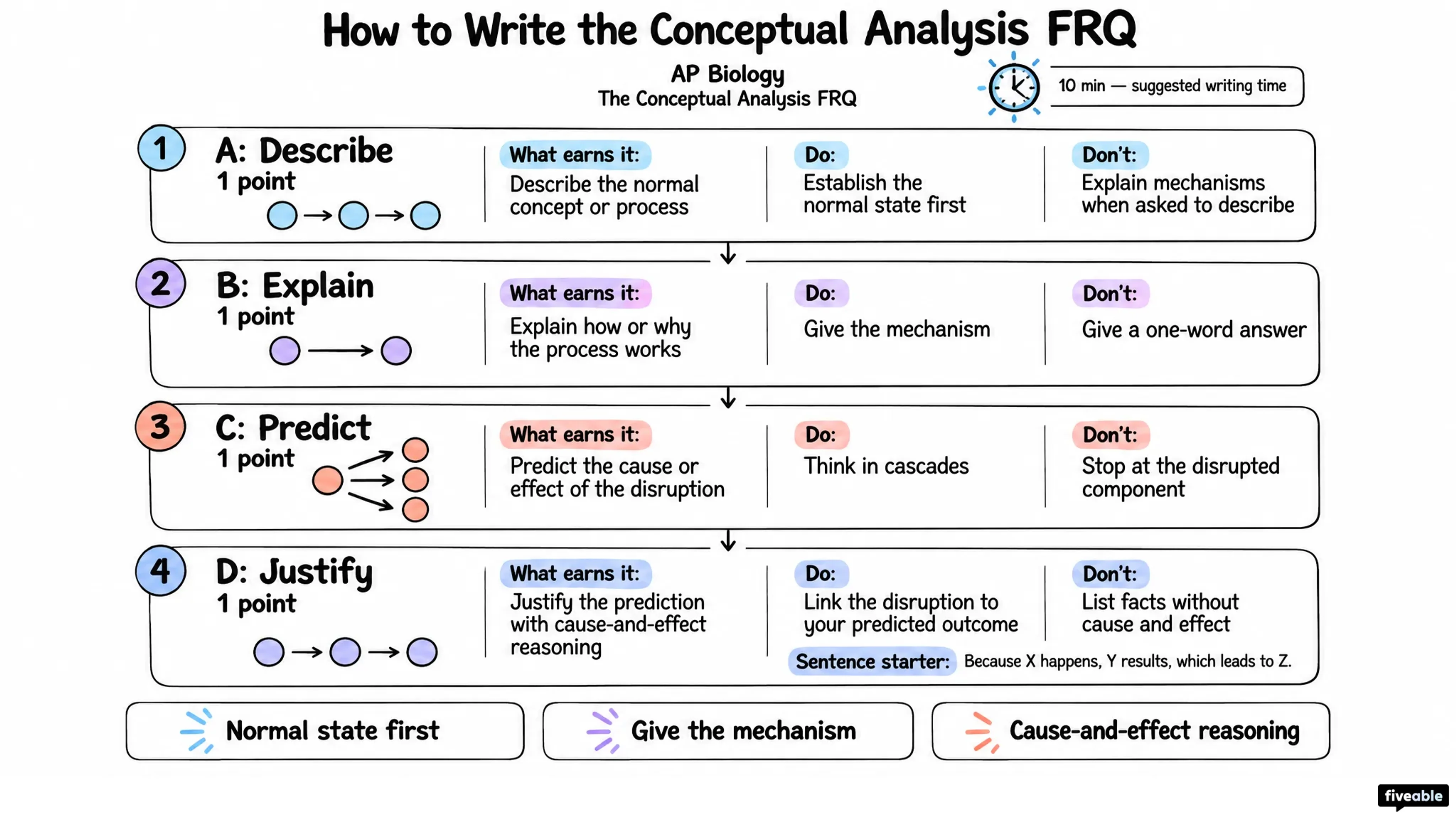
Conceptual Analysis FRQ skill sheet
Every rubric point on one page: what earns it, what to do and what to avoid. Tap the sheet to see it full size.
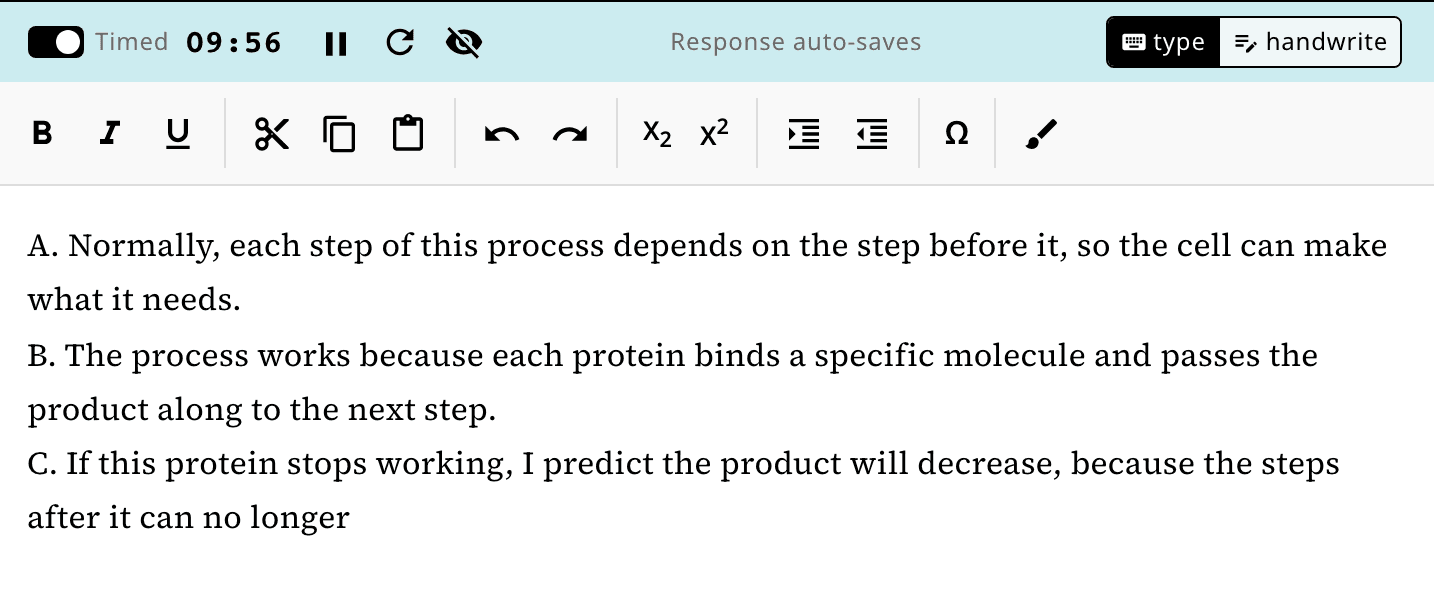
How Conceptual Analysis FRQ practice works
Each question follows the exam’s format, from the full prompt to a score on every part.
Read the full question
The scenario and all four parts, A through D, laid out the way the exam shows them.
Write on a 10-minute timer
The time to plan for on exam day. Pause it or turn it off, and your response saves as you go.
Submit for a score out of 4
Your response is scored against the scoring guidelines written for that question. Your first score is included.
Feedback on every part
A summary at the top tells you what to work on next. Below it, each part shows whether you earned the point and what the scoring guidelines were looking for.
Detailed Feedback
Part A: 1/1 point
Earned the point. You correctly described that hydrogen bonding between the polypeptide backbone creates alpha-helices and beta-pleated sheets, which are the organized structures of secondary structure. This demonstrates understanding of how hydrogen bonds stabilize these folding patterns.
Part B: 1/1 point
Earned the point. You provided a clear causal explanation linking water's polarity to the arrangement of R-groups: nonpolar R-groups aggregate in the middle to avoid water (hydrophobic effect), while polar R-groups localize on the surface to interact with water. You explicitly connected this to tertiary structure stability. Strong response.
Part C: 0/1 point
Did not earn the point. Your prediction states that glutamic acid causes denaturation, but the question asks about the effect of substituting glutamic acid WITH valine (replacing glutamic acid, not adding it). The correct prediction should be that hemoglobin molecules will aggregate or clump together. You need to predict the specific outcome of this amino acid substitution on hemoglobin-hemoglobin interactions.
What 511 scored Conceptual Analysis FRQs show
Patterns from the practice Conceptual Analysis FRQs students have turned in on Fiveable. Students lose the most points on Part D: justify.
A: Describe
77%
C: Predict
73%
B: Explain
68%
D: Justify
68%
36%
of responses earned all 4 points
2.9 of 4
average score
+1.2 points
average gain when students rewrote the same Conceptual Analysis FRQ after feedback
511 practice responses from 198 students, scored on Fiveable through October 10, 2026.
Questions about the Conceptual Analysis FRQ
How many responses can I get scored?
You can read every question without a plan. Your first scored response is included. A plan unlocks unlimited scoring.
What kinds of disruptions come up?
Mutations, environmental changes, disease states, or a missing component. You trace the effect from molecules to cells and up to organisms or ecosystems.
How is “explain” different from “describe”?
Describe asks what happens. Explain asks how or why, with a mechanism. Each earns its point for a different move.
How long should each part be?
Two to four focused sentences usually does it. Each part is worth 1 point, so answer every part.
More AP Biology practice
Experimental Results FRQ practice
Long FRQs with a research scenario, its figures, and all four parts.
Scientific Investigation FRQ practice
Short FRQs on experimental design, with the scenario and all four parts.
Data Analysis FRQ practice
Short FRQs with a graph or table of results and all four parts.
Write your first Conceptual Analysis FRQ
Pick one from the list, or let us choose for you.
Teaching AP Biology? Assign these Conceptual Analysis FRQs to your class