all units 200
unit 1 20
unit 2 20
unit 3 20
unit 4 20
unit 5 20
unit 6 20
unit 7 20
unit 8 20
unit 9 20
unit 10 20
200 questions
sorted by unit
Prehistoric art's ritual and sacred functions
Unit 1
Animal imagery in prehistoric spiritual and ritual communication
Unit 1
Art imagery, materials, form, ritual function
Unit 1
Animal depictions in prehistoric spiritual and cultural expression
Unit 1
Natural materials and imagery in prehistoric art
Unit 1
Prehistoric art's role in ritual and spiritual practices
Unit 1
Prehistoric art reflecting spiritual and religious beliefs
Unit 1
Human-nature relationships in prehistoric art
Unit 1
Prehistoric ritual art and sacred space marking
Unit 1
Natural imagery in prehistoric ritual and sacred art
Unit 1
Animal imagery in prehistoric sacred and ritual art
Unit 1
Prehistoric artistic depictions of nature and spirituality
Unit 1
Human-natural world connection in prehistoric art
Unit 1
Prehistoric art, natural materials, ritual function
Unit 1
Environmental materials and imagery in prehistoric spiritual practices
Unit 1
Animal imagery in prehistoric spiritual communication
Unit 1
Animal imagery in prehistoric spiritual expression
Unit 1
Animal imagery communicating supernatural and natural world beliefs
Unit 1
Animal imagery and natural materials in prehistoric art
Unit 1
Animal depictions in prehistoric spiritual and survival practices
Unit 1
Legitimization of power through ancient Mediterranean art and architecture
Unit 2
Ancient Mediterranean art asserting ruler power and authority
Unit 2
Ancient Mediterranean art asserting political and divine authority
Unit 2
Ancient Mediterranean art asserting authority and power
Unit 2
Ancient Mediterranean rulers' commissioned art and architecture
Unit 2
Rulers' artistic and architectural propaganda in ancient Mediterranean
Unit 2
Ruler propaganda through Ancient Mediterranean art and architecture
Unit 2
Ruler-commissioned art communicating power and authority
Unit 2
Ancient Mediterranean art asserting political power and authority
Unit 2
Ancient Mediterranean ruler propaganda through art
Unit 2
Ancient Mediterranean art asserting ruler power and authority
Unit 2
Ruler propaganda through Ancient Mediterranean art and architecture
Unit 2
Rulers' use of art and architecture for political authority
Unit 2
Ruler-commissioned art legitimizing political authority
Unit 2
Ancient Mediterranean art and political legitimacy
Unit 2
Ancient Mediterranean art and political authority communication
Unit 2
Ancient Mediterranean rulers' use of art and architecture
Unit 2
Ancient Mediterranean art and political authority
Unit 2
Ancient Mediterranean rulers' commissioned art and legitimacy
Unit 2
Ancient Mediterranean art asserting ruler authority
Unit 2
Sacred architecture: light, space, and spiritual experience
Unit 3
Art and architecture legitimizing political power and authority
Unit 3
Commissioned art asserting political power and authority
Unit 3
Religious architecture, beliefs, and ritual facilitation
Unit 3
Cultural interaction in European and Colonial American art
Unit 3
Sacred architecture and divine connection through design
Unit 3
Sacred architecture's accommodation of religious rituals
Unit 3
Religious architecture facilitating rituals and theological beliefs
Unit 3
Light manipulation in sacred spaces facilitating spiritual experience
Unit 3
Art, architecture, and political authority in early modern period
Unit 3
Cultural blending in art and architecture, Early Europe-Americas
Unit 3
Art, architecture, and political authority in Early Europe
Unit 3
Cultural interaction in European and Colonial American art
Unit 3
Religious architecture and ritual facilitation
Unit 3
Cultural exchange in Early European and Colonial American art
Unit 3
Religious narratives conveying theological messages in art
Unit 3
Light, space, and materials in Early European and Colonial religious art
Unit 3
Commissioned art asserting political power and authority
Unit 3
Art and architecture as instruments of political authority
Unit 3
Sacred space through architectural manipulation of light
Unit 3
Art as social and political critique
Unit 4
Art as social and political commentary, 1750–1980
Unit 4
Art responding to political events and social conditions
Unit 4
Artistic social and political critique in Later Europe and Americas
Unit 4
Art as political and social commentary, 1750–1980
Unit 4
Art as political and social commentary
Unit 4
Artistic critique of social and political structures
Unit 4
Visual imagery communicating political and social commentary
Unit 4
Artistic critique of social, political, economic conditions
Unit 4
Art as social and political critique
Unit 4
Political and social commentary in European American art
Unit 4
War, revolution, and political upheaval in art
Unit 4
Social and political commentary in art
Unit 4
Artistic critique of social injustice and modernization
Unit 4
Art critiquing social and political structures
Unit 4
Art as social and political commentary
Unit 4
Art critiquing political and social conditions
Unit 4
Industrialization's environmental and social transformation depicted
Unit 4
Artists commenting on social issues through imagery
Unit 4
Art critiquing social and political hierarchies
Unit 4
Indigenous American art reflecting natural world connections
Unit 5
Indigenous American sacred architecture and cosmological symbolism
Unit 5
Indigenous American sacred architecture and religious practice
Unit 5
Indigenous American sacred art and architectural spirituality
Unit 5
Indigenous American art and political legitimacy
Unit 5
Indigenous American sacred spaces and spiritual communication
Unit 5
Indigenous American spiritual art and architectural expression
Unit 5
Indigenous architectural design for religious ritual and cosmos connection
Unit 5
Indigenous American sacred architecture and ritual design
Unit 5
Indigenous American sacred architecture and cosmological relationships
Unit 5
Indigenous American art integrating nature for religious and political purposes
Unit 5
Indigenous American art legitimizing elite power and authority
Unit 5
Indigenous American elite power through art and architecture
Unit 5
Indigenous American art, nature, spiritual beliefs integration
Unit 5
Indigenous architectural complexes reflecting cosmological beliefs
Unit 5
Indigenous American sacred art and spiritual architecture
Unit 5
Indigenous American art and environmental integration
Unit 5
Indigenous American art: nature imagery, spiritual beliefs, power
Unit 5
Indigenous American sacred spaces and ritual architecture
Unit 5
Indigenous American art: materials, imagery, spiritual connection
Unit 5
African art legitimizing political authority and power
Unit 6
African art validating political authority and leadership
Unit 6
African art validating political authority and status
Unit 6
African art as validation of political authority
Unit 6
African art validating leadership and social status
Unit 6
African art depicting leadership power and authority
Unit 6
African art legitimizing leadership and political power
Unit 6
African art validating political authority and power
Unit 6
African art validating political authority and status
Unit 6
African art legitimizing political authority
Unit 6
African art validating political authority and leadership
Unit 6
African art and architecture legitimizing political authority
Unit 6
African art legitimizing political authority and social status
Unit 6
African art and political legitimacy
Unit 6
African art validating political authority and status
Unit 6
African art legitimizing political authority and power
Unit 6
African art validating political power and leadership
Unit 6
Art validating political power in African societies
Unit 6
African art validating political authority and power
Unit 6
African art communicating political power and authority
Unit 6
Religious architecture, ritual facilitation, faith expression
Unit 7
Religious architecture facilitating West and Central Asian worship practices
Unit 7
Religious architecture facilitating ritual and worship practices
Unit 7
Religious architecture and ritual accommodation in West and Central Asia
Unit 7
Religious architecture and spiritual practice facilitation
Unit 7
Religious architecture facilitating faith practices and rituals
Unit 7
Religious architecture facilitating spiritual practice in Asia
Unit 7
Religious art and architecture reflecting spiritual beliefs
Unit 7
Religious art and architecture facilitating worship practices
Unit 7
Sacred architecture facilitating religious practice in West and Central Asia
Unit 7
Religious architecture: structural elements and worship practices
Unit 7
Religious architecture facilitating faith practices West/Central Asia
Unit 7
Religious architecture facilitating ritual practice and spiritual belief
Unit 7
Cross-cultural artistic exchange in West and Central Asia
Unit 7
Religious architecture facilitating spiritual practice and ritual
Unit 7
Cultural interaction through West and Central Asian art
Unit 7
Religious architecture facilitating rituals and communal practices
Unit 7
Cross-cultural artistic exchange in West and Central Asia
Unit 7
Religious architecture facilitating ritual and communal worship
Unit 7
Religious architecture and community ritual accommodation
Unit 7
Religious architecture and spiritual progression through design
Unit 8
Art and architecture as tools of political legitimacy
Unit 8
Religious architecture facilitating spiritual practice in Asia
Unit 8
Ruler-commissioned art legitimizing power and divinity
Unit 8
Religious architecture facilitating Asian spiritual practices
Unit 8
Religious architecture facilitating spiritual practice and experience
Unit 8
Religious architecture design facilitating ritual practices
Unit 8
Political power through commissioned art and architecture
Unit 8
Religious architecture facilitating spiritual practices and rituals
Unit 8
Religious architecture design facilitating ritual practices across Asia
Unit 8
Natural world depictions expressing religious philosophical concepts
Unit 8
Sacred architecture guiding physical and spiritual movement
Unit 8
Religious architecture as spiritual journey and cosmic representation
Unit 8
Religious architecture as cosmic diagram and ritual space
Unit 8
Religious architecture facilitating spiritual rituals and journeys
Unit 8
Religious architecture facilitating spiritual practices in Asia
Unit 8
Religious architecture facilitating spiritual practices in Asia
Unit 8
Sacred sites and religious practice in Asian traditions
Unit 8
Religious art and architecture facilitating spiritual practice
Unit 8
Sacred space design reflecting Asian religious philosophy
Unit 8
Pacific ritual arts reinforcing social hierarchies
Unit 9
Pacific art, ritual function, social reinforcement
Unit 9
Pacific art objects, ritual performance, and social hierarchy
Unit 9
Pacific ritual art communicating status and spiritual power
Unit 9
Pacific art: ancestor commemoration and social hierarchy
Unit 9
Pacific art materials communicating status and spirituality
Unit 9
Materials and forms conveying social status, spiritual power
Unit 9
Pacific art materials, ritual status, and power
Unit 9
Pacific art and architecture communicating power, status, authority
Unit 9
Pacific art, architecture, political authority, spirituality
Unit 9
Pacific art and architecture asserting power authority
Unit 9
Pacific art and architecture asserting elite power
Unit 9
Pacific art demonstrating status and political power
Unit 9
Pacific art rituals reinforcing social structures and beliefs
Unit 9
Pacific art objects in performance and ritual contexts
Unit 9
Pacific art and architecture displaying elite power
Unit 9
Pacific performance arts communicating status and spiritual power
Unit 9
Pacific art and architecture communicating power, status, mana
Unit 9
Pacific art, materials, performance, social status, power
Unit 9
Materials, spirituality, and identity in Pacific art
Unit 9
Colonial history and global trade in contemporary art
Unit 10
Artistic appropriation and cultural reinterpretation in contemporary practice
Unit 10
Contemporary art, cultural stereotypes, complex identities
Unit 10
Contemporary art reinterpreting tradition and cultural identity
Unit 10
Contemporary art challenging stereotypes and historical narratives
Unit 10
Artist appropriation and social or political commentary
Unit 10
Materials, cultural history, social issues communication
Unit 10
Artist commentary on cultural identity and social history
Unit 10
Contemporary art challenging stereotypes and historical narratives
Unit 10
Contemporary art critiquing cultural narratives and stereotypes
Unit 10
Contemporary art commentary on identity and history
Unit 10
Artist materials and processes, cultural identity commentary
Unit 10
Artist materials and techniques expressing cultural identity
Unit 10
Artist materials and imagery exploring identity
Unit 10
Cultural appropriation and identity in contemporary art
Unit 10
Artistic responses to globalization and colonialism
Unit 10
Contemporary art critiques colonialism and global trade
Unit 10
Contemporary art exploring personal, cultural, national identity
Unit 10
Contemporary art challenging historical narratives and stereotypes
Unit 10
Materials, imagery, cultural identity, historical narratives
Unit 10
Note: There are no images provided for Question 2.
Works of art from Global Prehistory were often created to serve a ritual or sacred function, connecting the physical world with the spiritual realm or natural forces.
Select and completely identify one work of art from the list below or any other relevant work from Global Prehistory (30,000–500 BCE) that was created to serve a ritual or sacred function.
Explain how the work of art served a ritual or sacred function.
In your response you should do the following:
Provide two accurate identifiers for the work of art you have selected.
Respond to the prompt with an art historically defensible claim or thesis that establishes a line of reasoning.
Support your claim with at least two examples of relevant visual and/or contextual evidence.
Explain how the evidence supports the claim.
Corroborate or qualify your claim by explaining relevant connections, providing nuance, or considering diverse views.
When identifying the work of art, you should try to include all of the following: title or designation, name of the artist and/or culture of origin, date of creation, and materials. You will earn credit for the identification if you provide at least two accurate identifiers, but you will not be penalized if any additional identifiers you provide are inaccurate. If you select a work from the list below, you must include at least two accurate identifiers beyond those that are given .
Camelid sacrum in the shape of a canine
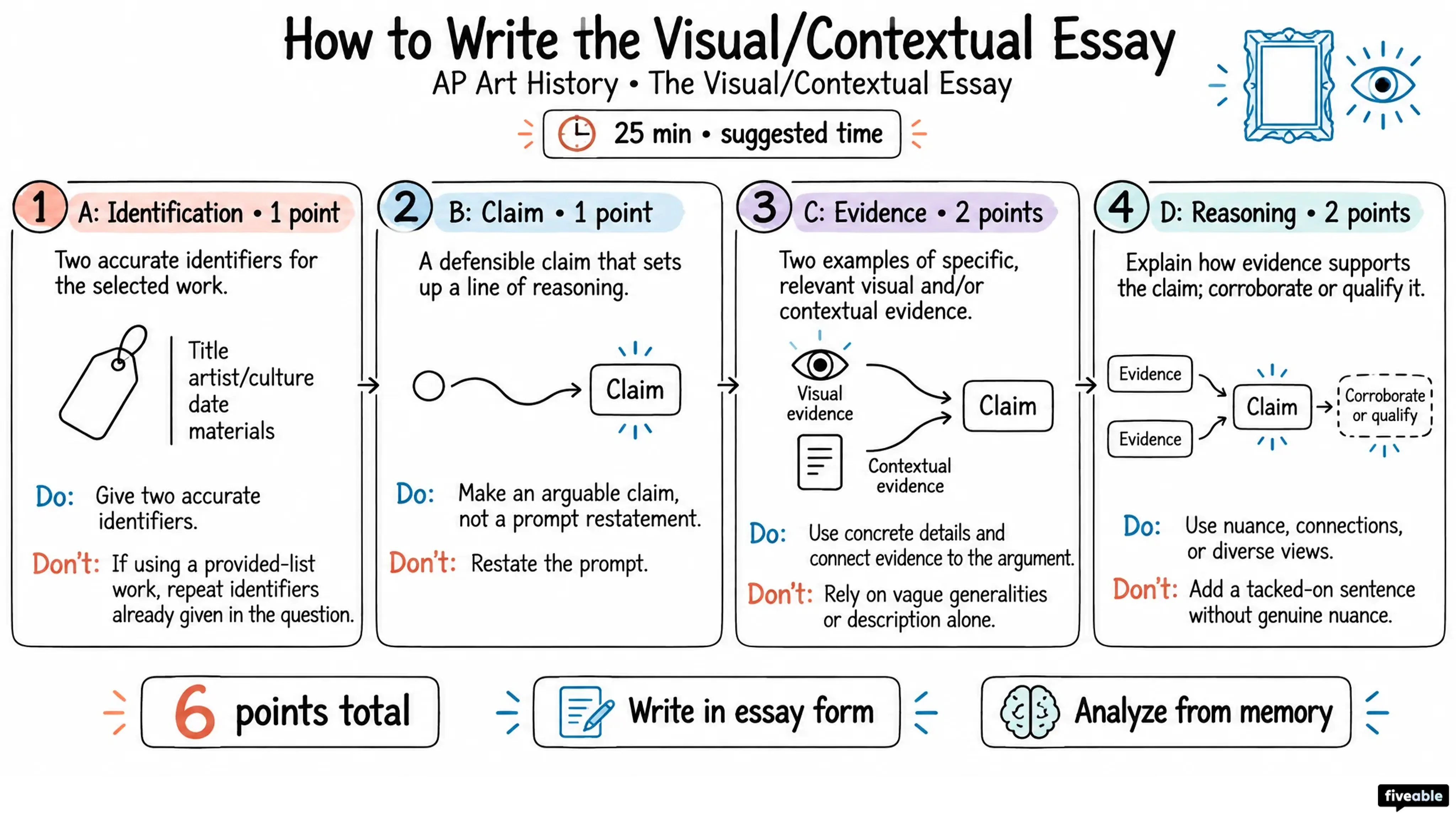
What the Visual/Contextual Essay asks The visual/contextual analysis essay is FRQ 2 on the AP Art History exam, the second long essay. There’s no image. You select a work from a list or your own knowledge and build an argument about it from memory.
25 min suggested time
6 points across rows A to D
50% of your score, across all six FRQs A
Part A: Identification Two accurate identifiers for the work you select
1 pt
B
Part B: Claim A defensible claim that sets up a line of reasoning
1 pt
C
Part C: Evidence Two examples of specific visual or contextual evidence
2 pts
D
Part D: Reasoning How the evidence supports the claim, then a point that corroborates or qualifies it
2 pts
How Visual/Contextual Essay practice works Each question follows the exam’s format, from the full prompt to a score on every part.
1
Read the full question The context, the prompt, and the list of works you can select from, laid out the way the exam shows them.
2
Write on a 25-minute timer The time to plan for on exam day. Pause it or turn it off, and your response saves as you go.
3
Submit for a score out of 6 Your response is scored against the scoring guidelines written for that question. Your first score is included.
Feedback on every part A summary at the top tells you what to work on next. Below it, each part shows whether you earned the point and what the scoring guidelines were looking for.
Earned the point. You correctly provided multiple accurate identifiers for Stonehenge beyond the title, including the date (2500 BCE), location (Wiltshire, England), culture (Neolithic), and materials (sarsen and bluestones).
Earned the point. You established a clear, defensible claim that Stonehenge served as a ritual site connecting ancient peoples with natural forces and the spiritual world through ceremonies related to nature's cycles.
Detailed feedback on a practice Visual/Contextual Essay Questions about the Visual/Contextual Essay How many responses can I get scored? You can read every question without a plan. Your first scored response is included. A plan unlocks unlimited scoring.
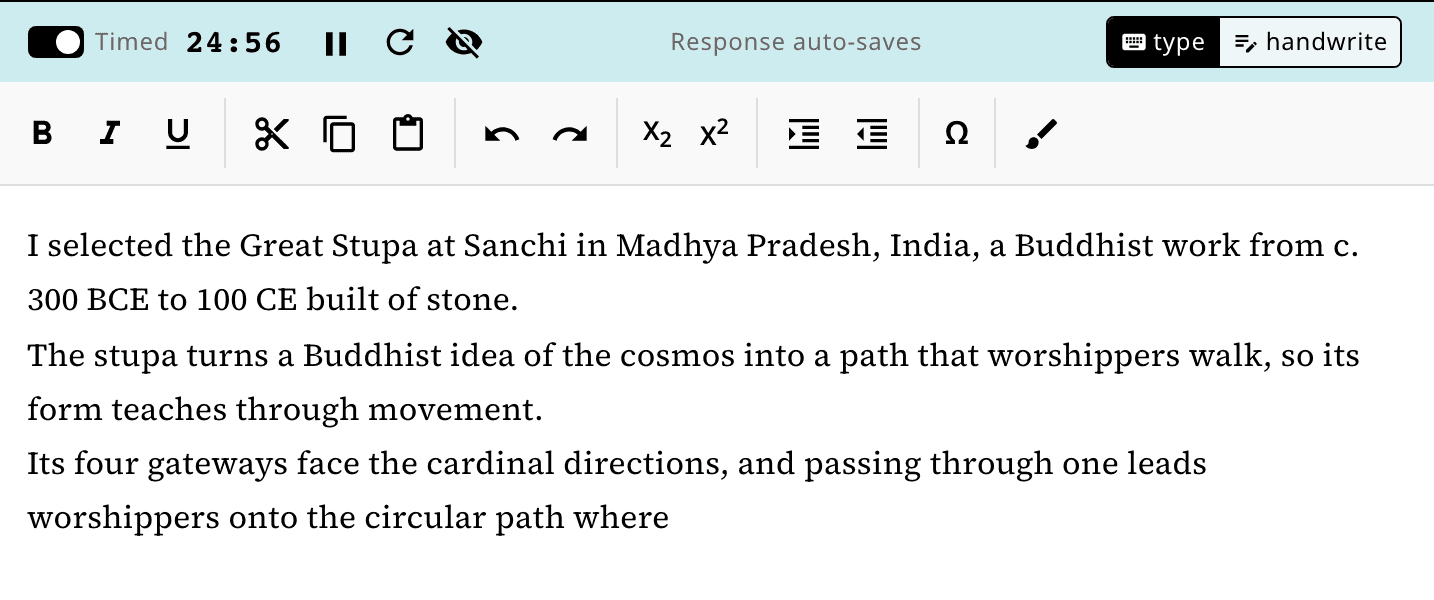
Why is there no image? FRQ 2 on the exam shows no images. You analyze a work from memory, so choose one you can describe in specific visual detail.
What counts as an identifier? The title, the artist or culture, the date, or the materials. Two accurate ones earn the point, and inaccurate extras don’t cost you.
Are these real College Board questions? No. We wrote them in the AP format, with a list of works to select from, and wrote scoring guidelines for each one.
Can I write my answer by hand? Yes. Switch the editor to handwrite, write on paper, and add a photo of your page.
More AP Art History practice Comparison Essay practice Comparison essay prompts with the required work’s image and the list to select from.
Visual Analysis Essay practice Visual analysis short essays with the work’s image and every part of the question.
Contextual Analysis Essay practice Contextual analysis short essays with the work’s image and every part of the question.
Attribution Essay practice Attribution short essays with the work’s image and every part of the question.
Continuity and Change Essay practice Continuity and change short essays with the work’s image and every part of the question.
AP Art History FRQs Every FRQ type for AP Art History, with practice for each.
AP Art History study guides Unit-by-unit review for the whole course.