AP Art History Continuity and Change Essay Practice
236 continuity and change short essay prompts written in the AP format. Pick one, study the image and question, and write your response. Fiveable scores each Continuity and Change Essay response part by part on the AP rubric.
Your first scored response is included. A plan unlocks unlimited scoring.
236 questions
sorted by unit
Neolithic ceramic animal representation and symbolism
Unit 1: Global Prehistory, 30,000-500 bce
Beaker with ibex motifs. Susa, Iran. 4200-3500 bce. Painted terra cotta
In your response you should do the following:
Describe two visual characteristics of the Beaker with ibex motifs.
Using specific visual or contextual evidence, explain how the work shown demonstrates continuity with earlier Paleolithic artistic traditions.
Using specific visual or contextual evidence, explain how the work shown demonstrates change from earlier Paleolithic artistic traditions.
Using specific visual or contextual evidence, explain why this work might be interpreted as a demonstration of social or cultural change.
What the Continuity and Change Essay asks
The continuity and change essay is FRQ 6 on the AP Art History exam, the last of four short essays. You see a work from the 250-work image set and explain how it continues and changes an artistic tradition.
- 15 min
- suggested time
- 5 points
- across parts A to E
- 50%
- of your score, across all six FRQs
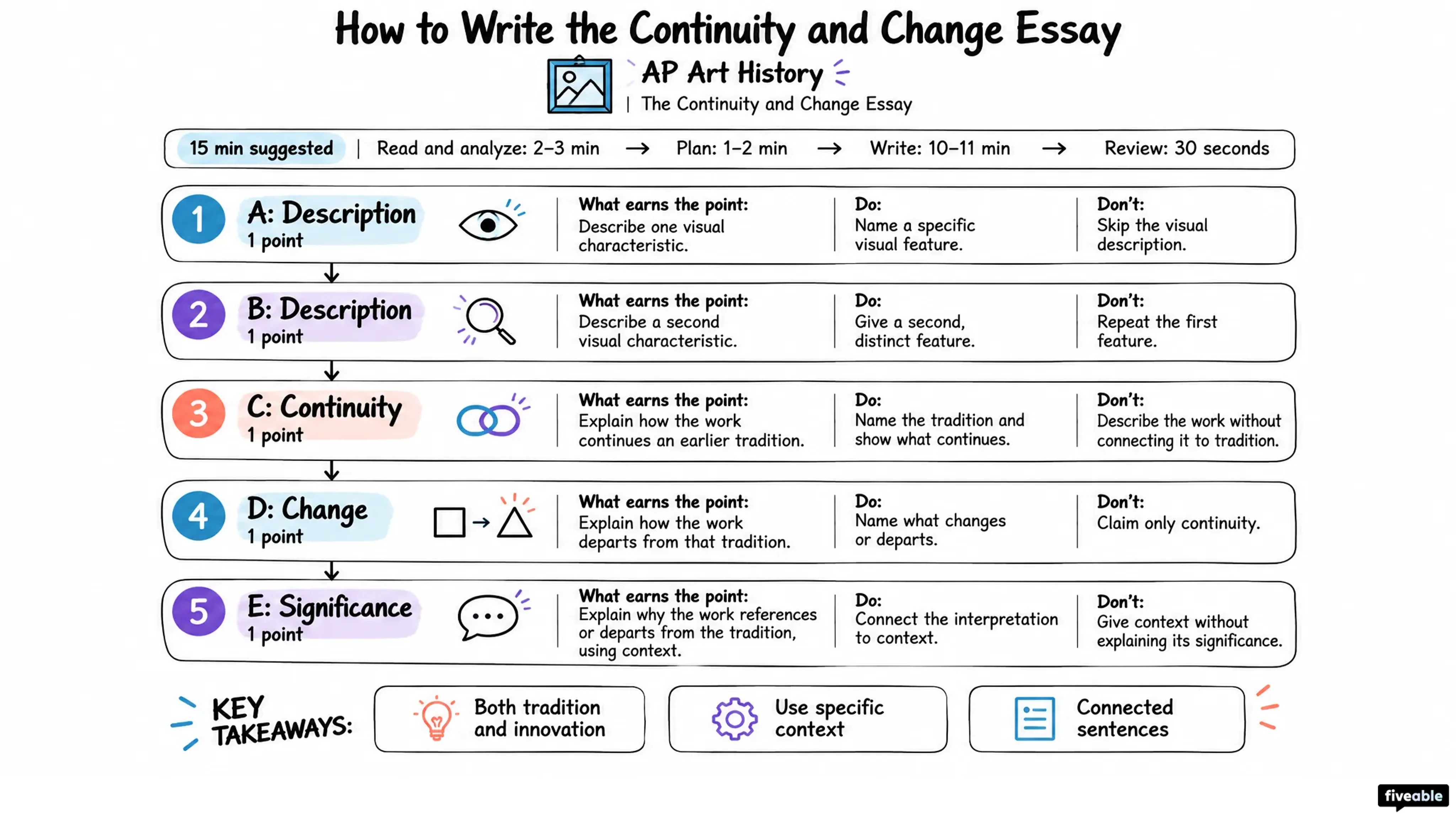
Part A: Description
One visual characteristic of the work
1 pt
Part B: Description
A second visual characteristic of the work
1 pt
Part C: Continuity
How the work continues an earlier tradition
1 pt
Part D: Change
How the work departs from that tradition
1 pt
Part E: Significance
Why the work references or departs from the tradition, using context
1 pt
Continuity and Change Essay skill sheet
Every rubric point on one page: what earns it, what to do and what to avoid. Tap the sheet to see it full size.
How Continuity and Change Essay practice works
Each question follows the exam’s format, from the full prompt to a score on every part.
Study the image and question
The image of the work and each part of the question, laid out the way the exam shows them.
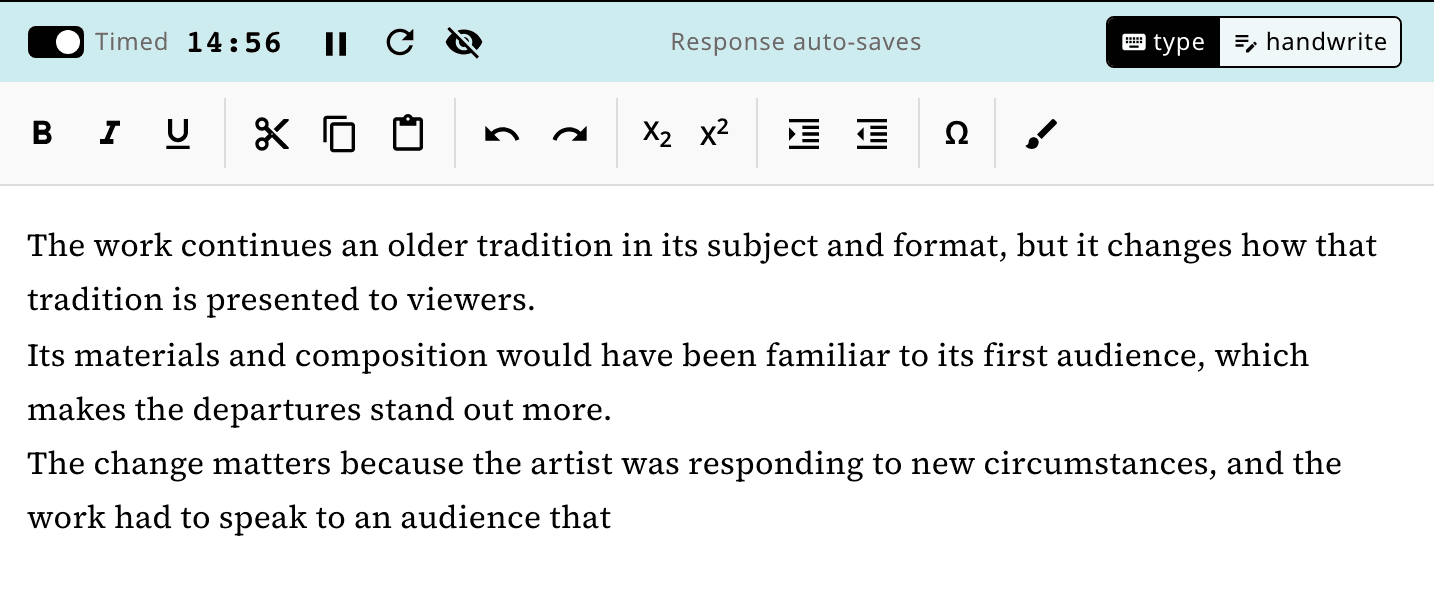
Write on a 15-minute timer
The time to plan for on exam day. Pause it or turn it off, and your response saves as you go.
Submit for a score out of 5
Your response is scored against the scoring guidelines written for that question. Your first score is included.
Feedback on every part
A summary at the top tells you what to work on next. Below it, each part shows whether you earned the point and what the scoring guidelines were looking for.
Detailed Feedback
Part A: 1/1 point
Earned the point. You correctly identified the depiction of a gun as a visual characteristic of the work.
Part B: 0/1 point
Did not earn the point. You needed to describe a second visual characteristic of the painting. While you mentioned it shows an angel, you needed to describe a specific visual feature of the angel or the painting, such as the feathered wings, the elaborate gold-embroidered clothing, or the wide-brimmed hat.
Part C: 1/1 point
Earned the point. You successfully explained that the depiction of an angel demonstrates continuity with the European Catholic tradition of featuring angels and saints in religious art.
Questions about the Continuity and Change Essay
How many responses can I get scored?
You can read every question without a plan. Your first scored response is included. A plan unlocks unlimited scoring.
Do I need to write about both continuity and change?
Yes. Separate parts ask how the work continues a tradition and how it departs from it. A sentence like “it continues X while changing Y” covers both, with evidence for each.
Will I know the work?
You should. On the exam, FRQ 6 shows a work from the 250-work image set, so knowing each work’s context pays off directly.
Can I answer in bullet points?
On the exam, responses must be in essay form, and outlines or bulleted lists don’t earn full credit. Practice in short, complete sentences that answer each part.
Can I write my answer by hand?
Yes. Switch the editor to handwrite, write on paper, and add a photo of your page.
More AP Art History practice
Comparison Essay practice
Comparison essay prompts with the required work’s image and the list to select from.
Visual/Contextual Essay practice
Visual/contextual analysis prompts with the full question and the list of works.
Visual Analysis Essay practice
Visual analysis short essays with the work’s image and every part of the question.
Contextual Analysis Essay practice
Contextual analysis short essays with the work’s image and every part of the question.
Attribution Essay practice
Attribution short essays with the work’s image and every part of the question.
AP Art History FRQs
Every FRQ type for AP Art History, with practice for each.
Write your first Continuity and Change Essay
Pick one from the list, or let us choose for you.
Teaching AP Art History? Assign these Continuity and Change Essays to your class