AP Art History Visual Analysis Essay Practice
132 visual analysis short essay prompts written in the AP format. Pick one, study the image and question, and write your analysis. Fiveable scores each Visual Analysis Essay response part by part on the AP rubric.
Your first scored response is included. A plan unlocks unlimited scoring.
132 questions
sorted by unit
Neolithic Chinese painted ceramic vessel decoration
Unit 1: Global Prehistory, 30,000-500 bce
The work shown is a Jar (Guan) from Neolithic China, created during the Banshan phase (ca. 2650-2350 BCE). This work is not from the required image set.
Describe at least two visual characteristics of the work.
Using specific visual evidence, explain how the artist creates a sense of dynamic movement.
Using specific visual evidence, explain how the painted decoration emphasizes the three-dimensional form of the vessel.
Using specific visual or contextual evidence, explain how the work demonstrates continuity with global Neolithic ceramic traditions.
What the Visual Analysis Essay asks
The visual analysis essay is FRQ 3 on the AP Art History exam, the first of four short essays. You see a work from outside the 250-work image set and explain its visual choices and how it relates to an artistic tradition.
- 15 min
- suggested time
- 5 points
- across parts A to D
- 50%
- of your score, across all six FRQs
Part A: Description
Two visual characteristics of the work
2 pts
Part B: Artistic choices
How the artist creates an effect, with visual evidence
1 pt
Part C: Meaning
How the work communicates an idea, story, or status
1 pt
Part D: Tradition
How the work continues or departs from an earlier tradition
1 pt
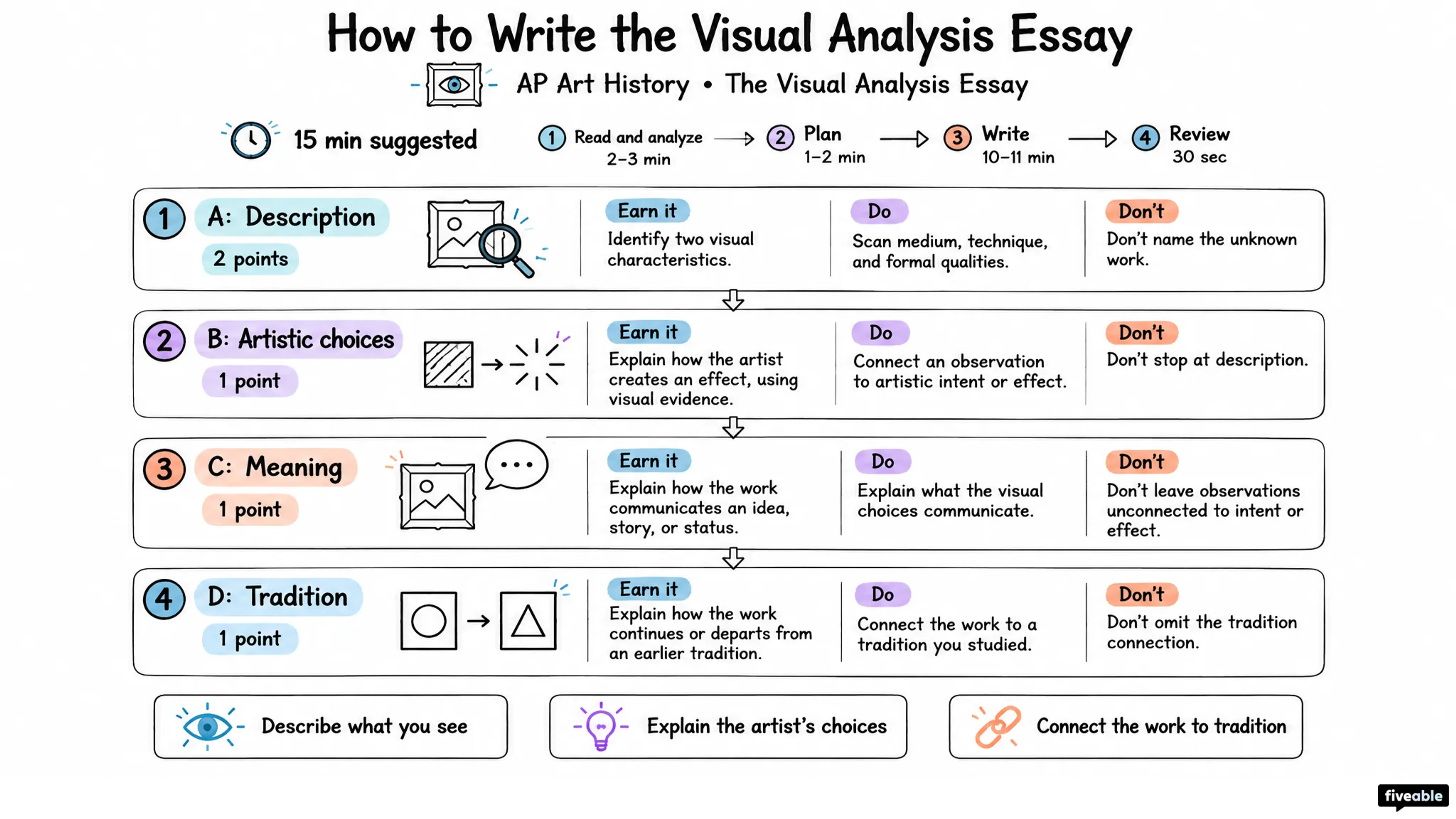
Visual Analysis Essay skill sheet
Every rubric point on one page: what earns it, what to do and what to avoid. Tap the sheet to see it full size.
How Visual Analysis Essay practice works
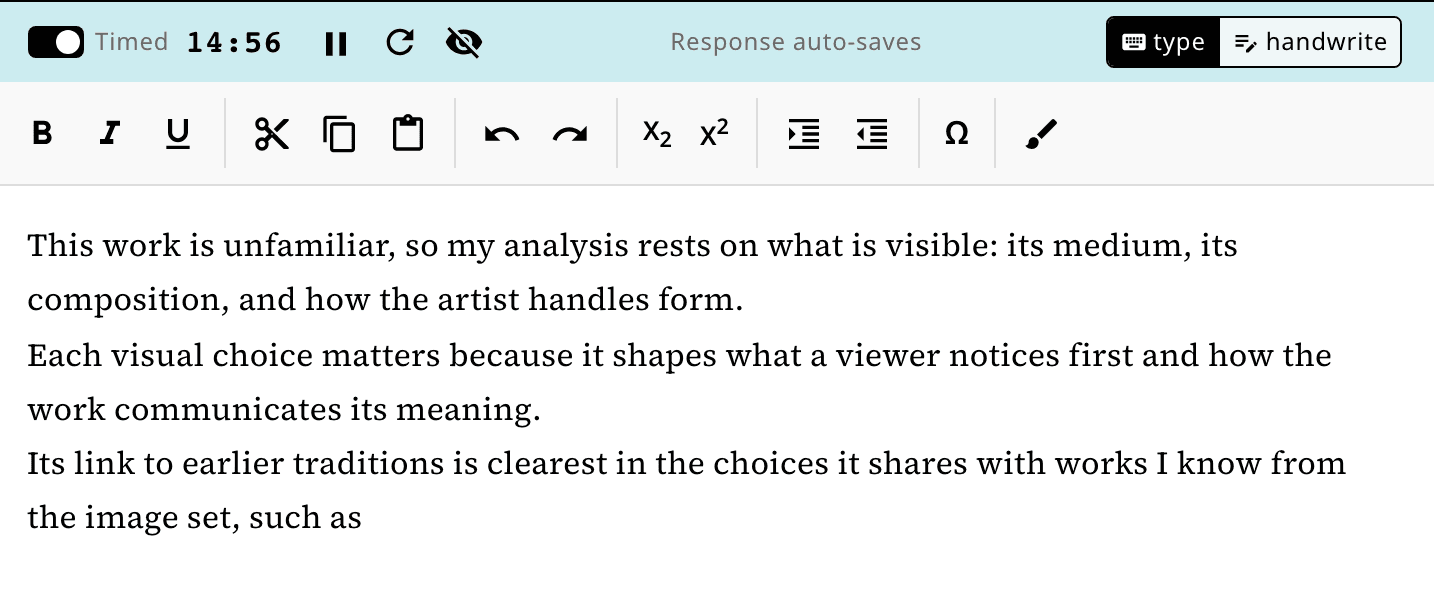
Each question follows the exam’s format, from the full prompt to a score on every part.
Study the image and question
The image of the work and each part of the question, laid out the way the exam shows them.
Write on a 15-minute timer
The time to plan for on exam day. Pause it or turn it off, and your response saves as you go.
Submit for a score out of 5
Your response is scored against the scoring guidelines written for that question. Your first score is included.
Feedback on every part
A summary at the top tells you what to work on next. Below it, each part shows whether you earned the point and what the scoring guidelines were looking for.
Detailed Feedback
Part A: 1/1 point
Earned the point. You correctly described a visual characteristic by noting the lack of a body, pointing out that the sculpture depicts only the head and neck.
Part A: 1/1 point
Earned the point. You correctly described a second visual characteristic by identifying the vertical elements (which you called "poles") hanging down to depict hair.
Part B: 0/1 point
Did not earn the point. You described features of the face (flat nose, protruding mouth) and stated they draw attention because they are unnatural. However, simply describing facial features is not enough. To earn this point, you needed to explain how the artist used visual strategies—such as framing the face with the hairline, contrasting the smooth face with the rough neck, or making the face proportionally large relative to the neck—to direct the viewer's eye to the face.
Questions about the Visual Analysis Essay
How many responses can I get scored?
You can read every question without a plan. Your first scored response is included. A plan unlocks unlimited scoring.
Will the work be one I studied?
Not on the exam. FRQ 3 shows a work from outside the 250-work image set, so it tests how you read what you see. Your knowledge of the image set helps with the tradition part.
How is visual analysis different from attribution?
Both show an unfamiliar work. Visual analysis asks how the artist’s choices create effects. Attribution asks you to name where the work comes from and justify it.
Can I answer in bullet points?
On the exam, responses must be in essay form, and outlines or bulleted lists don’t earn full credit. Practice in short, complete sentences that answer each part.
Can I write my answer by hand?
Yes. Switch the editor to handwrite, write on paper, and add a photo of your page.
More AP Art History practice
Comparison Essay practice
Comparison essay prompts with the required work’s image and the list to select from.
Visual/Contextual Essay practice
Visual/contextual analysis prompts with the full question and the list of works.
Contextual Analysis Essay practice
Contextual analysis short essays with the work’s image and every part of the question.
Attribution Essay practice
Attribution short essays with the work’s image and every part of the question.
Continuity and Change Essay practice
Continuity and change short essays with the work’s image and every part of the question.
AP Art History FRQs
Every FRQ type for AP Art History, with practice for each.
Write your first Visual Analysis Essay
Pick one from the list, or let us choose for you.
Teaching AP Art History? Assign these Visual Analysis Essays to your class