AP Art History Contextual Analysis Essay Practice
249 contextual analysis short essay prompts written in the AP format. Pick one, study the image and question, and write your analysis. Fiveable scores each Contextual Analysis Essay response part by part on the AP rubric.
Your first scored response is included. A plan unlocks unlimited scoring.
249 questions
sorted by unit
Ancient Iranian pottery with geometric animal decoration
Unit 1: Global Prehistory, 30,000-500 bce
Beaker with ibex motifs. Susa, Iran. 4200-3500 bce. Painted terra cotta
The image shows the Beaker with ibex motifs, created in Susa, Iran, circa 4200–3500 BCE.
Describe one visual characteristic of the work shown.
Describe the original location of the work shown.
Using two examples of specific visual and/or contextual evidence, explain how the original context influenced the design of the work shown.
Using specific visual or contextual evidence, explain why scholars have interpreted the work as an expression of social organization or identity.
What the Contextual Analysis Essay asks
The contextual analysis essay is FRQ 4 on the AP Art History exam. You see a work from the 250-work image set and explain how its historical and cultural context shaped it.
- 15 min
- suggested time
- 5 points
- across parts A to D
- 50%
- of your score, across all six FRQs
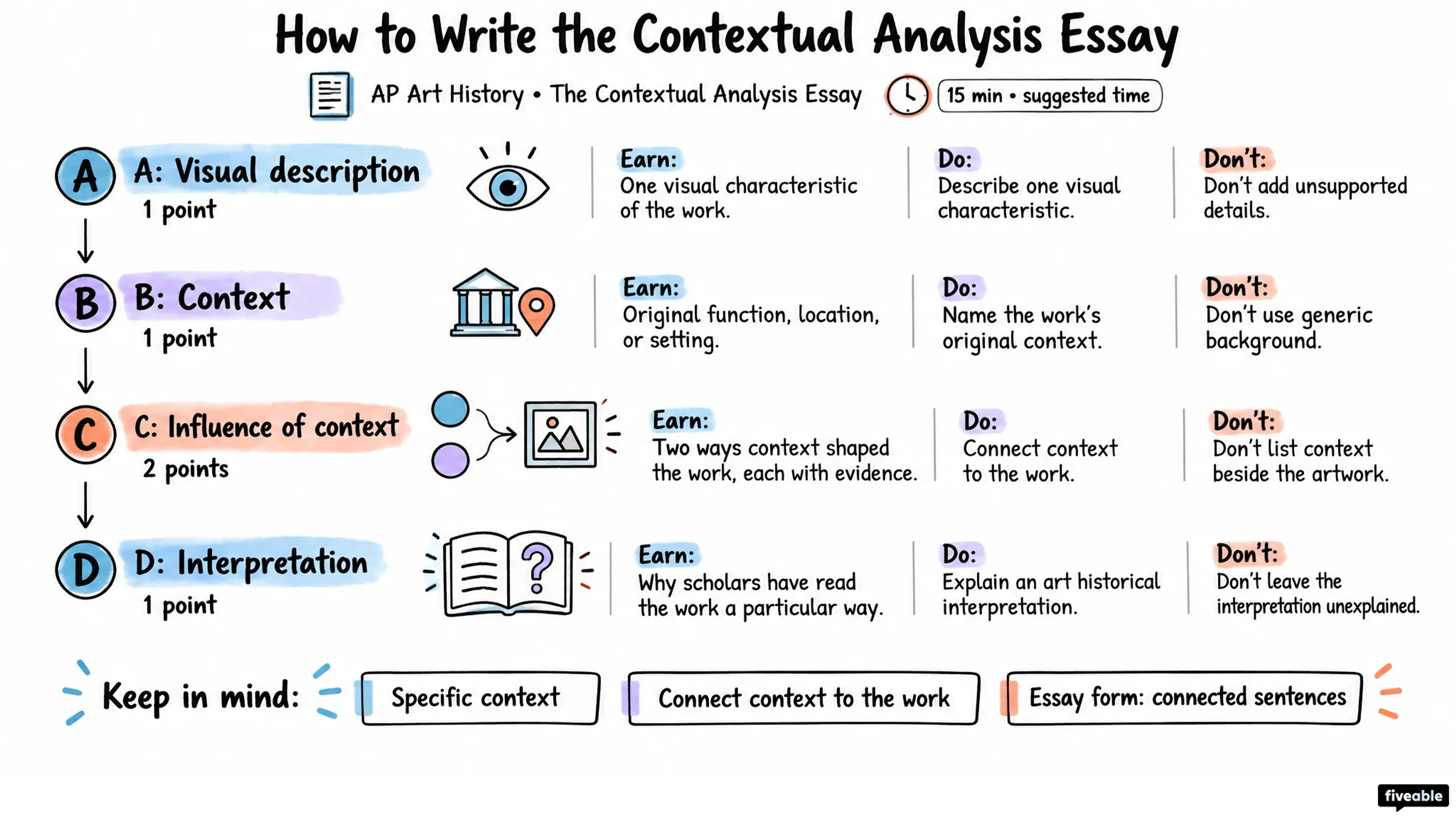
Part A: Visual description
One visual characteristic of the work
1 pt
Part B: Context
The work’s original function, location, or setting
1 pt
Part C: Influence of context
Two ways the context shaped the work, each with evidence
2 pts
Part D: Interpretation
Why scholars have read the work a particular way
1 pt
Contextual Analysis Essay skill sheet
Every rubric point on one page: what earns it, what to do and what to avoid. Tap the sheet to see it full size.
How Contextual Analysis Essay practice works
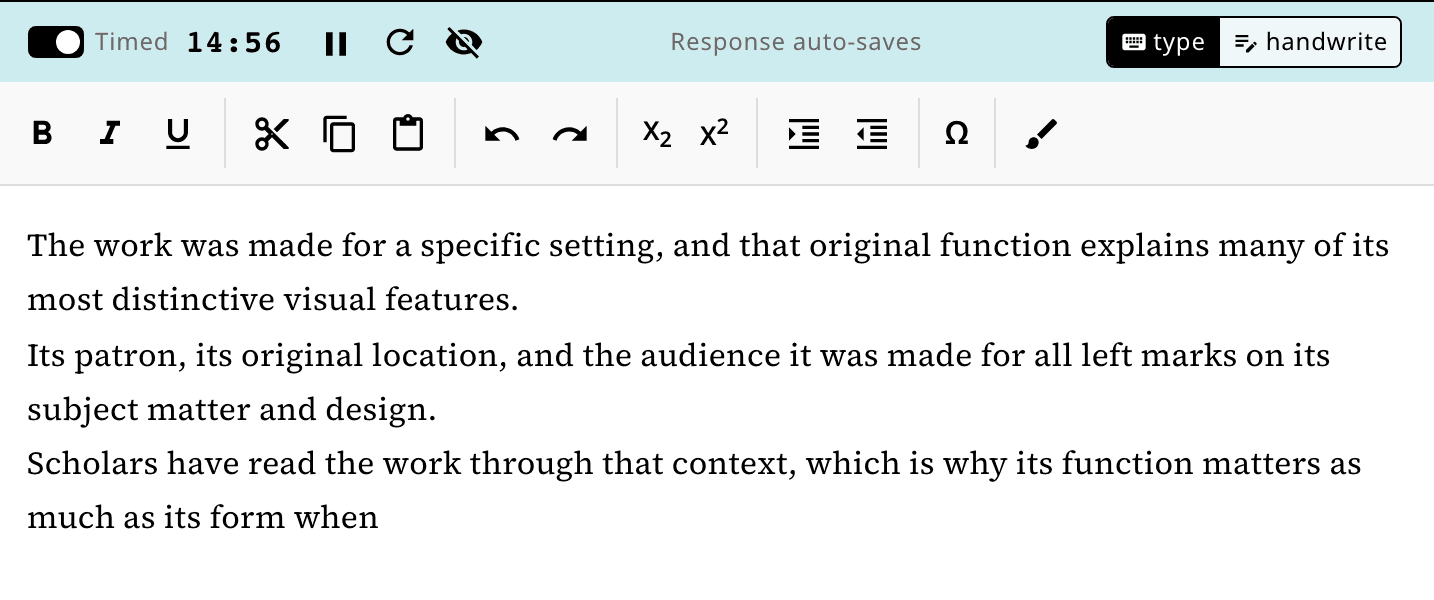
Each question follows the exam’s format, from the full prompt to a score on every part.
Study the image and question
The image of the work and each part of the question, laid out the way the exam shows them.
Write on a 15-minute timer
The time to plan for on exam day. Pause it or turn it off, and your response saves as you go.
Submit for a score out of 5
Your response is scored against the scoring guidelines written for that question. Your first score is included.
Feedback on every part
A summary at the top tells you what to work on next. Below it, each part shows whether you earned the point and what the scoring guidelines were looking for.
Detailed Feedback
Part A: 1/1 point
Earned the point. You accurately described visual characteristics of the work, specifically noting the "roses with bullets" and the "tv with a video of a man crying."
Part B: 0/1 point
Did not earn the point. You mentioned it was located in New York where Puerto Rican immigrants live, but to earn this point, you needed to specify that the installation was originally placed in an actual, functioning barbershop in a Puerto Rican neighborhood (the South Bronx), rather than just a town in New York.
Part C: 1/1 point
Earned the point. You successfully used the visual evidence of the video of the man crying to explain how the work critiques the machismo expectation that men must be strong and not show weakness.
Questions about the Contextual Analysis Essay
How many responses can I get scored?
You can read every question without a plan. Your first scored response is included. A plan unlocks unlimited scoring.
What counts as context?
Specific circumstances tied to this work: its patron, its original setting, the events, beliefs, or practices it responded to. Background that fits any work from the period earns less.
How is contextual analysis different from visual analysis?
Contextual analysis uses a work from the image set and asks how its context shaped it. Visual analysis uses an unfamiliar work and asks how the artist’s visual choices create effects.
Can I answer in bullet points?
On the exam, responses must be in essay form, and outlines or bulleted lists don’t earn full credit. Practice in short, complete sentences that answer each part.
Can I write my answer by hand?
Yes. Switch the editor to handwrite, write on paper, and add a photo of your page.
More AP Art History practice
Comparison Essay practice
Comparison essay prompts with the required work’s image and the list to select from.
Visual/Contextual Essay practice
Visual/contextual analysis prompts with the full question and the list of works.
Visual Analysis Essay practice
Visual analysis short essays with the work’s image and every part of the question.
Attribution Essay practice
Attribution short essays with the work’s image and every part of the question.
Continuity and Change Essay practice
Continuity and change short essays with the work’s image and every part of the question.
AP Art History FRQs
Every FRQ type for AP Art History, with practice for each.
Write your first Contextual Analysis Essay
Pick one from the list, or let us choose for you.
Teaching AP Art History? Assign these Contextual Analysis Essays to your class