all units 248
unit 1 11
unit 2 36
unit 3 54
unit 4 50
unit 5 14
unit 6 14
unit 7 11
unit 8 20
unit 9 11
unit 10 27
248 questions
sorted by unit
Animal and zoomorphic forms in art
Unit 1
Animal depiction in spiritual and cultural expression
Unit 1
Spiritual and supernatural figures in art
Unit 1
Stylized human figures across sculptural traditions
Unit 1
Funerary vessels and burial art traditions
Unit 1
Animal form depiction across cultures and time periods
Unit 1
Stylized human figure representation across cultures
Unit 1
Funerary art across cultures and time periods
Unit 1
Astronomical alignment in ancient monumental architecture
Unit 1
Animal depiction across prehistoric and historical art
Unit 1
Stylized geometric patterns across cultures
Unit 1
Sacred architecture facilitating religious practices
Unit 2
Visual depiction of social status through portraiture
Unit 2
Artistic depictions of ruler power and authority
Unit 2
Royal authority through artistic representation
Unit 2
Ancient Egyptian funerary architecture and design principles
Unit 2
Artistic depictions of ruler power and authority
Unit 2
Sculptural figures as religious proxies across cultures
Unit 2
Sacred architectural design across cultures and time periods
Unit 2
Artistic representations of afterlife beliefs across cultures
Unit 2
Funerary art depicting afterlife status and power
Unit 2
Idealized human figures across cultures and periods
Unit 2
Civic and political spaces across cultures
Unit 2
Religious sculpture depicting the human form
Unit 2
Artistic representation of couples across cultures
Unit 2
Artistic representations of political power and authority
Unit 2
Architectural demonstration of ruler power and authority
Unit 2
Architecture integrated with natural landscape environments
Unit 2
Royal family portraiture across cultures
Unit 2
Religious architecture and ritual accommodation
Unit 2
Royal power depicted through visual hierarchy
Unit 2
Afterlife beliefs in funerary art across cultures
Unit 2
Divine and supernatural narratives in visual art
Unit 2
Idealized human figures across artistic traditions
Unit 2
Architectural complexes expressing political power and authority
Unit 2
Funerary art depicting social status and identity
Unit 2
Battle depictions across artistic traditions and periods
Unit 2
Domestic architecture reflecting wealth and status
Unit 2
Ruler depictions conveying power and authority
Unit 2
Dynamic movement in sculptural and artistic representation
Unit 2
Human figure portraying emotion and physical condition
Unit 2
Portrait representation of social status and values
Unit 2
Architectural expression of political power and authority
Unit 2
Artistic depictions of battle across civilizations
Unit 2
Artistic depictions of battle across civilizations
Unit 2
Monumental architecture demonstrating state power and authority
Unit 2
Sacred spaces reflecting religious beliefs
Unit 2
Sacred architecture and worshiper experience design
Unit 3
Funerary architecture and afterlife beliefs
Unit 3
Architecture projecting political and religious authority
Unit 3
Visual depiction of biblical narratives across time periods
Unit 3
Religious and political authority in art and architecture
Unit 3
Personal adornment communicating status and identity
Unit 3
Human suffering and emotional intensity in art
Unit 3
Artistic depictions of historical military conflicts
Unit 3
Sacred pilgrimage architecture and religious accommodation
Unit 3
Symbolic imagery in royal or political authority
Unit 3
Sacred spaces and religious architectural design
Unit 3
Visual representation of rulers communicating power authority
Unit 3
Artistic representations of grief and mourning
Unit 3
Sacred spaces reflecting political power and authority
Unit 3
Royal residences expressing architectural power
Unit 3
Religious narrative visual representation across artworks
Unit 3
Artistic depictions of couples across time periods
Unit 3
Human figure sculpture conveying political ideals
Unit 3
Classical architectural elements in Renaissance buildings
Unit 3
Text and image in religious art
Unit 3
Private devotional artworks and visual design strategies
Unit 3
Architectural patronage displaying wealth and power
Unit 3
Sacred figures depicted across Byzantine and comparative art traditions
Unit 3
Sacred figures across artistic traditions and periods
Unit 3
Female deity depiction across artistic traditions
Unit 3
Religious narrative depiction across artistic traditions
Unit 3
Idealized human form across artistic traditions and periods
Unit 3
Religious narrative composition and central figure emphasis
Unit 3
Artistic representations of human suffering
Unit 3
Artistic depiction of grief and mourning
Unit 3
Artistic representation of intellectual and philosophical ideals
Unit 3
Religious allegory through visual imagery comparison
Unit 3
Idealized female figures across artistic traditions
Unit 3
Visual narratives recording historical events
Unit 3
Light as divine presence in artworks
Unit 3
Human activity within natural landscapes
Unit 3
Sacred spaces expressing political and imperial authority
Unit 3
Self-portraiture and artistic identity representation
Unit 3
Religious architecture and spiritual experience design
Unit 3
Religious art and architectural devotional inspiration
Unit 3
Artistic depictions of spiritual and religious experiences
Unit 3
Architectural structures projecting political power
Unit 3
Moral and spiritual messages in paintings
Unit 3
Divine figures elevating ruler status in art
Unit 3
Cultural syncretism in religious artwork
Unit 3
Visual depiction of colonial social hierarchy
Unit 3
Cultural syncretism in colonial visual art
Unit 3
Artistic social commentary across time periods
Unit 3
Knowledge transmission through art and science
Unit 3
Multicultural artistic traditions in decorative screens
Unit 3
Royal and elite figure representation across artworks
Unit 3
Portraiture conveying status and identity through attributes
Unit 3
Artistic depictions of romantic relationships
Unit 3
Symbolic meaning in flora and fauna depiction
Unit 3
Political and moral messaging in visual art
Unit 4
Artistic depictions of leadership and authority
Unit 4
Architecture embodying political and philosophical ideals
Unit 4
Self-portraiture and artist identity representation
Unit 4
War's visual representation across artistic traditions
Unit 4
Visual representation of political and social conflict
Unit 4
Idealized female figures in neoclassical and romantic art
Unit 4
Still life composition and artistic representation
Unit 4
Humanity's relationship with natural landscapes
Unit 4
Social or political messaging in visual art
Unit 4
Government architecture expressing political power
Unit 4
Art and photography as social critique tools
Unit 4
Female subject depiction across artistic traditions
Unit 4
Artistic depiction of motion across time periods
Unit 4
Natural landscapes and national identity representation
Unit 4
Artistic depiction of intense psychological states
Unit 4
Van Gogh's Starry Night and landscape artistic depictions
Unit 4
Commemorative art across historical periods
Unit 4
Natural landscape depiction across artistic periods
Unit 4
Innovative architectural materials and construction techniques
Unit 4
Social class representation in early twentieth-century art
Unit 4
Cross-cultural artistic influence in visual art
Unit 4
Female figure representation in modernist art
Unit 4
Abstraction and simplification of human form
Unit 4
Abstraction and fragmentation in early modernist art
Unit 4
Color conveying mood and meaning in paintings
Unit 4
Abstract art expressing spiritual concepts
Unit 4
Artist self-portraits expressing identity and psychology
Unit 4
Modernist residential architecture and design philosophy
Unit 4
Philosophical beliefs on human existence and mortality
Unit 4
Political propaganda art and visual messaging techniques
Unit 4
Abstraction conveying meaning through visual elements
Unit 4
Political violence and artistic commemoration
Unit 4
Architecture integrating with natural environments
Unit 4
Subversion of everyday objects through unconventional materials
Unit 4
Unconventional materials challenging traditional art definitions
Unit 4
Personal and cultural identity in visual art
Unit 4
Colonialism's visual legacy and cultural identity
Unit 4
Mexican cultural identity and historical narrative
Unit 4
Female figure representation across artistic traditions
Unit 4
Architecture expressing patron power and prestige
Unit 4
Abstraction evoking natural environments through visual art
Unit 4
Interactive installations engaging viewer participation
Unit 4
Artistic critiques of militarism and consumerism
Unit 4
Environmental art and landscape transformation
Unit 4
Social and political commentary in visual art
Unit 4
Portraiture reflecting cultural values and societal ideals
Unit 4
Architectural conventions challenged through visual and contextual departure
Unit 4
Modern life and industrial environments in art
Unit 4
Human figures depicting social injustice
Unit 4
Sacred architecture and spiritual experience design
Unit 5
Architecture adapted to natural environments
Unit 5
Political power legitimization through art
Unit 5
Earthworks and landscape modification across cultures
Unit 5
Materials conveying ruler power and authority
Unit 5
Architecture integrated with natural environment
Unit 5
Architectural design demonstrating political power and authority
Unit 5
Rulers' power and authority in visual art
Unit 5
Architecture reflecting cosmological beliefs across cultures
Unit 5
Cultural exchange in decorative arts
Unit 5
Ritual masks and ceremonial performance objects
Unit 5
Artistic preservation of cultural traditions
Unit 5
Natural world subjects expressing cultural religious beliefs
Unit 5
Geometric abstraction across cultural artistic traditions
Unit 5
Architectural power and authority across cultures
Unit 6
Ruler depiction across artistic traditions
Unit 6
Symbols of royal and political authority
Unit 6
Sculptural depictions of ruler power and authority
Unit 6
Spiritual power in African and world art objects
Unit 6
Idealized portraiture across cultures and time periods
Unit 6
Idealized female figures across cultures and periods
Unit 6
Visual methods of recording cultural memory
Unit 6
Artistic depictions of ruler power and authority
Unit 6
Personal power, status, and achievement representation
Unit 6
Worn regalia demonstrating power and status
Unit 6
Sacred spaces constructed from local materials and traditions
Unit 6
Guardian and protector figures across cultures
Unit 6
Cultural ideals of women across artistic traditions
Unit 6
Colossal figures inspiring religious awe
Unit 7
Sacred pilgrimage sites and architectural design accommodation
Unit 7
Religious and political authority through architectural design
Unit 7
Sacred objects and pilgrimage destinations worldwide
Unit 7
Architecture integrated into natural environments
Unit 7
Architectural design facilitating communal worship spaces
Unit 7
Illuminated manuscripts expressing sacred religious meaning
Unit 7
Hunting and warfare depictions across cultures
Unit 7
Rulers and leaders in visual representation
Unit 7
Textiles and fibers conveying cultural meaning
Unit 7
Rulers and heroes demonstrating power through visual representation
Unit 7
Sacred architecture guiding ritual worshipper movement
Unit 8
Afterlife beliefs in funerary art traditions
Unit 8
Political power and religious beliefs in art
Unit 8
Sacred sites expressing political and religious authority
Unit 8
Sacred objects emphasizing religious devotion
Unit 8
Sacred architecture guiding worshipper spiritual journeys
Unit 8
Political power and religious beliefs in architecture
Unit 8
Funerary art depicting power and status
Unit 8
Sacred architecture and ritualistic processional design
Unit 8
Humans and nature in landscape art
Unit 8
Artistic depictions of historical military conflicts
Unit 8
Portraits depicting social status and authority
Unit 8
Architectural design expressing political power and authority
Unit 8
Sacred spaces facilitating spiritual contemplation
Unit 8
Rulers demonstrating power and authority
Unit 8
Funerary and memorial architecture across cultures
Unit 8
Humans and nature in artistic representation
Unit 8
Artistic depictions of natural flora
Unit 8
Artistic depictions of political leader authority and power
Unit 8
Cross-cultural artistic exchange and visual evidence
Unit 8
Ancestor and ruler representation in sculpture
Unit 9
Architectural complexes demonstrating political power authority
Unit 9
Deity representations across cultures and time periods
Unit 9
Stylized human figures across cultures and time periods
Unit 9
Regalia and adornment expressing hierarchical power
Unit 9
Portrait conventions depicting power and authority
Unit 9
Funerary art across cultures and contexts
Unit 9
Ritual masks: visual design and ceremonial function
Unit 9
Patterns and motifs expressing cultural identity status
Unit 9
Textiles and regalia communicating status and cultural identity
Unit 9
Navigation charts and geographic representation methods
Unit 9
Site-specific installations transforming natural environments
Unit 10
Cultural identity expression in visual art
Unit 10
Adapting traditional artistic practices for cultural expression
Unit 10
Human figures depicting suffering, vulnerability
Unit 10
Text and script in artistic composition
Unit 10
Pop culture imagery as social commentary
Unit 10
Art challenging traditional cultural narratives and expectations
Unit 10
Portraiture exploring constructed identity and representation
Unit 10
Colonial legacy in visual art
Unit 10
Abstract representation of natural environments
Unit 10
Portraiture exploring cultural and political identity
Unit 10
Visual representation of cultural identity and gender roles
Unit 10
Artistic commemoration of historical conflict and loss
Unit 10
National and cultural identity in visual art
Unit 10
Non-traditional materials conveying cultural and social messages
Unit 10
Innovative architectural forms and materials in buildings
Unit 10
Artistic reinterpretation across cultural and temporal contexts
Unit 10
Self-portraiture across cultural and artistic contexts
Unit 10
Historical narratives and cultural stereotypes in visual art
Unit 10
Spiritual and physical transformation in art
Unit 10
Female figures, cultural identity, societal expectations
Unit 10
Repurposed materials commenting on cultural identity
Unit 10
Innovative architectural form and contemporary spatial design
Unit 10
Artistic representation of social and political division
Unit 10
Artistic commentary on authoritarianism and human rights
Unit 10
Female figures challenging traditional cultural narratives
Unit 10
Dynamic movement and energy in visual art
Unit 10
The Ambum stone. Ambum Valley, Enga Province, Papua New Guinea. c. 1500 bce. Greywacke
The work shown is The Ambum stone , created c. 1500 BCE. The work features an animal or zoomorphic form.
Select and completely identify another work of art that features an animal or zoomorphic form. You may select a work from the list below or any other relevant work.
Describe one visual characteristic of The Ambum stone and one visual characteristic of your selected work.
Using specific visual evidence from The Ambum stone and specific visual evidence from your selected work, explain ONE similarity or difference in how the animal or zoomorphic form is depicted.
Using specific visual evidence from The Ambum stone and specific visual evidence from your selected work, explain ANOTHER similarity or difference in how the animal or zoomorphic form is depicted.
Make a claim that explains one similarity or difference in why the animal or zoomorphic form was depicted.
Support your claim using specific contextual evidence from The Ambum stone and specific contextual evidence from your selected work.
When identifying the work you select, you should try to include all of the following identifiers: title or designation, name of the artist and/or culture of origin, date of creation, and materials. You will earn credit for the identification if you provide at least two accurate identifiers, but you will not be penalized if any additional identifiers you provide are inaccurate. If you select a work from the list below, you must include at least two accurate identifiers beyond those that are given.
Camelid sacrum in the shape of a canine
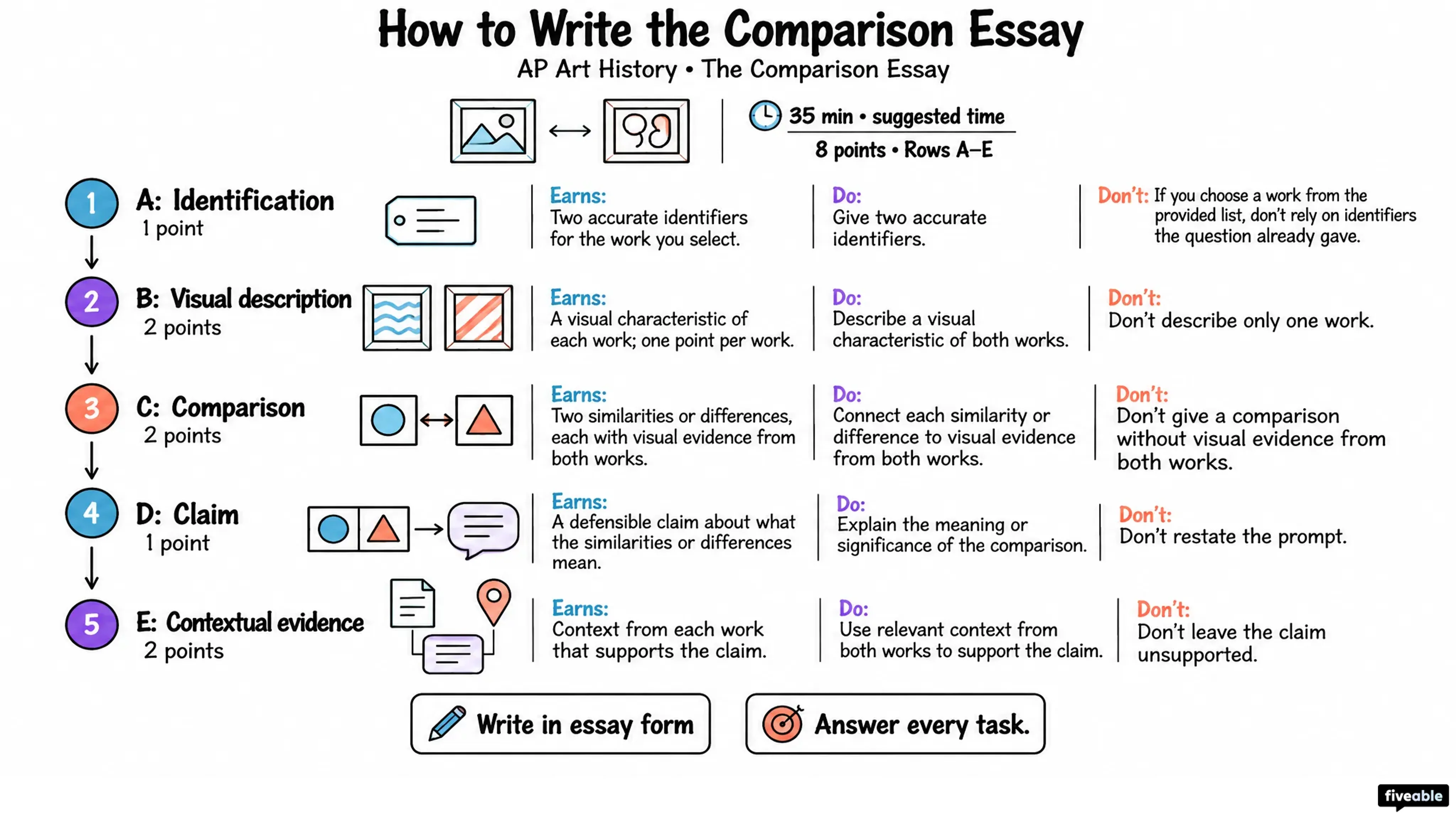
What the Comparison Essay asks The comparison essay is FRQ 1 on the AP Art History exam, the first of two long essays. You get one work with its image, select a second work from a short list or your own knowledge, and compare how the two convey meaning.
35 min suggested time
8 points across rows A to E
50% of your score, across all six FRQs A
Part A: Identification Two accurate identifiers for the work you select
1 pt
B
Part B: Visual description A visual characteristic of each work, one point per work
2 pts
C
Part C: Comparison Two similarities or differences, each with visual evidence from both works
2 pts
D
Part D: Claim A defensible claim about what the similarities or differences mean
1 pt
E
Part E: Contextual evidence Context from each work that supports the claim
2 pts
How Comparison Essay practice works Each question follows the exam’s format, from the full prompt to a score on every part.
1
Read the full question The prompt, the image of the required work, and the list of works you can select from, laid out the way the exam shows them.
2
Write on a 35-minute timer The time to plan for on exam day. Pause it or turn it off, and your response saves as you go.
3
Submit for a score out of 8 Your response is scored against the scoring guidelines written for that question. Your first score is included.
Feedback on every part A summary at the top tells you what to work on next. Below it, each part shows whether you earned the point and what the scoring guidelines were looking for.
Earned the point. You correctly provided two accurate identifiers for your selected work beyond the title by identifying its culture (Egyptian) and material (gold).
Part B(Visual Characteristic – Jade cong): 1/1 point Earned the point. You accurately described a visual characteristic of the Jade cong by stating that it is made of jade.
Part C(Visual Evidence – Comparison 1): 0/1 point Did not earn the point. While you compared the materials of both works (jade and gold), you discussed how difficult they were to carve or shape. To earn this point, you needed to explain how these visual characteristics reflect the works' funerary or burial context (for example, explaining that both use precious, hard-to-work materials to visually communicate the high status of the deceased in the afterlife).
Detailed feedback on a practice Comparison Essay Questions about the Comparison Essay How many responses can I get scored? You can read every question without a plan. Your first scored response is included. A plan unlocks unlimited scoring.
Which work can I choose for the comparison? One from the list in the question or any other relevant work. If you pick from the list, your two identifiers have to go beyond what the question already gives.
How is the comparison essay different from FRQ 2? The comparison essay shows you one work and asks you to compare it with a second. The visual/contextual analysis essay shows no image, so you write about a work from memory.
Are these real College Board questions? No. We wrote them in the AP format, with the same 8-point structure, and wrote scoring guidelines for each one.
Can I write my answer by hand? Yes. Switch the editor to handwrite, write on paper, and add a photo of your page.
More AP Art History practice Visual/Contextual Essay practice Visual/contextual analysis prompts with the full question and the list of works.
Visual Analysis Essay practice Visual analysis short essays with the work’s image and every part of the question.
Contextual Analysis Essay practice Contextual analysis short essays with the work’s image and every part of the question.
Attribution Essay practice Attribution short essays with the work’s image and every part of the question.
Continuity and Change Essay practice Continuity and change short essays with the work’s image and every part of the question.
AP Art History FRQs Every FRQ type for AP Art History, with practice for each.
AP Art History study guides Unit-by-unit review for the whole course.