5.3 Bronze Age trade networks and international relations

🏛️Ancient Mediterranean Unit 5 Review
5.3 Bronze Age trade networks and international relations
🏛️ Ancient Mediterranean
Bronze Age Trade and International Relations
Bronze Age trade networks linked the Aegean, Anatolia, the Levant, and Egypt through both sea and overland routes. These connections did more than move goods: they spread technologies, artistic styles, and diplomatic relationships across the entire eastern Mediterranean. Raw materials like copper and tin were the driving force, since bronze production depended on sourcing these metals from widely scattered regions.

Top images from around the web for Bronze Age trade networks
Phoenicians and wine - Wikipedia View original
Is this image relevant?
1200 год до н. э. — Википедия View original
Is this image relevant?
Phoenicia - Wikipedia View original
Is this image relevant?
Phoenicians and wine - Wikipedia View original
Is this image relevant?
1200 год до н. э. — Википедия View original
Is this image relevant?
Bronze Age Trade Networks
Major maritime trade routes connected the Aegean (Crete, mainland Greece, the Cyclades), Anatolia, the Levant (city-states like Ugarit, Byblos, and Tyre), and Egypt. Overland routes crossed Anatolia through Hittite territory and ran along the Levantine coast, carrying goods and ideas between inland and coastal centers.
Key trade hubs and ports included:
- Minoan Crete (Knossos, Phaistos, Zakros): Major export centers for luxury goods such as fine Kamares-ware pottery, textiles, and olive oil. Crete's central position in the eastern Mediterranean made it a natural crossroads.
- Mycenaean Greece (Mycenae, Tiryns, Pylos): After Minoan decline, Mycenaean centers took over and expanded existing trade routes, becoming the dominant Aegean trading power.
- Egypt (Thebes, Memphis): A major market for imported Aegean goods and a source of luxury materials like gold and ivory. Note that Alexandria did not exist in the Bronze Age; it was founded by Alexander the Great in 331 BCE.
.svg.png)
Minoan and Mycenaean Trade Roles
The Minoans (c. 3000–1450 BCE) were the earlier maritime power. They built extensive trade networks across the eastern Mediterranean, exporting luxury goods and engaging in diplomacy with Egypt and the Levant. Evidence from Egyptian tomb paintings at Thebes shows figures identified as "Keftiu" (likely Cretans) bearing gifts, suggesting formal diplomatic contact.
The Mycenaeans (c. 1600–1100 BCE) inherited and expanded these networks after Minoan civilization declined around 1450 BCE. Mycenaean pottery has been found across the Mediterranean, from the Levant to Sicily, showing just how far their trade reached. They maintained diplomatic relations with major powers like the Hittites and Egypt. The Amarna Letters (diplomatic correspondence found in Egypt, c. 1350 BCE) provide direct evidence of this kind of international communication between Bronze Age states.
Both civilizations acted as intermediaries, moving goods between regions and facilitating the spread of ideas, technologies, and artistic styles in the process.

Cultural Exchange in the Aegean Region
Trade didn't just move objects; it moved culture.
Artistic influences: Minoan and Mycenaean art incorporated elements from Egyptian and Near Eastern traditions. Minoan frescoes show stylistic parallels with Egyptian wall painting, and pottery from both cultures sometimes depicts motifs with Levantine or Egyptian connections.
Technological exchange:
- Writing systems: Linear A (used by the Minoans, still undeciphered) and Linear B (used by the Mycenaeans, an early form of Greek) both developed in a broader context of Near Eastern literacy, though their exact relationship to Near Eastern scripts remains debated. Linear B was adapted from Linear A rather than directly from a Near Eastern model.
- Metalworking techniques: Advanced methods like lost-wax casting and sheet metal production spread across the region through trade contacts, raising the quality of craft production on all sides.
Religious and cultural exchange:
- Shared iconography appears across regions, such as bull symbolism (prominent in both Minoan Crete and Anatolia) and goddess figures.
- Foreign prestige objects like cylinder seals (originally Mesopotamian) and faience items (often Egyptian) circulated widely, adopted by local elites as status markers.
Raw Materials in the Bronze Age Economy
Bronze production was the engine of this entire system. Bronze is an alloy of roughly copper and tin, and since these two metals rarely occur in the same place, long-distance trade was a necessity.
- Copper: The primary component of bronze, sourced mainly from Cyprus (the island's name may even derive from the Latin word for copper), as well as from Anatolia and the Levant. Copper was traded in standardized oxhide ingots, flat slabs shaped roughly like animal hides, weighing about 25–30 kg each. Shipwrecks like the Uluburun wreck (c. 1300 BCE, off the coast of Turkey) have been found carrying hundreds of these ingots.
- Tin: Scarce in the eastern Mediterranean, tin had to be imported from distant sources, possibly Afghanistan (Badakhshan region) or even Cornwall in Britain. This scarcity made tin extremely valuable and drove the establishment of long-distance trade routes.
- Gold: Used for prestige objects and elite burial goods, sourced primarily from Egypt (Nubian mines) and Anatolia.
- Silver: Used as a medium of exchange and for luxury items, sourced from Anatolia and the Levant.
- Ivory: Carved into decorative and luxury objects, sourced from Egypt (African elephant ivory) and the Levant (which also traded hippopotamus ivory).
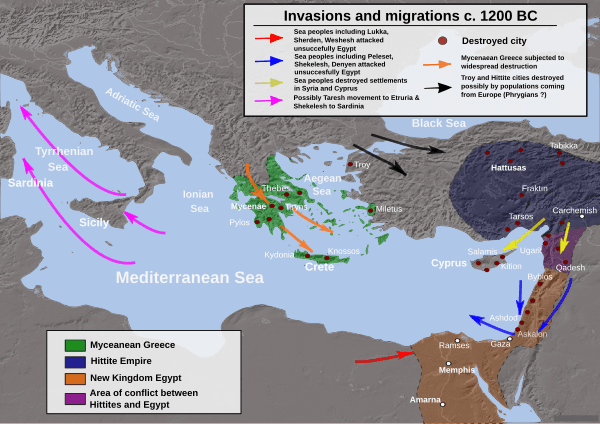
The trade in these raw materials had far-reaching effects. It fueled economic growth, encouraged craft specialization (particularly in metalworking), and pushed states into political alliances and diplomatic relationships to secure access to supply routes. The interconnected world this created was so tightly linked that when it collapsed around 1200–1100 BCE, the disruption cascaded across the entire region.
See Fiveable more often in Google
Mark Fiveable as a preferred source and Google is more likely to show you our guides in Top Stories, with a "preferred" badge in AI Mode and AI Overviews.