5.1 Minoan civilization on Crete

🏛️Ancient Mediterranean Unit 5 Review
5.1 Minoan civilization on Crete
🏛️ Ancient Mediterranean
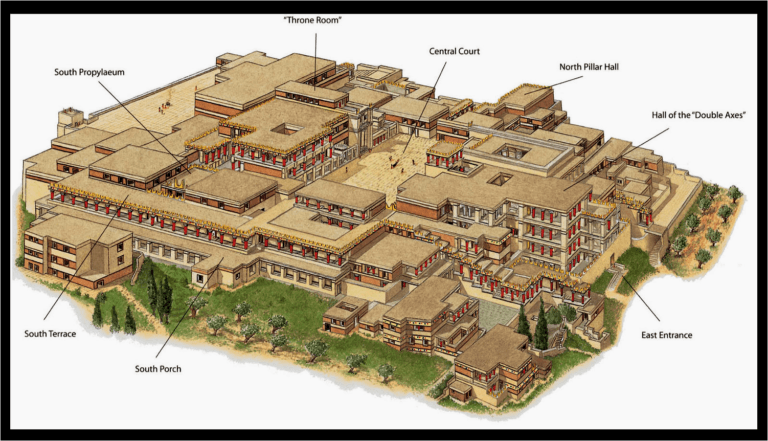
The Minoan civilization thrived on Crete during the Bronze Age, leaving behind impressive palaces and artwork. Their society revolved around elaborate palace complexes that served as hubs for politics, economics, and religion, managing resources and trade across the Mediterranean.
Minoan art and architecture showcased their sophistication through multi-story buildings, advanced water systems, and vibrant frescoes. Their religious practices, while not fully understood, centered on nature deities and fertility, with symbols like the double axe and horns of consecration playing key roles.
Minoan Civilization on Crete

Top images from around the web for Key features of Minoan civilization
Minoan civilization - Wikipedia View original
Is this image relevant?
Minoan Art – Art and Visual Culture: Prehistory to Renaissance View original
Is this image relevant?
Minoan civilization - Wikipedia View original
Is this image relevant?
Minoan civilization - Wikipedia View original
Is this image relevant?
Minoan Art – Art and Visual Culture: Prehistory to Renaissance View original
Is this image relevant?
Key features of Minoan civilization
- Flourished during the Bronze Age from approximately 3000 to 1450 BCE on the island of Crete
- Named after the legendary King Minos, a prominent figure in Greek mythology
- Developed a complex urban civilization characterized by elaborate palace complexes (Knossos, Phaistos), advanced architecture and engineering, and sophisticated art and craftsmanship
- Established extensive trade networks across the Aegean and Mediterranean, exchanging goods and ideas with other civilizations
- Developed a unique hieroglyphic writing system known as Linear A, which remains undeciphered, limiting our understanding of Minoan language and history
- Achieved a high level of prosperity and cultural sophistication, as evidenced by their impressive architectural feats, intricate artworks, and advanced technological innovations

Role of Minoan palace system
- Palaces served as the center of political, economic, and religious life in Minoan society, with major examples including Knossos, Phaistos, Malia, and Zakros
- Functioned as residences for the ruling elite, providing luxurious living quarters and spaces for administrative activities
- Acted as administrative centers for the collection and redistribution of resources, managing the palace economy and overseeing agricultural production
- Housed workshops for the production of luxury goods and crafts, such as pottery, textiles, jewelry, and metalwork
- Provided storage facilities for agricultural produce (grains, olive oil) and trade goods (copper, tin), ensuring a stable supply of resources
- Palace economy was based on a redistributive system, where agricultural produce and goods were collected, stored, and redistributed by the palace authorities
- Palaces sponsored and controlled long-distance trade, importing raw materials (copper, tin, gold, ivory) and exporting finished products (pottery, textiles, olive oil)

Minoan artistic and architectural styles
- Minoan architecture is characterized by multi-story buildings with complex layouts, featuring open courtyards, colonnades, and light wells for natural illumination
- Utilized advanced construction techniques, such as ashlar masonry and timber frames, to create sturdy and visually impressive structures
- Implemented advanced water management systems, including bathrooms with flushing toilets, drainage systems, and piping for fresh water supply
- Frescoes were a prominent form of Minoan art, depicting scenes of nature (marine life, flora), daily life (festivals, sports), and religious ceremonies
- Employed vibrant colors and naturalistic styles in frescoes, showcasing a keen eye for detail and a appreciation for the natural world
- Notable examples of Minoan frescoes include the "Bull-Leaping Fresco" and the "Prince of the Lilies" from the Palace of Knossos
- Minoan pottery is renowned for its high quality and technical sophistication, with distinctive styles such as Kamares ware (polychrome designs on dark background) and Marine Style (motifs inspired by sea life)
- Pottery featured intricate decorative motifs, including marine life (octopuses, dolphins), floral patterns, and abstract geometric designs
Evidence for Minoan religious practices
- Minoan religion was polytheistic, centered around the worship of nature deities and the celebration of fertility and regeneration
- Evidence for religious practices is derived from architectural features (shrines, altars, peak sanctuaries), iconography in art (frescoes, pottery, seal stones), and ritual objects (figurines, offering tables)
- Key religious symbols and motifs include the double axe (labrys), often associated with bull imagery and possibly representing divine power or authority
- The horns of consecration, a stylized representation of bull horns, were prominent in Minoan architecture and art, possibly symbolizing the sacred nature of the bull
- Snake goddess figurines, depicting a female figure holding snakes, may have been linked to fertility, nature, and the regenerative powers of the earth
- Ritual practices likely included animal sacrifices, particularly of bulls, as suggested by the presence of sacrificial altars and bull imagery in art
- Processions and offerings at peak sanctuaries (open-air shrines on mountaintops) and cave shrines were probably important aspects of Minoan religious life
- Ceremonies involving bull-leaping, as depicted in frescoes and seal stones, may have held religious or ritual significance, though their exact nature remains uncertain
- The lack of deciphered written records limits our understanding of the specific beliefs, deities, and mythologies of Minoan religion, leaving many aspects open to interpretation and speculation
See Fiveable more often in Google
Mark Fiveable as a preferred source and Google is more likely to show you our guides in Top Stories, with a "preferred" badge in AI Mode and AI Overviews.