2.3 Ecological systems theory (Bronfenbrenner)

🐣Adolescent Development Unit 2 Review
2.3 Ecological systems theory (Bronfenbrenner)
🐣 Adolescent Development
Understanding Ecological Systems Theory
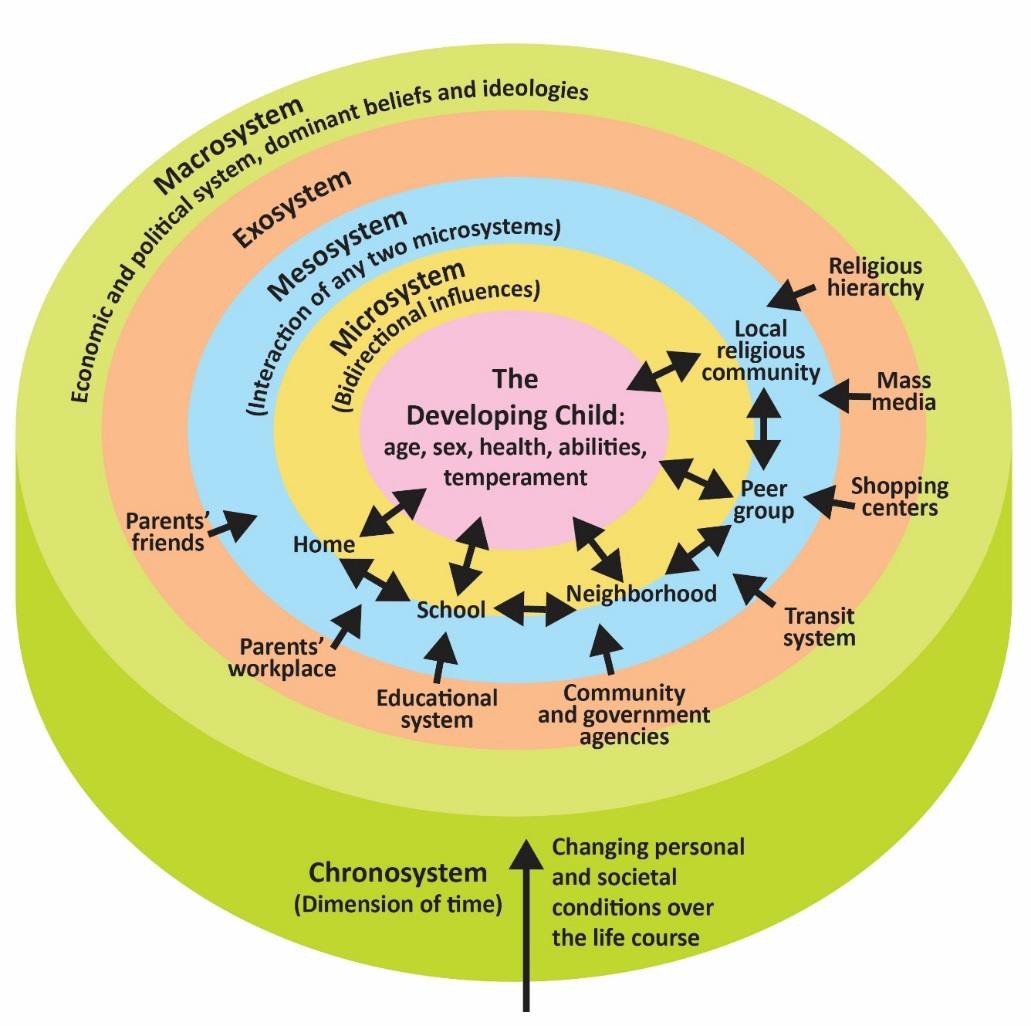
Bronfenbrenner's ecological systems theory explains how adolescents develop within layers of environmental influence. Rather than focusing on just one factor (like parenting or peer pressure), this theory maps out how family, school, community, culture, and even historical timing all interact to shape a teen's development. It's one of the most widely used frameworks for understanding why the same teenager might thrive in one context and struggle in another.
A core idea here is bidirectional influence: the environment shapes the teen, but the teen also shapes the environment. A student who's outgoing might draw more attention from teachers, which changes their school experience. A teen who withdraws from family conflict might deepen that conflict. Development is never a one-way street.
The Five Nested Systems
Think of these systems as layers, each one wrapping around the next. The closer the layer, the more direct its influence on the adolescent's daily life.
Microsystem is the innermost layer. It includes the people and settings a teen interacts with directly: family, peers, school, neighborhood, and religious community. These are the relationships that shape everyday experience. A teen with a supportive home environment and a strong friend group has a very different microsystem than one dealing with family instability and social isolation.
Mesosystem is the connections between microsystems. It's not a separate place but rather the interaction between the settings a teen is already in. For example:
- How well a parent communicates with a teen's teachers
- Whether a teen's friend group overlaps with their sports team or church group
- How conflict at home spills into behavior at school
When microsystems reinforce each other (parents and teachers are on the same page), outcomes tend to be better. When they clash, teens can feel caught in the middle.
Exosystem includes settings the adolescent doesn't directly participate in but that still affect them. Examples:
- A parent's workplace (a parent who loses a job or works long hours changes the home environment)
- Local government decisions (school funding cuts, zoning laws)
- Mass media and social media platforms shaping what teens are exposed to
The teen has no seat at the table in these settings, but the effects trickle down.
Macrosystem is the broadest cultural layer. It includes societal values, laws, economic systems, and cultural norms. Whether a society values individualism or collectivism, how it treats gender roles, what its laws say about education or juvenile justice: all of this sets the backdrop for adolescent development. A teen growing up in a culture that prioritizes academic achievement faces different pressures than one in a culture that emphasizes early employment.
Chronosystem captures the dimension of time. Bronfenbrenner added this layer later to account for how both personal and historical changes affect development. It operates on two levels:
- Personal transitions: divorce, moving to a new city, the onset of puberty, switching schools
- Historical and generational shifts: growing up during a recession, the rise of smartphones, a global pandemic
A teen experiencing their parents' divorce at age 13 faces different challenges than one who experienced it at age 5. The timing matters, not just the event itself.
Applying Ecological Systems Theory
Why This Framework Is Useful
The biggest strength of Bronfenbrenner's theory is that it pushes you to think holistically. Instead of blaming a teen's struggles on one cause ("bad parenting" or "wrong crowd"), you examine how multiple systems interact.
This matters for identifying risk and protective factors at every level:
| System | Risk Factor | Protective Factor |
|---|---|---|
| Microsystem | Harsh or neglectful parenting | Warm, consistent family support |
| Mesosystem | Poor communication between parents and school | Strong parent-teacher partnership |
| Exosystem | Lack of community mental health resources | Access to after-school programs and mentoring |
| Macrosystem | Cultural stigma around seeking help | Cultural emphasis on education and youth well-being |
Practical Applications
Effective interventions target multiple systems at once rather than just one. A program that provides tutoring (microsystem), improves parent-school communication (mesosystem), and advocates for better school funding (exosystem) will likely be more effective than one that only addresses the teen's individual behavior.
Researchers also use this framework to design longitudinal studies that track how changes over time (chronosystem) affect adolescent outcomes, and cross-cultural comparisons that reveal how macrosystem differences lead to different developmental patterns.
For policy, the ecological model argues that youth programs should address systemic issues across multiple levels. Helping one teen cope with stress is valuable, but changing the community conditions that create that stress has a wider impact.
See Fiveable more often in Google
Mark Fiveable as a preferred source and Google is more likely to show you our guides in Top Stories, with a "preferred" badge in AI Mode and AI Overviews.