4.2 Major humanist thinkers and their works

🎨The Renaissance Unit 4 Review
4.2 Major humanist thinkers and their works
🎨 The Renaissance
Renaissance Humanism sparked a revolution in thought by emphasizing classical learning and human potential. Thinkers like Petrarch, Erasmus, and More championed education, individual dignity, and societal reform through works that still shape how we think about rights, knowledge, and civic life.
Renaissance Humanist Thinkers

Top images from around the web for Key Figures and Their Contributions
Renaissance - Wikipedia View original
Is this image relevant?
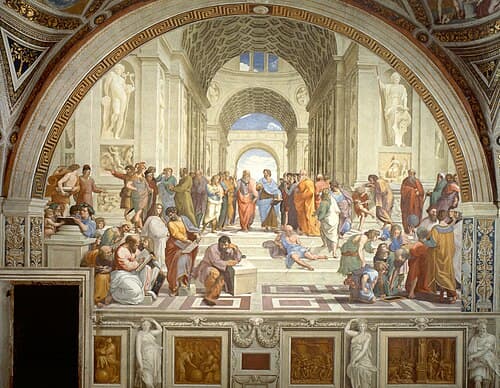
Renaissance humanism - Wikipedia View original
Is this image relevant?
Italian Renaissance - Wikipedia View original
Is this image relevant?
Renaissance - Wikipedia View original
Is this image relevant?
Renaissance humanism - Wikipedia View original
Is this image relevant?
Key Figures and Their Contributions
Francesco Petrarca (Petrarch, 1304–1374) is widely considered the "Father of Humanism." He devoted himself to rediscovering lost manuscripts by ancient Roman authors like Cicero and Livy, and he championed writing in Italian (the vernacular) at a time when Latin dominated serious literature. His work kicked off a broader movement to recover and study classical texts.
Desiderius Erasmus (1466–1536), a Dutch scholar, became the most influential humanist in Northern Europe. He pushed for religious reform from within the Catholic Church, produced a groundbreaking Greek-and-Latin edition of the New Testament, and insisted that education and careful reading of original sources were the path to both moral and spiritual improvement.
Thomas More (1478–1535), an English lawyer and statesman, used humanist principles to critique the society he lived in. His most famous work, Utopia (1516), imagined a fictional island commonwealth built on reason, communal property, and education, a pointed contrast to the inequality and corruption of early 16th-century Europe.
Giovanni Pico della Mirandola (1463–1494), an Italian philosopher, is best known for his Oration on the Dignity of Man (1486), often called the "manifesto of the Renaissance." In it, he argued that human beings are unique in creation because they have the freedom to shape their own nature, a radical claim about human potential.
Leonardo Bruni (1370–1444) translated major works of Greek philosophy (including Aristotle and Plato) into Latin, making them accessible to Western European scholars. He also promoted the studia humanitatis, the humanist curriculum of grammar, rhetoric, poetry, history, and moral philosophy, as essential for producing virtuous citizens.
Coluccio Salutati (1331–1406), chancellor of Florence for over three decades, used his political position to promote classical learning and attract humanist scholars to the city. He helped make Florence the intellectual capital of the early Renaissance.
Notable Works and Their Significance
- Petrarch's Canzoniere is a collection of 366 Italian poems, mostly sonnets, exploring love, loss, and self-reflection. It demonstrated that vernacular poetry could achieve the same depth and beauty as classical Latin verse, and it established the sonnet form that later writers across Europe would adopt.
- Petrarch's Africa is an epic poem in Latin modeled on Virgil's Aeneid, celebrating the Roman general Scipio Africanus. It shows how humanists revived classical literary forms to glorify ancient heroes and connect their own era to the greatness of Rome.
- Erasmus' The Praise of Folly (1509) uses satire and irony to expose the vices of contemporary society. The goddess Folly narrates, skewering corrupt clergy, superstitious monks, and pompous theologians. It became one of the best-selling books of the 16th century and fueled calls for Church reform.
- Erasmus' Adagia is a massive collection of Greek and Latin proverbs with commentary. It made classical wisdom practical and quotable, showing how ancient insights could apply to everyday Renaissance life.
- More's Utopia (1516) works on two levels: Book I directly criticizes European society (enclosure of common lands, harsh criminal punishments, wealth inequality), while Book II describes an imaginary island where property is shared, education is universal, and religious tolerance prevails. It's both a humanist thought experiment and a sharp social critique.
Humanist Thought in Context

Humanism's Impact on Education and Learning
Humanists fundamentally changed what and how Europeans studied. They replaced the medieval emphasis on logic and scholastic theology with the studia humanitatis, a curriculum centered on grammar, rhetoric, poetry, history, and moral philosophy, all grounded in close reading of Greek and Roman texts.
This new approach led to concrete institutional changes:
- New schools and academies appeared across Italy and Northern Europe. The Platonic Academy in Florence, supported by the Medici family, became a hub where scholars gathered to discuss Plato, translate Greek texts, and exchange ideas.
- Universities began incorporating humanist subjects alongside traditional programs in law, medicine, and theology.
Humanism also reshaped who could become an intellectual. The ideal of the "Renaissance man" emerged: a person who cultivated excellence across multiple fields. Leonardo da Vinci, who combined art, engineering, anatomy, and scientific observation, is the most famous example. Wealthy patrons like the Medici in Florence and the popes in Rome funded humanist scholars and artists, creating networks of support that allowed this new intellectual class to thrive.
Humanism's Influence on Art and Literature
Humanist ideas about human dignity and individual experience directly shaped Renaissance art. Artists increasingly focused on realistic human subjects, emotions, and the natural world:
- Portraiture emerged as a major genre, celebrating the individuality and status of the subject. Think of Leonardo da Vinci's Mona Lisa or Raphael's portraits of popes and scholars.
- Classical forms returned in sculpture and architecture. Michelangelo's David (1504) drew on ancient Greek ideals of the human body, while architects like Brunelleschi studied Roman ruins to design buildings with classical proportions.
In literature, the humanist push for vernacular writing had lasting consequences. When writers composed poetry, prose, and drama in Italian, French, and English rather than Latin, literature reached a far wider audience. Petrarch's Italian sonnets influenced poets across Europe for centuries, and the tradition of vernacular literary achievement eventually produced figures like Shakespeare. Translations of classical texts into local languages also spread humanist ideas beyond the small circle of Latin-literate scholars.
Humanism's Influence on Renaissance Culture

Humanism and Religious Reform
Humanist scholars didn't set out to break the Church apart, but their methods and criticisms helped set the stage for the Protestant Reformation.
Erasmus was central to this. His satirical attacks on clerical corruption in The Praise of Folly, combined with his scholarly edition of the Greek New Testament, exposed how far Church practice had drifted from scripture. He argued that Christians should read the Bible in its original languages and develop a personal, inward spirituality rather than relying on rituals and indulgences.
Martin Luther drew on humanist techniques of textual criticism when he challenged Church authority. His insistence on sola scriptura (scripture alone) owed something to the humanist emphasis on returning to original sources. There's a reason people said "Erasmus laid the egg that Luther hatched."
Beyond the Reformation, humanism also nourished a movement called Christian humanism, which tried to blend classical learning with Christian faith. Figures like Erasmus and the English scholar John Colet promoted studying the Bible and the early Church Fathers alongside Cicero and Plato. Meanwhile, devotional works like Thomas à Kempis' The Imitation of Christ reflected a growing desire for personal, inner spirituality over institutional religion.
Humanism and Political Thought
Humanists contributed political ideas that rippled forward for centuries.
More's Utopia introduced the concept of an ideal commonwealth built on justice, equality, and the common good. While More himself may have intended it partly as satire, the idea of designing a rational society from scratch influenced later political thinkers, from Rousseau's Social Contract to modern utopian thought.
In Italy, humanists developed a tradition of civic humanism, the idea that educated citizens have a duty to participate actively in public life. Bruni and Salutati both served Florence as chancellors and argued that learning and eloquence should serve the state, not just personal advancement. This ideal shaped republican political thought in city-states like Florence and Venice, where citizens debated policy and held elected offices.
Niccolò Machiavelli, though often seen as a break from earlier humanism, built on this civic tradition. His Discourses on Livy defended republican government and analyzed how free states could maintain their liberty, themes rooted in the humanist study of Roman history.
Lasting Impact of Humanist Ideas
Humanism and the Development of Modern Culture
The humanist emphasis on individual potential and broad education didn't end with the Renaissance. These ideas fed directly into the Enlightenment of the 17th and 18th centuries, when thinkers like John Locke developed theories of natural rights, individual freedom, and government by consent.
The ideal of a liberal arts education, one that cultivates well-rounded thinkers through the study of history, literature, philosophy, and science, traces back to the humanist studia humanitatis. The continued study of Greek and Latin in schools and universities, though less common today, shaped the Western intellectual tradition for centuries.
Humanism and the Legacy of the Renaissance
Humanist promotion of vernacular literature helped forge modern national identities. Petrarch elevated Italian, Rabelais and Montaigne enriched French, and Shakespeare transformed English into a vehicle for the full range of human experience. National literary traditions became sources of cultural pride and shared identity.
More broadly, the humanist conviction that every person possesses inherent dignity and the capacity for self-improvement influenced the political revolutions that created the modern world. The American Declaration of Independence (1776) and the French Declaration of the Rights of Man (1789) both echo humanist principles about individual liberty and equality. The line from Pico della Mirandola's Oration to these founding documents isn't direct, but the intellectual current connecting them is real.
See Fiveable more often in Google
Mark Fiveable as a preferred source and Google is more likely to show you our guides in Top Stories, with a "preferred" badge in AI Mode and AI Overviews.