
Determining sample size is crucial for accurate statistical analysis. Factors like desired precision, confidence level, population variability, and effect size all play a role in calculating the required sample size. Formulas help estimate the necessary number of participants for different study types.
Practical considerations often require adjustments to sample size calculations. Budget constraints, non-response rates, time limitations, and accessibility of the population can all impact the final sample size. Balancing statistical rigor with real-world limitations is key to efficient research design.
Sample Size Determination Fundamentals
Factors in sample size determination
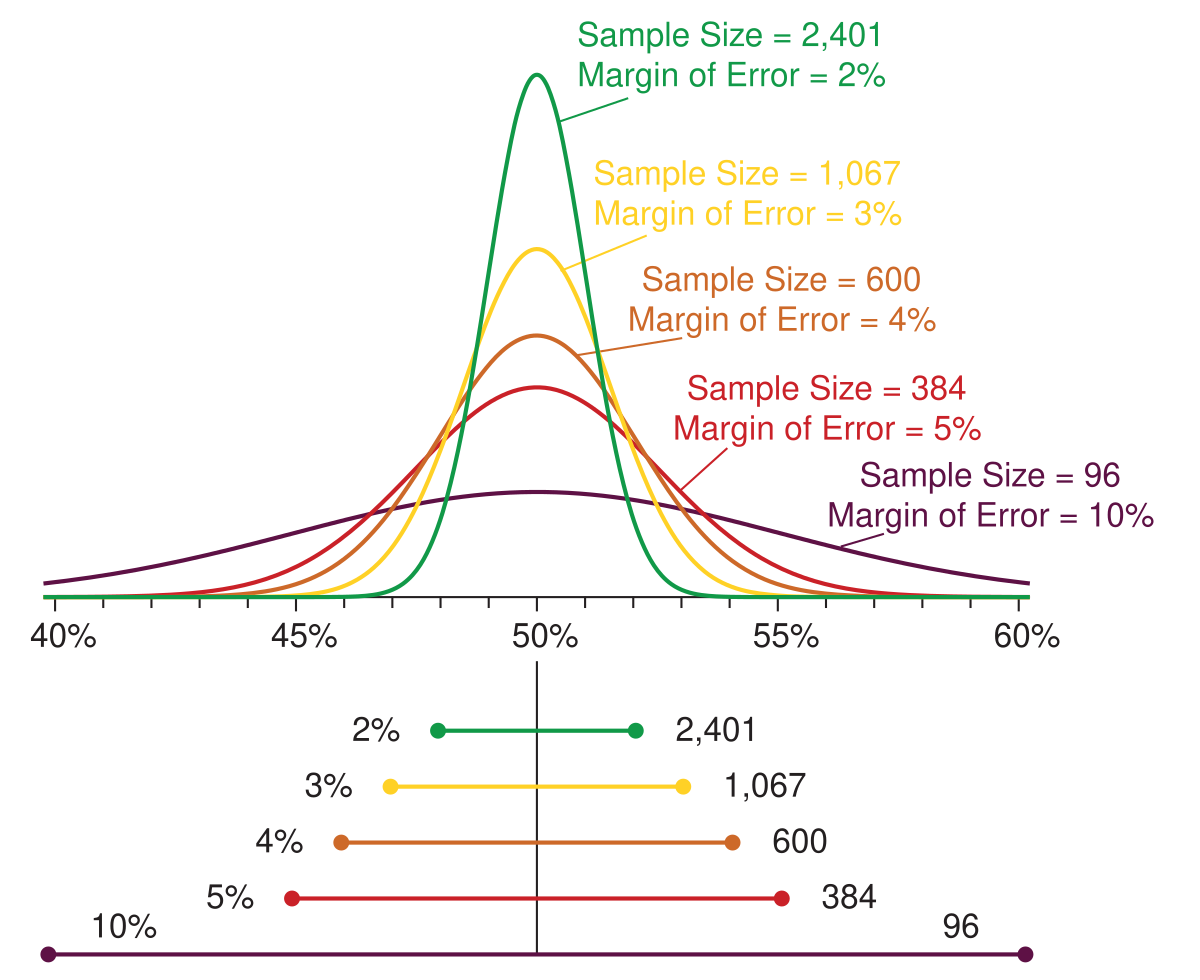
- Desired precision drives margin of error and acceptable range of estimate (±5% of population mean)
- Confidence level impacts Z-score used in calculations (95% confidence level corresponds to Z-score of 1.96)
- Population variability measured by standard deviation affects required sample size (higher variability requires larger samples)
- Effect size indicates magnitude of difference to detect (small effect sizes need larger samples)
- Power of the test determines ability to detect true effects (80% power commonly used)

Calculation of required sample size
- Sample size formula for estimating population mean: where n represents sample size, Z denotes Z-score for desired confidence level, σ signifies population standard deviation, E indicates margin of error
- Sample size formula for estimating population proportion: where p represents estimated population proportion
- Finite population correction factor adjusts sample size for small populations (reduces required sample size)
Practical Considerations and Trade-offs
Adjustments for practical considerations
- Budget constraints limit total available funds and cost per sample unit (online surveys vs in-person interviews)
- Non-response rates require oversampling using adjustment factor: where r represents anticipated non-response rate
- Time constraints affect data collection period (longitudinal studies vs cross-sectional surveys)
- Accessibility of population influences sampling method (hard-to-reach populations require specialized techniques)
- Sampling method limitations impact sample size calculations (cluster sampling requires larger samples than simple random sampling)
Trade-offs of size vs precision
- Larger sample size increases precision but faces diminishing returns (doubling sample size reduces margin of error by ~30%)
- Cost implications of increased sample size include direct costs (data collection, processing) and indirect costs (researcher time, participant burden)
- Balancing statistical rigor with practical limitations requires careful consideration of study objectives
- Impact on decision-making involves weighing risks of Type I and Type II errors (false positives vs false negatives)
- Optimal sample size determination uses cost-benefit analysis and value of information approach to maximize research efficiency